

With a Real Example of Chairs Exported from China + How Fiowind Helps
Exporting goods into the European Union involves detailed customs duty and tax rules that can significantly impact your landed costs. In this blog you will learn:
- How EU customs duties are calculated step by step
- A practical example for chairs exported from China
- How Fiowind helps you minimize risk, avoid misclassification, and optimize costs
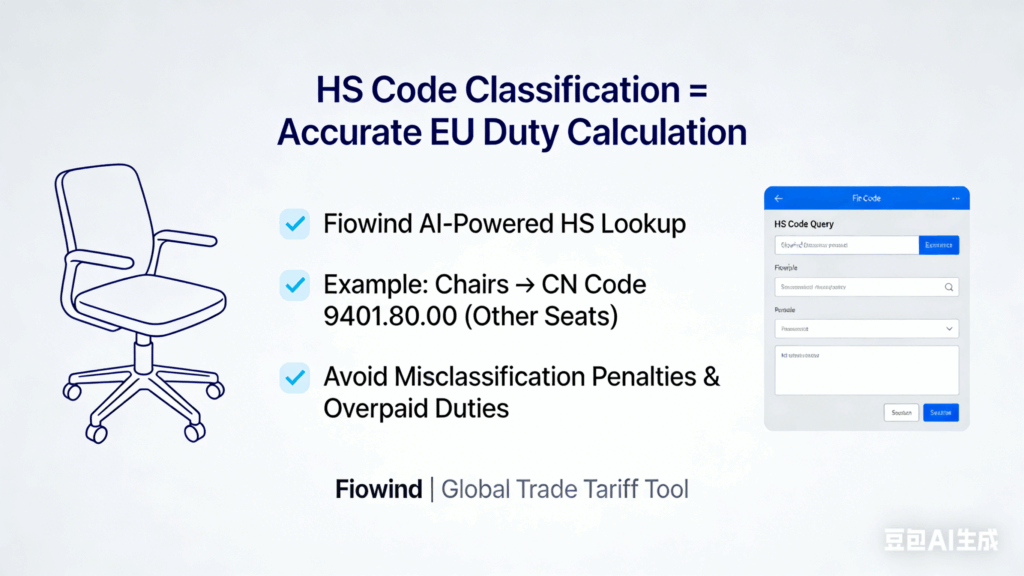
1. Why Accurate HS Classification Matters
Before any customs duty calculation, you must determine the correct HS / CN code for your product — this directly affects tariff rates.
This is where Fiowind excels:
✔ Ai-powered HS Code lookup that finds accurate harmonized codes fast
✔ Search using product names, keywords, or partial codes
✔ Up-to-date tariff and global customs data to support classification
✔ Helps reduce misclassification risk and unexpected duty charges
Correct classification is essential: a misclassified chair might be assigned either a higher duty rate or incorrect VAT base, potentially costing thousands in unnecessary taxes or compliance penalties.
2. Step-by-Step Duty Calculation (with Chairs from China)
Let’s walk through a real case of chairs exported from China (CN) into the EU.
Step 2.1 — Product Classification Using Fiowind
Before calculating duties, go to Fiowind and search:
➡ “chairs from China to European Union”
Fiowind returns the best-match HS codes with product descriptions, tariff rates, and duty rates by destination.
This helps you confidently classify the chair into a CN code such as 9401.80.00 (other seats), instead of an incorrect category — reducing risk of duty miscalculations.
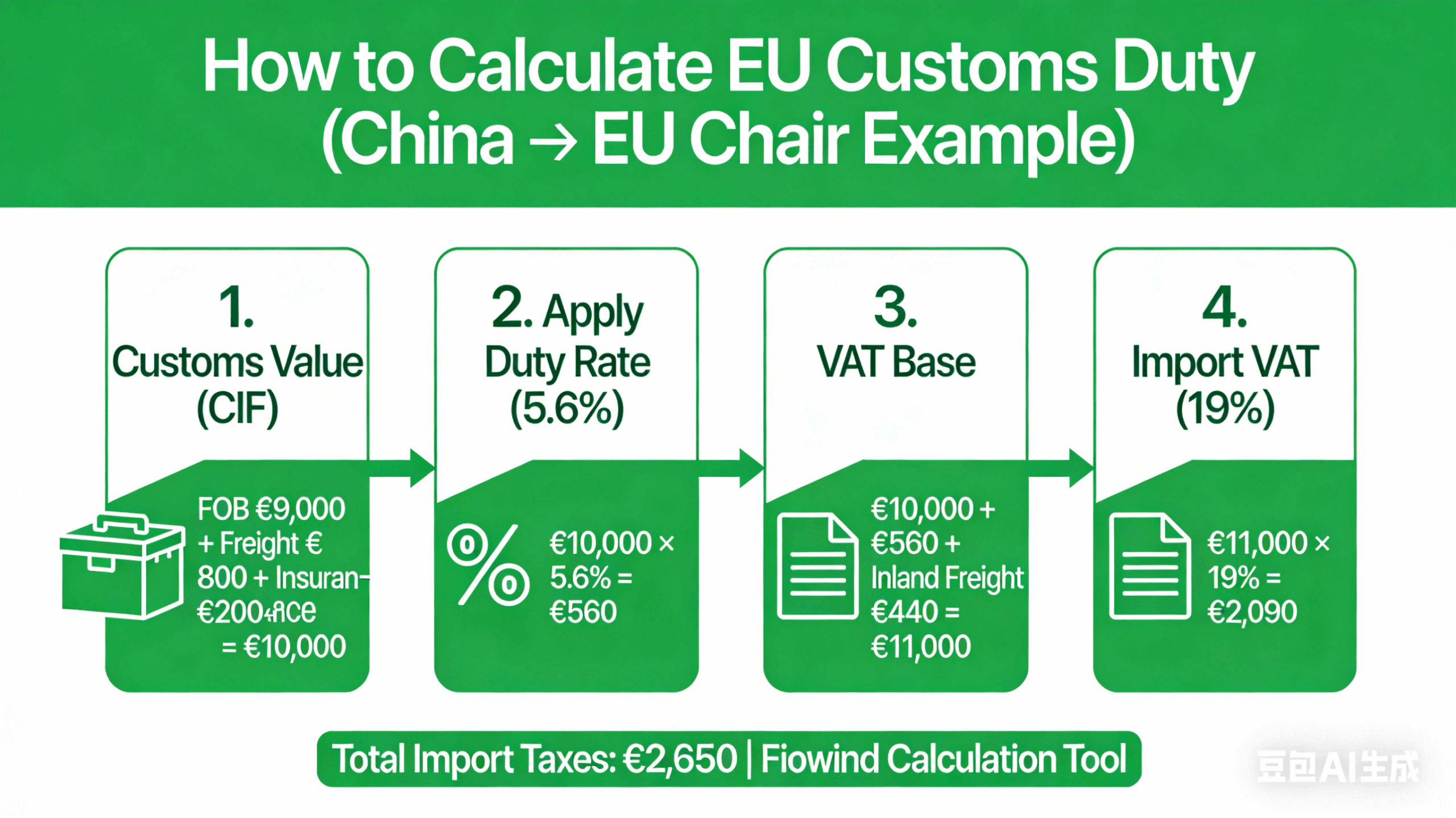
3. Step 3 — Calculate Customs Value (CIF)
Once classified, you calculate the customs value:
Example:
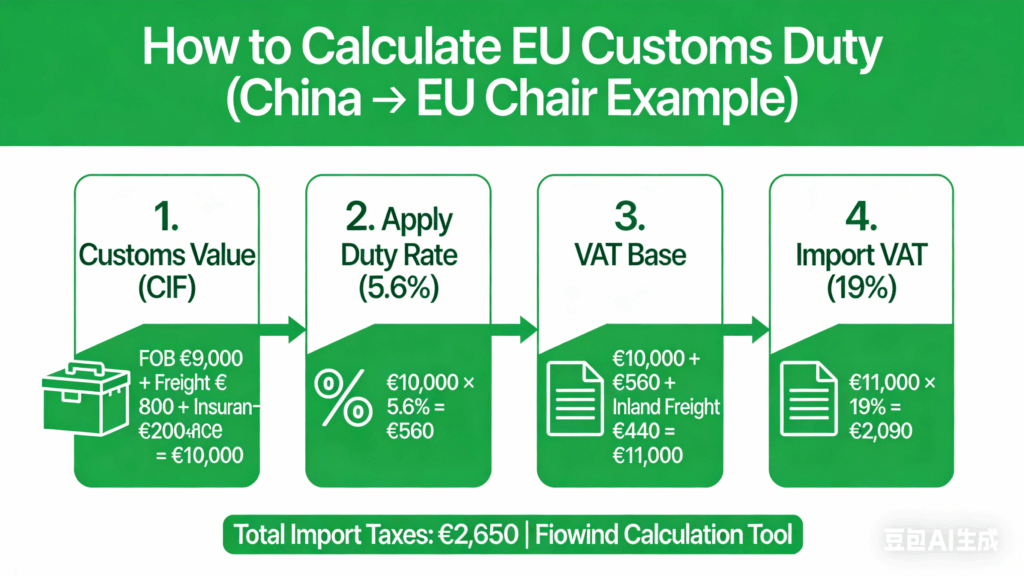
- FOB price: €9,000
- Freight to EU: €800
- Insurance: €200
➡ Customs Value: €10,000
4. Step 4 — Apply EU Duty Rate
Assume EU applies a 5.6% duty rate for the chair CN code (this rate comes from the EU TARIC database or Fiowind tariff lookup).
Customs Duty = €10,000 × 5.6% = €560Fiowind’s tariff insights help you verify the actual duty rate for this product and detect possible trade agreements or exclusions you might otherwise miss.
5. Step 5 — Calculate Import VAT
Import VAT is charged on:
Customs Value + Duty + Inland EU transport (if applicable)Example:
- Customs Value: €10,000
- Duty: €560
- EU inland freight: €440
➡ VAT Base: €11,000
If your EU destination (e.g., Germany) has 19% VAT:
VAT = €11,000 × 19% = €2,0906. Total Import Taxes
| Charge | Amount (€) |
|---|---|
| Customs Duty | €560 |
| Import VAT | €2,090 |
| Total | €2,650 |
Using Fiowind’s HS code accuracy and tariff data means you calculate this total with confidence and avoid costly errors.
7. How Fiowind Optimizes Your EU Import Process
Here are key ways Fiowind supports cross-border businesses importing into the EU:
🧠 1. Accurate HS Code Lookup
Fiowind uses AI to analyze product descriptions and recommend the best HS code — reducing misclassification risk that leads to underpaid duties and penalties.
📊 2. Global Tariff & Duties Insight
You can check tariff rates for specific routes (e.g., China → EU), including duty percentages and any special measures.
📉 3. Reduced Compliance Costs
By classifying products correctly the first time, you:
- avoid customs audit issues
- reduce incorrect duty burdens
- streamline clearance
Fiowind’s global trade data helps customs brokers, importers, and logistics teams reduce manual workload and decision errors — saving time and money.
8. Final Thoughts
Import duty calculation into the EU is precise work — especially for products like furniture where tariff rates vary by code.
Combining a step-by-step duty calculation with an AI HS code tool like Fiowind gives importers a strategic edge:
- Accurate classification
- Real tariff data
- Reduced compliance risk
- Better landed cost estimates
Exporters who understand their duty liabilities before shipping are better positioned to price, plan, and grow in EU markets.