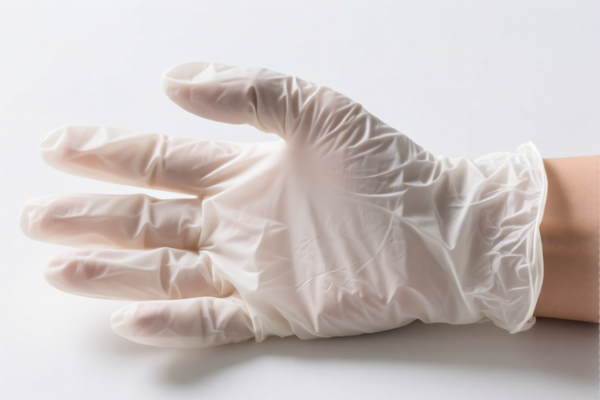
Disposable PVC Gloves
CN → US商品图片



AI分析
🧤 Disposable PVC Gloves (Chemical-Resistant & Food-Safe Hygiene Gloves)
🌐 HS Code Reference & Customs Clearance Guide | 2026 Latest Tariff Analysis | Professional-Level Entry Strategy
📌 I. Product Definition & Classification: Do You Truly Understand “PVC Gloves”?
Disposable PVC Gloves, made primarily from Polyvinyl Chloride, are essential protective gear in healthcare, food processing, and laboratory settings. In international trade, they are strictly categorized based on material composition and specific use.
Two Main Categories: 1. Plastic-Based Gloves (HS Chapter 39): Made from synthetic polymers/plastics (PVC, PE, PP). 2. Rubber-Base Gloves (HS Chapter 40): Made from natural rubber, latex, or other polymer elastomers.
⚠️ Key Distinction Point:
- If the material is explicitly PVC (Plastic) or non-latex synthetic → Classify under 3926 (Articles of Plastics).
- If the material is inferred as Rubber/Elastomer (even if used for food/medical) → Classify under 4015 (Articles of Rubber).
- Crucial Note: Even if labeled "PVC," customs may reclassify based on actual chemical properties if mislabeled.
📦 II. HS Code Classification Details (2026 Latest Tariff Authority Comparison)
| HS Code | Product Description | Application Scenario | Material Basis |
|---|---|---|---|
3926.20.40.10 |
Disposable plastic gloves, matching characteristics of disposability, plastic material, and glove morphology | Standard PVC disposable gloves, catering, cleaning | ✅ Plastic (PVC) |
3926.20.10.20 |
Disposable plastic articles/gloves, plastic material, for single-use | Generic plastic disposable gloves, no specific polymer detail | ✅ Plastic (Generic) |
4015.19.51.00 |
Disposable gloves, material inferred as vulcanized rubber or polymer class, suitable for food-grade or similar uses | Misclassified PVC or actual Rubber/Latex gloves intended for food/medical use | ❌ Rubber/Polymer |
🔍 Critical Reminder:
-3926.20.40.10is the most precise fit for PVC gloves, acknowledging the "plastic" nature. -4015.19.51.00applies if the goods are actually Rubber/Latex but described loosely as "disposable gloves." Customs often inspect material composition to prevent under-tariffing via misclassification. -3926.20.10.20is a broader "catch-all" for plastic gloves if specific PVC descriptors are missing from the declaration.
💰 III. 2026 Latest Tariff Rate Breakdown (Including Surtaxes & Policy Add-ons)
✅ Applicable Country: United States (US)
✅ Country of Origin: China (CN)
✅ Effective Date: Post-November 10, 2025 (Including subsequent imports)
🎯 1. 3926.20.40.10 —— Disposable Plastic Gloves (PVC)
| Item | Content |
|---|---|
| Base Tariff | 6.5% (ad valorem) |
| USITC Add-on Tariff | 0.0% |
| Section 301/122 Clause Tariff | +10.0% (Specific 122 Clause) |
| Total Tariff Rate | 16.5% |
| Tax Calculation | CIF Value × 16.5% |
| De Minimis Exemption Eligibility | ❌ Not Applicable (Subject to Section 321 scrutiny if high value) |
| Legal Basis Path | HTSUS:3926.20.40.10 → Section 122 Tariff Rules |
📌 Explanation:
- This is the standard classification for PVC gloves. - The 16.5% total includes the base duty (6.5%) plus a specific 10% surcharge often associated with certain Chinese imports under recent trade enforcement clauses (referred to here as "122 Clause"). - Risk: If declared as generic plastic (3926.20.10.20), the base rate drops to 0%, but the 122 Clause 10% still applies, totaling 10.0%. However, misclassification risks penalties.
🎯 2. 3926.20.10.20 —— Disposable Plastic Articles (Generic Plastic)
| Item | Content |
|---|---|
| Base Tariff | 0.0% (ad valorem) |
| USITC Add-on Tariff | 0.0% |
| Section 301/122 Clause Tariff | +10.0% (Specific 122 Clause) |
| Total Tariff Rate | 10.0% |
| Tax Calculation | CIF Value × 10.0% |
| De Minimis Exemption Eligibility | ❌ Not Applicable |
| Legal Basis Path | HTSUS:3926.20.10.20 → Section 122 Tariff Rules |
📌 Note:
- Lower base rate (0%) but still subject to the 10% surcharge. - Caution: Use this only if the product is a generic plastic item not specifically defined as "gloves" under 3926.20.40. Misusing this for standard PVC gloves can lead to audits.
🎯 3. 4015.19.51.00 —— Disposable Gloves (Rubber/Polymer Inference)
| Item | Content |
|---|---|
| Base Tariff | 14.0% (ad valorem) |
| USITC Add-on Tariff | +25.0% (Section 301) |
| Section 301/122 Clause Tariff | +10.0% |
| Total Tariff Rate | 49.0% |
| Tax Calculation | CIF Value × 49.0% |
| De Minimis Exemption Eligibility | ❌ Not Applicable |
| Legal Basis Path | HTSUS:4015.19.51.00 → Section 301 Footnote 9903.88.01 → Section 122 Tariff Rules |
📌 Critical Warning:
- This tariff is extremely high (49%). - It applies if the gloves are actually made of rubber/latex or if customs determines the material is a polymer elastomer rather than simple plastic PVC. - Why so high? Combination of high base duty (14%), Section 301 tariff (25%), and additional clause (10%). - Misclassification Risk: Declaring PVC as "Rubber" to try and fit into medical exemptions is dangerous. Conversely, declaring Rubber as "Plastic" to avoid the 49% is fraudulent.
🛠️ IV. Customs Clearance Practical Advice (Battlefield Pitfall Avoidance Guide)
✅ 1. Required Documentation Checklist (None Can Be Missing)
| Document | Mandatory? | Explanation |
|---|---|---|
| ✅ Product Specification Sheet | ✔️ | Must specify Material Composition (e.g., 95% PVC, 5% Plasticizer). Crucial for distinguishing Ch. 39 vs Ch. 40. |
| ✅ Material Safety Data Sheet (MSDS) | ✔️ | Proves chemical composition. If it lists PVC, it supports 3926. If it lists Natural Rubber Latex, it forces 4015. |
| ✅ Product Photos (Clear Labeling) | ✔️ | Show packaging, texture (matte PVC vs shiny Latex), and any certifications (FDA, CE). |
| ✅ Commercial Invoice | ✔️ | Must clearly state "Disposable PVC Gloves" or "Disposable Rubber Gloves". Do not use vague terms like "Hygiene Gloves." |
| ✅ Certificate of Origin (CO) | ✔️ | Required for verifying Chinese origin and applying surcharges. |
✅ 2. Declaration Tips (Key Mnemonics)
🔥 “Material is King, Plastic is Cheaper, Rubber is Expensive!”
| Scenario | Correct Declaration | Wrong Practice |
|---|---|---|
| Genuine PVC Gloves | 3926.20.40.10 (16.5%) |
Declaring as 4015 → 49% tax loss |
| Latex/Rubber Gloves | 4015.19.51.00 (49%) |
Declaring as PVC → Customs Fraud/Seizure |
| Mixed/Batch Uncertain | Provide MSDS + Samples | Vague description "Disposables" → Detention/Audit |
| Generic Plastic Item | 3926.20.10.20 (10%) |
Using for specific gloves → Penalty for Misclassification |
✅ 3. Special Case Handling
| Situation | Handling Advice |
|---|---|
| "Food Grade" Labeling | Does not change HS Code. PVC food gloves go to 3926.20.40.10. Rubber food gloves go to 4015.19.51.00. |
| Powdered vs. Powder-Free | Does not change HS Code. Still 3926.20.40.10. |
| OEM Custom Colors | Provide design specs. Ensure material remains PVC to keep the 16.5% rate. |
| Small Samples (De Minimis) | Caution: While Section 321 allows duty-free entry for <$800, 122 Clause tariffs and Section 301 rules may still trigger inspections or duties if deemed commercial quantity. Do not rely on it for bulk shipping. |
🌍 V. Global Market Clearance Comparison (2026 Latest)
| Country/Region | Recommended HS Code | Tariff (China Origin) | Certification Requirements | Remarks |
|---|---|---|---|---|
| 🇺🇸 United States | 3926.20.40.10 (PVC) |
16.5% | FDA (if food/med) | High scrutiny on material composition. |
| 🇺🇸 United States | 4015.19.51.00 (Rubber) |
49.0% | FDA, 510(k) (if med) | Avoid unless truly rubber. |
| 🇨🇳 China | 3926.20.40.10 |
6.5% | None (Import) | Base rate only. |
| 🇪🇺 European Union | 3926.20.90 |
0% - 6.5% | CE, REACH | Lower barriers than US. |
| 🇬🇧 United Kingdom | 3926.20.90 |
0% - 6.5% | UKCA, UK REACH | Post-Brexit rules apply. |
📌 Conclusion:
- The US market is the most expensive due to the complex layering of base tariffs + 122 Clause (+10%) and potential Section 301 (+25%) if misclassified as rubber. - PVC classification (3926) is significantly cheaper than Rubber classification (4015) for the US market. - Accurate material declaration is the single most important factor to avoid the 49% pitfall or the penalty of misclassification.
📌 VI. Common Errors & Pitfall Guide (Blood & Tears Lessons)
❌ Error 1: Declaring PVC Gloves as 3926.20.10.20 to save 6.5% base duty.
👉 Consequence: Customs may reject it because 3926.20.40.10 is the specific subheading for gloves. Risk of audit and penalty.
❌ Error 2: Declaring Latex Gloves as "PVC" to pay 16.5% instead of 49%.
👉 Consequence: Customs Fraud. If lab test shows latex, you face seizure, fines, and criminal charges.
❌ Error 3: Vague Description: "Disposable Gloves."
👉 Consequence: Customs officer makes the worst-case assumption (likely higher tariff or detention for verification).
❌ Error 4: Ignoring the 122 Clause.
👉 Consequence: Underestimating costs. Even if base duty is low, the 10% surcharge is mandatory for these HS codes from China.
✅ Correct Practice:
"Disposable PVC Gloves, Powder-Free, Food Grade, Material: Polyvinyl Chloride, Model XYZ, FDA Registered, HS Code: 3926.20.40.10"
🎯 VII. Conclusion: Professional Declaration, Cost Savings, Efficiency!
🎯 Remember the Mnemonic:
🔹 "PVC is Plastic, 16.5% is the Price. Rubber is Polymer, 49% is the Risk. Material is Key, Don't Take the Fix!"
🔹 "HS Code determines Tax, 32.5% difference, One wrong step, Profit disappears!"
📌 Pro Tip:
If your gloves are exclusively Rubber/Latex, consider if they qualify for any medical device exemptions (though rare for disposable gloves under 301).
For PVC gloves, ensure your MSDS explicitly states "PVC" to defend against customs scrutiny.
Recommend applying for an Advance Ruling if your product is unique or if you are unsure about the material composition.
📣 Immediate Action:
📞 Contact your broker + Provide MSDS + Verify HS Code 3926.20.40.10
🚀 Let your PVC gloves, clear customs smoothly, save costs, and maximize profit!
✨ Professional Clearance Starts with Accurate Classification!
💼 Every penny of cost deserves to be calculated precisely!
用户评价
关于 HS 编码归类
协调制度(HS)是由世界海关组织(WCO)制定的国际贸易商品分类标准。全球 200 多个国家采用 HS 系统作为海关关税、贸易统计和进出口监管的基础。
每个 HS 编码遵循以下层级结构:
- 章(2 位)——商品大类(例如:第 84 章:机器和机械设备)
- 品目(4 位)——章内的更具体分类
- 子目(6 位)——国际通用细分,所有 WCO 成员国统一使用
- 本国细分(8-10 位)——各国自行扩展的细分编码,如美国 HTSUS 10 位编码
正确的 HS 编码归类对于顺利通关、准确缴纳关税和遵守贸易法规至关重要。错误归类可能导致海关延误、多缴关税或罚款。
从CN进口到US时,适用的关税税率可能包括:
- 最惠国(MFN)税率——适用于 WTO 成员国的标准关税税率
- 普通税率——适用于无贸易协定国家
- 贸易救济关税——附加关税,如 301 条款(反倾销)、232 条款(国家安全)或反补贴税
本页内容仅供参考。如需正式归类,请咨询当地海关或持牌报关代理。