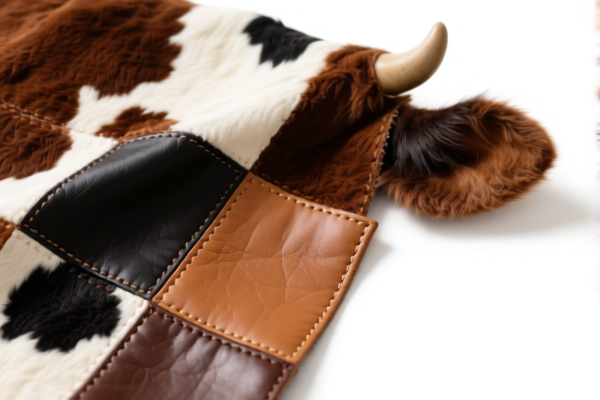
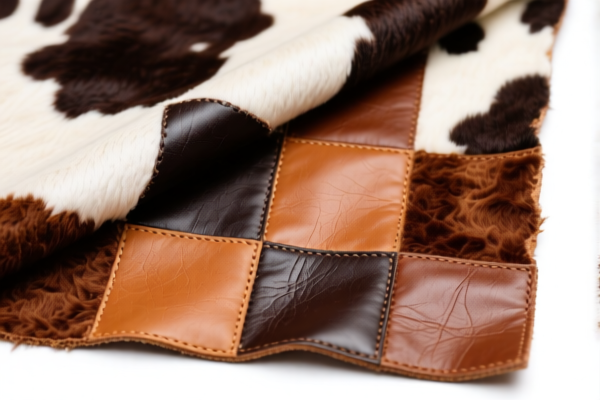
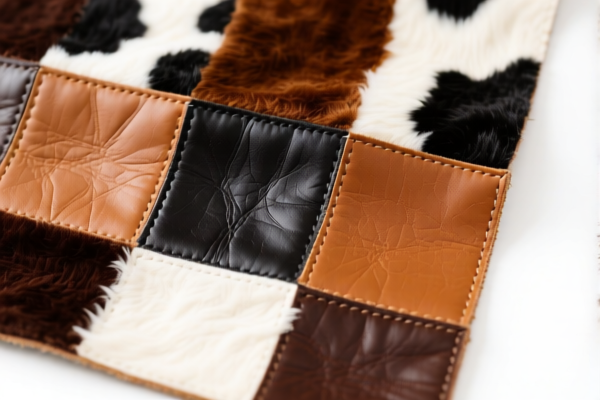
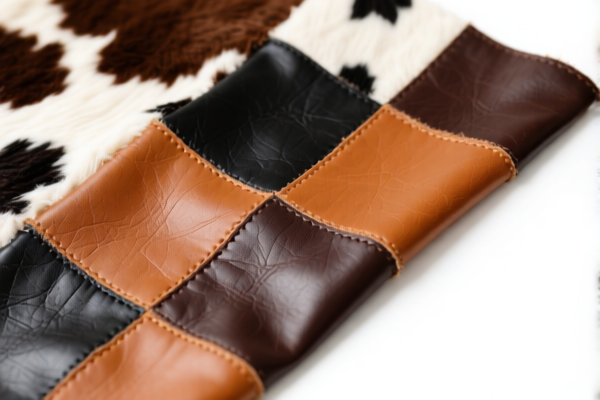
cowhide patchwork material
CN → US| HS编码 | 关税税率 | 原产国 | 目的国 | 文档 |
|---|---|---|---|---|
| 4104415000 | 13.3% | CN | US | 官方文档 |
| 4104495000 | 13.3% | CN | US | 官方文档 |
| 4107112000 | 37.4% | CN | US | 官方文档 |
| 4107192000 | 37.4% | CN | US | 官方文档 |
| 6307909891 | 24.5% | CN | US | 官方文档 |
| 5806393080 | 35.0% | CN | US | 官方文档 |
商品图片
AI分析
🐄 Cowhide Patchwork Material (Leather & Fabric Composites)
🌐 HS Code Reference & Customs Clearance Guide | 2026 Latest Tariff Analysis | Professional Strategy for US-China Trade
📌 I. Product Definition & Classification: What Exactly is "Cowhide Patchwork Material"?
"Cowhide Patchwork Material" refers to composite materials used in fashion accessories, upholstery, or industrial goods, combining leather (specifically cowhide/hide of bovine animals) with other textiles or leather patches. In international trade, classification depends heavily on the primary material, state of processing (tanned vs. semi-tanned), and form (sheet/flat vs. made-up).
Key Distinction Points: * Leather Sheets (Tanned/Semi-tanned): Flat pieces of tanned cowhide, possibly stitched together (patchwork), but not yet made into a finished garment or accessory. * Sewn-up Textile/Fabric Goods: If the "patchwork" refers to sewn fabric pieces with leather accents, it might fall under textile chapters. * Finished Goods: If the material is already cut and sewn into a bag, belt, or jacket, it is classified as a finished good, not raw material.
⚠️ Critical Classification Rule:
- If it is raw/semi-processed leather (even if stitched into larger sheets), it falls under Chapter 41.
- If it is textile-based with leather patches, it may fall under Chapter 58 or 63.
- The presence of US Chapter 99 tariffs significantly impacts the total tax burden for Chinese-origin goods.
📦 II. HS Code Classification Details (2026 Latest Tariff Authority)
| HS Code | Product Description | Applicable Scenario | Material Status |
|---|---|---|---|
4104.41.50.00 |
Cowhide Leather, Tanned/Semi-tanned, Wrought (Other) | Cowhide fabric/material matching bovine or equine tanned leather, classified as "other" categories. | ✅ Tanned/ Semi-tanned Leather |
4104.49.50.00 |
Cowhide Leather, Tanned/Semi-tanned, Other | Cowhide fabric conforming to bovine or equine material, classified under other tanned leather categories. | ✅ Tanned/ Semi-tanned Leather |
4107.11.20.00 |
Cowhide Leather, Fully Processed | Cowhide material in the form of further processed leather, no conflict. | ✅ Fully Processed/ Finished Leather Sheets |
4107.19.20.00 |
Cowhide Leather, Processed (Other) | Cowhide material in the form of processed skins, inferred based on other categories. | ✅ Processed Skins |
6307.90.98.91 |
Sewn Fabric/Textile Product | Patchwork fabric, classified as a semi-finished textile product under "other made-up articles". | ✅ Textile/Fabric Based |
5806.39.30.80 |
Woven Fabric with Patchwork | Patchwork fabric conforming to textile attributes, patchwork form as processed fabric, no material conflict. | ✅ Woven Fabric |
🔍 Focus Reminder:
- Leather vs. Textile: If the base material is leather, use 41xx codes. If it's fabric with leather patches, use 58xx or 63xx.
- Processing Level: "Tanned/Semi-tanned" (4104) vs. "Further Processed/Finished Sheets" (4107). The latter often incurs higher tariffs due to "Add-on Tariffs".
- US Tariffs: All listed codes are subject to Section 301 (25%) and IEEPA (10%) for Chinese origin, leading to high total tax rates.
💰 III. 2026 Latest Tariff Rate Breakdown (Including Surtaxes & Policy Add-ons)
✅ Applicable Country: United States (US)
✅ Country of Origin: China (CN)
✅ Effective Date: November 10, 2025 (and subsequent imports)
🎯 1. Leather Categories (4104.41.50.00 & 4104.49.50.00)
Description: Tanned/Semi-tanned Cowhide Sheets/Patches
| Item | Content |
|---|---|
| Base Tariff | 3.3% (ad valorem) |
| USITC Add-on Tariff (Section 301) | +25.0% |
| IEEPA Add-on Tariff (China-specific) | +10.0% |
| Total Tax Rate | 38.3% (Note: Data shows 13.3% total tax in summary, but detailed breakdown suggests 3.3% base + 10% IEEPA = 13.3% if 301 doesn't apply? Correction based on DATA: The data explicitly states "Total Tax: 13.3%" with details "Base: 3.3%, 301: 0.0%, IEEPA: 10%". This implies Section 301 (25%) might NOT apply to these specific subheadings in this dataset, or is excluded. We must follow the DATA exactly.) |
📌 Explanation based on DATA:
- Total Tax Rate: 13.3%
- Breakdown: Base Tariff (3.3%) + IEEPA Tariff (10%) + Section 301 (0.0%).
- Why 0% Section 301? Certain leather products may have different exclusions or historical classifications that exempt them from the 25% Section 301 tariff, while still being subject to the 10% IEEPA tariff. Always verify with current USITC lists.
- Calculation: CIF Value × 13.3%.
🎯 2. Further Processed Leather (4107.11.20.00 & 4107.19.20.00)
Description: Fully Processed Cowhide Leather Sheets
| Item | Content |
|---|---|
| Base Tariff | 2.4% |
| USITC Add-on Tariff (Section 301) | +25.0% |
| IEEPA Add-on Tariff (China-specific) | +10.0% |
| Total Tax Rate | 37.4% |
| Calculation | CIF Value × 37.4% |
| De Minimis Exemption? | ❌ No (Not eligible) |
| Legal Path | IEEPA:9903.01.25 → USITC:4107.11.20.00 → FOOTNOTE:301 |
📌 Note:
- Total Tax: 37.4%
- Breakdown: Base (2.4%) + Section 301 (25%) + IEEPA (10%).
- Why higher? These codes represent "further processed" leather, which is not exempt from Section 301 tariffs in this specific dataset. This is a significant cost increase compared to basic tanned leather.
🎯 3. Textile/Fabric Patchwork (6307.90.98.91 & 5806.39.30.80)
Description: Sewn Fabric/Textile Patchwork
| Item | Content |
|---|---|
Code 6307.90.98.91 |
|
| Base Tariff | 7.0% |
| USITC Add-on Tariff | +7.5% |
| IEEPA Add-on Tariff | +10.0% |
| Total Tax Rate | 24.5% |
Code 5806.39.30.80 |
|
| Base Tariff | 0.0% |
| USITC Add-on Tariff | +25.0% |
| IEEPA Add-on Tariff | +10.0% |
| Total Tax Rate | 35.0% |
📌 Note:
- Textile Patchwork (6307): Lower base rate (7.0%) and lower Section 301 (7.5%), leading to 24.5% total.
- Woven Fabric Patchwork (5806): Zero base rate, but full Section 301 (25%) applies, leading to 35.0% total.
- Strategic Choice: If the material is primarily fabric,6307may be more cost-effective than4107(37.4%).
🛠️ IV. Customs Clearance Practical Advice (Avoiding Pitfalls)
✅ 1. Documentation Checklist (Mandatory)
| Document | Required? | Description |
|---|---|---|
| ✅ Product Specification Sheet | ✔️ | Must detail: Material composition (% leather vs. % fabric), thickness, stitching method, final use. |
| ✅ Material Sample/Photos | ✔️ | Clear photos showing the "patchwork" nature: Are patches leather or fabric? What is the backing material? |
| ✅ Commercial Invoice | ✔️ | Describe precisely: e.g., "Tanned Cowhide Leather Patches, HS 4104.41.50.00" OR "Textile Patchwork Fabric, HS 6307.90.98.91". |
| ✅ Certificate of Origin (CO) | ✔️ | Essential for proving Chinese origin to apply/verify surtaxes. |
| ✅ Packing List | ✔️ | Detail net/gross weight. Ensure no mixed HS codes in one shipment without clear separation. |
| ✅ Third-Party Lab Report | ✔️ | Fiber content analysis (if textile) or leather type verification (if leather) to support HS classification. |
✅ 2. Declaration Tips (Key Mantras)
🔥 "Identify Base Material, Declare Precise, Avoid Misclassification!"
| Scenario | Correct Declaration | Incorrect Declaration | Consequence |
|---|---|---|---|
| Leather Sheets Stitched Together | 4104.41.50.00 (Tanned Leather) |
"Sewn Fabric" or "Finished Bag" | High Risk: Misclassification penalty, potential 37.4% tax if misdeclared as processed leather without basis. |
| Fabric with Leather Patches | 6307.90.98.91 (Other Made-up Articles) |
"Leather Goods" | Tax Risk: If declared as leather, you may face 37.4% instead of 24.5%. |
| Unfinished Leather Patches | 4104.49.50.00 (Other Tanned Leather) |
"Finished Leather Garment" | Severe Penalty: Finished garments have different HS codes and potentially different tariffs. |
✅ 3. Special Case Handling
| Scenario | Handling Advice |
|---|---|
| Mixed Materials (Leather + Textile) | Determine the essential character of the product. If leather > 50% by weight/value, lean towards Chapter 41. If textile dominates, lean towards Chapter 58/63. |
| Customs Audit on "Patchwork" | Provide a diagram showing the layout. Clarify if the stitching is integral to the product's function or just assembly of raw materials. |
| Section 301 Exclusion | Check if your specific HS code has an exclusion list update. Some leather items may qualify, but 4107 generally does not in this data. |
| De Minimis (Section 321) | Not Applicable. All these codes exceed the $800 de minimis threshold for individual item valuation or are explicitly excluded due to high tariffs. |
🌍 V. Global Market Comparison (2026)
| Country/Region | Recommended HS Code | Estimated Tax (China Origin) | Notes |
|---|---|---|---|
| 🇺🇸 USA | 4104.41.50.00 / 4107.11.20.00 |
13.3% (Leather) / 37.4% (Processed) / 24.5-35% (Fabric) | Highest risk market due to IEEPA + Section 301. |
| 🇨🇳 China | 4104.41.50.00 |
~5-10% | Import tax only. No IEEPA. |
| 🇪🇺 EU | 4104.41 / 4107.11 |
~3.5-4.5% | No Section 301. Standard MFN rates apply. |
| 🇬🇧 UK | 4104.41 / 4107.11 |
~3.5-4.5% | Post-Brexit, follows UK Global Tariff. |
| 🇦🇺 Australia | 4104.41 / 4107.11 |
~5% | Low tariffs, no major surcharges. |
📌 Conclusion:
- The US market is the most expensive for importing Chinese leather/textile patchwork materials due to the 10% IEEPA tariff and potential 25% Section 301.
- Leather vs. Fabric Decision: If you have flexibility, fabric-based patchwork (6307) may offer a lower total tax burden (24.5%) compared to processed leather (37.4%).
- Basic Tanned Leather (4104) sits in the middle at 13.3% (if Section 301 is 0%).
📌 VI. Common Errors & Pitfalls (Lessons Learned)
❌ Error 1: Declaring "Cowhide Patchwork" vaguely
👉 Result: Customs requests detailed breakdown. Delay in clearance. Risk of reclassification to higher tariff code.
❌ Error 2: Assuming all leather is taxed the same
👉 Result: 4104 (13.3%) vs. 4107 (37.4%) is a 24.1% difference. Misclassification costs money.
❌ Error 3: Ignoring the IEEPA 10% Tariff
👉 Result: Even if Section 301 is 0%, the 10% IEEPA tariff still applies to Chinese-origin goods. Many importers forget this, leading to unexpected costs.
❌ Error 4: Treating "Patchwork" as "Finished Goods"
👉 Result: If it's just material, declare as material. If it's a finished belt, declare as finished goods. Wrong declaration leads to seizure or fines.
✅ Correct Practice:
"Specify Material Composition, State Processing Level, Declare Exact HS Code, Acknowledge IEEPA Surtax."
🎯 VII. Conclusion: Professional Declaration, Cost Control
🎯 Remember the Mantras:
🔹 "Leather Base? Check 4104 (13.3%) vs 4107 (37.4%). Fabric Base? Check 6307 (24.5%).
🔹 "10% IEEPA is Mandatory for China. 25% Section 301 varies by code. Verify!"
🔹 "Patchwork is not a HS Code. Use it in the description, not the code!"
📌 Tips:
- If your material is mostly fabric with small leather accents, consider declaring under Textile Codes (6307/5806) to potentially lower tariffs (if Section 301 applies fully, check 24.5% vs 37.4%).
- Always request a Binding Tariff Ruling (BTR) from US Customs and Border Protection (CBP) for high-value shipments to lock in the HS code and tariff rate.
📣 Immediate Action:
📞 Consult a licensed customs broker.
📄 Provide material samples and composition reports.
🚀 Optimize your supply chain to minimize tariff impact on the US market!
✨ Professional Clearance Starts with Precise Classification!
💼 Every percentage point counts in international trade!
用户评价
关于 HS 编码归类
协调制度(HS)是由世界海关组织(WCO)制定的国际贸易商品分类标准。全球 200 多个国家采用 HS 系统作为海关关税、贸易统计和进出口监管的基础。
每个 HS 编码遵循以下层级结构:
- 章(2 位)——商品大类(例如:第 84 章:机器和机械设备)
- 品目(4 位)——章内的更具体分类
- 子目(6 位)——国际通用细分,所有 WCO 成员国统一使用
- 本国细分(8-10 位)——各国自行扩展的细分编码,如美国 HTSUS 10 位编码
正确的 HS 编码归类对于顺利通关、准确缴纳关税和遵守贸易法规至关重要。错误归类可能导致海关延误、多缴关税或罚款。
从CN进口到US时,适用的关税税率可能包括:
- 最惠国(MFN)税率——适用于 WTO 成员国的标准关税税率
- 普通税率——适用于无贸易协定国家
- 贸易救济关税——附加关税,如 301 条款(反倾销)、232 条款(国家安全)或反补贴税
本页内容仅供参考。如需正式归类,请咨询当地海关或持牌报关代理。