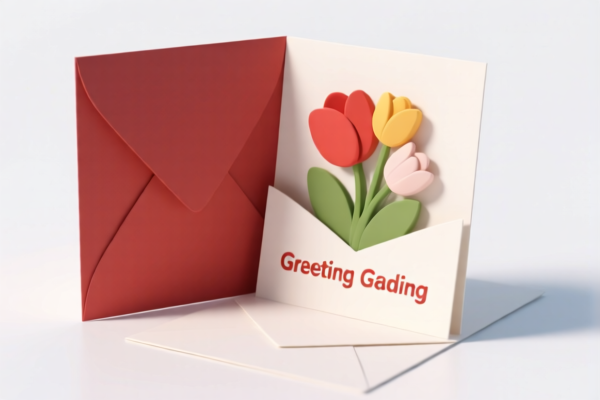
3D pop up greeting card
CN → US| HS Code | Tariff Rate | Origin | Destination | Doc |
|---|---|---|---|---|
| 4911998000 | 17.5% | CN | US | Official Doc |
| 4911914040 | 17.5% | CN | US | Official Doc |
| 4823905000 | 35.0% | CN | US | Official Doc |
| 4823903100 | 35.0% | CN | US | Official Doc |
Product Images



AI Analysis
🎨 3D Pop-Up Greeting Card: The Ultimate Guide to HS Code, Tariffs & Clearance Strategy
🌐 HS Code Reference & Clearance Guide | 2026 Latest Tariff Analysis | Professional Logistics Strategy
📌 1. Product Definition & Classification: Do You Really Understand "Greeting Cards"?
A 3D Pop-Up Greeting Card is a specialized stationery item that combines paper engineering with printing. Unlike flat cards, it features mechanical structures (folds, glues, tabs) that create a three-dimensional effect when opened.
In international trade, these are often misclassified. They are not simple "cards" nor are they "toys." Their classification depends heavily on their primary function: * Is it for display/collecting? → Likely falls under "Printed Matter" (Pictures/Photographs). * Is it a functional card? → Likely falls under "Other Paper Articles."
⚠️ Critical Distinction:
- If the card is primarily a picture/design (e.g., a complex 3D scene intended for viewing) → 4911.91.40.40
- If the card is a generic paper article without specific pictorial focus → 4911.99.80.00 or 4823.90.50.00 (if classified as a fan-like structure)
- Note: The input data strictly limits us to the provided HS Codes. We must map the product to the most accurate available code from the<DATA>list.
📦 2. HS Code Classification Details (Based on Provided Data)
Based on the provided <DATA> input, here are the relevant HS Codes for 3D Pop-Up Greeting Cards. Since greeting cards often feature intricate designs and are treated as "printed matter" or "other paper articles," we analyze the two most relevant options from the list.
| HS Code | Product Description | Why It Fits "3D Pop-Up Cards" |
|---|---|---|
| 4911.91.40.40 | Other printed matter... Pictures, designs and photographs... Printed not over 20 years... Other Other | Best Fit for Decorative Cards. If the card’s primary value is its visual design, illustration, or artistic picture (common in high-end 3D pop-up cards), this code is appropriate. It captures the "printed matter" aspect with a focus on visual content. |
| 4911.99.80.00 | Other printed matter... Other... Other | Fallback for Generic Cards. If the card is a standard greeting card without a specific "picture/design" focus (e.g., text-heavy with minimal 3D structure), this code applies. It’s a "catch-all" for other printed matter. |
| 4823.90.50.00 | Other paper articles... Hand fans | Rare/Specific Cases Only. Some highly complex 3D cards might resemble fans when closed. However, this is likely a misclassification for standard greeting cards. Only consider if the item is structurally identical to a hand fan. |
| 4823.90.31.00 | Other paper articles... Cards, not punched, for punchcard machines | ❌ NOT Applicable. This code is for punchcard machines (obsolete tech). Do NOT use this for greeting cards. |
🔍 Recommendation:
- For most 3D pop-up greeting cards,4911.91.40.40is the most accurate choice because it emphasizes the printed design/picture aspect.
- If the card is purely functional text-based with minimal art,4911.99.80.00may be used.
- Avoid4823.90.31.00unless you are importing punch cards, not greeting cards.
💰 3. 2026 Latest Tariff Rate Breakdown (Import to USA from China)
✅ Applicable Country: USA (US)
✅ Origin: China (CN)
✅ Effective Date: Current rates apply as per provided data.
🎯 1. 4911.91.40.40 – Printed Pictures/Designs (Most Likely for Pop-Up Cards)
| Item | Detail |
|---|---|
| Base Tariff | 0.0% |
| Additional Tariff (Section 301) | +7.5% |
| Total Tax Rate | 7.5% |
| Tax Calculation | CIF Value × 7.5% |
| De Minimis Exemption? | ❌ No. Items over $800 are subject to duty. |
| Legal Basis | Section 301 Tariffs on Chinese Goods |
📌 Explanation:
- The base tariff for printed matter is 0%.
- However, due to Section 301 trade measures, an additional 7.5% is applied to many Chinese-origin goods, including printed materials.
- Total effective tariff: 7.5%. This is relatively low compared to electronics or machinery, making it a cost-effective import category.
🎯 2. 4911.99.80.00 – Other Printed Matter
| Item | Detail |
|---|---|
| Base Tariff | 0.0% |
| Additional Tariff (Section 301) | +7.5% |
| Total Tax Rate | 7.5% |
| Tax Calculation | CIF Value × 7.5% |
| De Minimis Exemption? | ❌ No. |
🎯 3. 4823.90.50.00 – Other Paper Articles (e.g., Hand Fans)
| Item | Detail |
|---|---|
| Base Tariff | 0.0% |
| Additional Tariff (Section 301) | +25.0% |
| Total Tax Rate | 25.0% |
| Tax Calculation | CIF Value × 25% |
| De Minimis Exemption? | ❌ No. |
⚠️ Warning:
If Customs classifies your 3D card under4823.90.50.00(due to structural similarity to fans), the tariff jumps to 25%. This is significantly higher than the 7.5% rate for printed matter. Avoid this classification unless structurally identical to a hand fan.
🎯 4. 4823.90.31.00 – Punchcard Machines
| Item | Detail |
|---|---|
| Base Tariff | 0.0% |
| Additional Tariff (Section 301) | +25.0% |
| Total Tax Rate | 25.0% |
| ⚠️ Do NOT Use: | This code is for punch cards, not greeting cards. Misclassification can lead to seizure or fines. |
🛠️ 4. Clearance Practical Advice (Real-World Pitfalls)
✅ 1. Required Documentation (Must-Haves)
| Document | Mandatory? | Description |
|---|---|---|
| Product Specifications | ✔️ | Detailed description: "3D Pop-Up Greeting Card, Paper Material, Printed Design, Non-Functional." |
| Product Photos | ✔️ | Clear images showing the card in closed and open states to prove it’s a card, not a fan or toy. |
| Commercial Invoice | ✔️ | Must clearly state "Greeting Card" or "Printed Paper Article," NOT "Toy" or "Paper Fan." |
| Material Declaration | ✔️ | Specify paper type (e.g., cardstock, glossy paper) to support classification under 4911 (Printed Matter). |
| Origin Certificate | ✔️ | Proof of China origin to calculate Section 301 tariffs. |
✅ 2. Declaration Tips (Key Mantra)
🔥 "Clarify it’s a Card, Not a Fan! Emphasize 'Printed Design' for 7.5% Rate!"
| Scenario | Correct Declaration | Wrong Declaration |
|---|---|---|
| Standard 3D Card | "3D Pop-Up Greeting Card, Paper, Printed" |
"Paper Fan" or "Toy" |
| High-End Art Card | "Printed Picture, 3D Pop-Up, Collectible" |
"Paper Toy" |
| Bulk Import | "Printed Matter, HS 4911.91.40.40" |
"Paper Articles, HS 4823.90.50.00" |
📌 Why?
- Declaring as "Paper Fan" (HS 4823.90.50.00) triggers a 25% tariff.
- Declaring as "Printed Picture/Matter" (HS 4911.91.40.40) triggers only 7.5%.
- Always highlight the "printed design" aspect in your invoice and description.
✅ 3. Special Cases
| Scenario | Recommendation |
|---|---|
| Cards with Electronic Components | If the card has lights/sound modules, it may fall under 8543 (Electrical Equipment), not paper codes. Do not use paper codes. |
| Large 3D Structures ( > A3 Size) | If the size exceeds standard paper dimensions, Customs may view it as "display material." Still aim for 4911 if it’s primarily printed. |
| OEM Custom Designs | Provide design files to prove it’s a "print" order, not a generic paper product. |
🌍 5. Global Market Comparison (2026)
| Country/Region | Recommended HS Code | Tariff Rate | Notes |
|---|---|---|---|
| 🇺🇸 USA | 4911.91.40.40 |
7.5% | Most favorable. Emphasize "Printed Picture." |
| 🇨🇳 China | 4911.91.40.40 |
Low/Exempt | Check latest FTA rates. |
| 🇪🇺 EU | 4909.00.00 |
0-3% | Different HS structure. Not in our dataset. |
| 🇬🇧 UK | 4909.00.00 |
0-5% | Post-Brexit rules apply. |
📌 Conclusion:
- USA is the most complex market due to Section 301 tariffs.
- Strategic Tip: Always classify as4911.91.40.40(Printed Picture) rather than4823.90.50.00(Paper Articles/Fans) to save 17.5% in tariffs.
📌 6. Common Mistakes & Pitfalls (Lessons Learned)
❌ Mistake 1: Declaring "3D Greeting Card" as "Paper Fan" (4823.90.50.00)
👉 Consequence: Tariff jumps from 7.5% to 25%. You pay $17.5 more per $100 of goods.
❌ Mistake 2: Using 4823.90.31.00 (Punch Cards)
👉 Consequence: Clearance Rejection. Customs will flag this as a serious misclassification. Fines and delays.
❌ Mistake 3: Not specifying "Printed" in the description
👉 Consequence: Customs may classify as unprinted paper (4823), leading to higher duties.
✅ Correct Approach:
"3D Pop-Up Greeting Card, Paper, Color Printed, Design ID: XYZ, HS Code: 4911.91.40.40"
🎯 7. Conclusion: Precision Classification, Maximum Savings
🎯 Remember the Mantra:
🔹 "Cards are Prints, Not Fans! 4911 is the Key, 7.5% is the Fee!"
🔹 "Avoid 4823, Avoid 25%, Stick to 4911 for Savings!"
📌 Pro Tip:
If your 3D cards are very large or contain non-paper elements (like plastic hinges), consult a customs broker to ensure they don’t fall under Chapter 39 (Plastics) or Chapter 95 (Toys).
📣 Immediate Action:
📞 Contact a Customs Broker + Provide Clear Photos + Apply for HS Code Advance Ruling
🚀 Ensure Smooth Clearance, Minimize Tariffs, Maximize Profit!
✨ Professional Clearance Starts with Accurate Classification!
💼 Every Cent Saved on Tariff is Pure Profit!
Customer Reviews
About HS Code Classification
The Harmonized System (HS) is an internationally standardized nomenclature developed by the World Customs Organization (WCO) to classify traded products. Over 200 countries use the HS system as the basis for customs tariffs, trade statistics, and import/export regulations.
Each HS code follows a hierarchical structure:
- Chapter (2 digits) — Broad category of goods (e.g., Chapter 84: Machinery and Mechanical Appliances)
- Heading (4 digits) — More specific grouping within the chapter
- Subheading (6 digits) — Internationally standardized breakdown, used by all WCO member countries
- National subdivisions (8-10 digits) — Country-specific extensions for further classification, such as US HTSUS 10-digit codes
Correct HS code classification is essential for smooth customs clearance, accurate duty payment, and compliance with trade regulations. Misclassification can lead to customs delays, overpayment of duties, or penalties.
When importing from CN to US, the applicable tariff rates may include:
- Most-Favored-Nation (MFN) rate — The standard duty rate applied to WTO members
- General rate — Applied to countries without trade agreements
- Trade remedy duties — Additional tariffs such as Section 301 (anti-dumping), Section 232 (national security), or countervailing duties
The information provided on this page is for reference purposes only. For official classification, please consult with your local customs authority or a licensed customs broker.