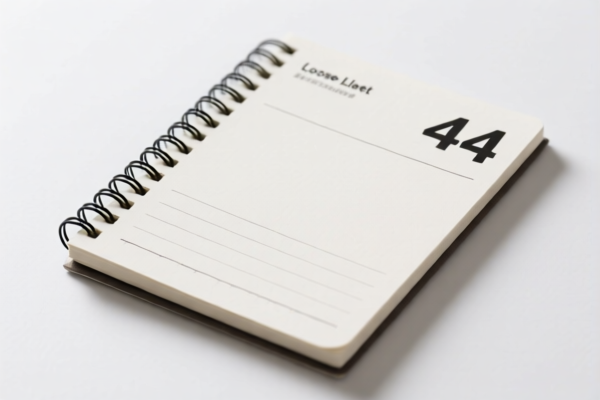
A4 Loose leaf Notebook
CN → US| HS Code | Tariff Rate | Origin | Destination | Doc |
|---|---|---|---|---|
| 4823908680 | 35.0% | CN | US | Official Doc |
| 4823906700 | 35.0% | CN | US | Official Doc |
| 4820300020 | 35.0% | CN | US | Official Doc |
| 3926100000 | 15.3% | CN | US | Official Doc |
| 4820102060 | 35.0% | CN | US | Official Doc |
Product Images


AI Analysis
📓 A4 Loose Leaf Notebook (活页笔记本)
🌐 HS Code Reference & Customs Clearance Guide | 2026 Latest Tariff Analysis | Professional Customs Strategy
📌 Part I: Product Definition & Classification: Do You Truly Understand "Loose Leaf Notebook"?
An A4 Loose Leaf Notebook is a stationery item designed for flexible organization, featuring removable pages held together by metal rings or plastic combs. In international trade, its classification hinges on two critical factors: Material Composition and Structural Form.
1. Paper-Based Classification (The Most Common Scenario)
If the notebook consists primarily of paper/plyboard (pages, cover, binder mechanism made of paper/plastic):
- It falls under Chapter 48 (Paper and Paperboard).
- Key distinction: Is it a "bound notebook" (bound by rings/hooks) or a "loose-leaf binder"?
- Loose-leaf binders/clips (designed to hold loose sheets) often fall under 4820.30.
- Paper products cut to shape/size that are not specific books/notebooks fall under 4823.90.
2. Plastic-Based Classification (Less Common but Possible)
If the notebook is predominantly made of plastic (e.g., plastic cover, plastic rings, plastic dividers) and does not fit the specific "paper notebook" definition:
- It falls under Chapter 39 (Plastics and Articles Thereof).
⚠️ Key Distinction Point:
- If the product is "Loose Leaf" (松页) and designed to hold separate sheets → Likely 4820.30.00.20 (Loose-leaf binders/clips) or 4820.10.20.60 (Notebooks/Registers).
- If the material is ambiguous but predominantly paper-based → 4823.90.86.80 / 4823.90.67.00 (Other paper articles).
- If the product is mostly plastic (e.g., plastic ring binder with plastic cover) → 3926.10.00.00 (Articles of plastics).
📦 Part II: HS Code Classification Details (2026 Latest Tariff Authority Comparison)
Based on the provided data, here are the 5 potential HS Codes with matching logic and tax implications:
| HS Code | Product Description | Matching Logic (Summary) | Total Tax Rate |
|---|---|---|---|
4823.90.86.80 |
Other paper articles (Loose leaf) | Material: Paper. Form: Cut to size/shape. Category: Other paper articles. No material conflict. | 35.0% |
4823.90.67.00 |
Other paper articles (Loose leaf) | Material: Paper (inferred). Form: Cut to certain size. Consistent with paper/plyboard category. | 35.0% |
4820.30.00.20 |
Loose-leaf binders/clips | Form: "Loose leaf" (matches "loose-leaf clip" usage). Material: Paper inferred. Fits paper stationery characteristics. | 35.0% |
3926.10.00.00 |
Articles of plastics | Form: Office/school supplies. Inferred: Plastic components (rings/dividers). Fits plastic articles & office supplies. | 15.3% |
4820.10.20.60 |
Notebooks/Registers | Form: Notebook. Category: Register/Book/Notebook. Material: Paper inferred. No material conflict. | 35.0% |
🔍 Critical Reminder:
- Paper Dominance: 4 out of 5 codes are in Chapter 48 (Paper), reflecting that most loose-leaf notebooks are paper-based.
- Plastic Exception: Only3926.10.00.00applies if the product is predominantly plastic.
- Tax Disparity: Paper-based codes incur 35% total tax, while the plastic-based code incurs only 15.3%. Misclassification can lead to significant duty differences or penalties.
💰 Part III: 2026 Latest Tariff Rate Details (Including Surcharges & Policy Add-ons)
✅ Applicable Country: United States (US)
✅ Origin: China (CN)
✅ Effective Date: November 10, 2025 (for subsequent imports)
🎯 1. Paper-Based Codes (4823.90.86.80, 4823.90.67.00, 4820.30.00.20, 4820.10.20.60)
| Item | Content |
|---|---|
| Base Rate | 0% (ad valorem) |
| USITC Surcharge (301 Tariff) | +25% |
| IEEPA Surcharge (Section 122/301 Extension) | +10% |
| Total Tax Rate | 35.0% |
| Tax Calculation | CIF Value × 35% |
| De Minimis Eligibility | ❌ Not Eligible (Due to surcharges) |
| Legal Basis Path | USITC:4823.90.86.80 → FOOTNOTE:9903.88.01 / IEEPA:9903.01.24 |
📌 Explanation:
- The 25% is the standard Section 301 tariff on Chinese goods.
- The 10% is an additional IEEPA surcharge (often linked to Section 122 or extended 301 measures).
- Total 35% is a high tariff rate for stationery, significantly impacting profit margins.
🎯 2. Plastic-Based Code (3926.10.00.00)
| Item | Content |
|---|---|
| Base Rate | 5.3% (ad valorem) |
| USITC Surcharge (301 Tariff) | 0% (Plastic articles often exempt from specific 301 lists or lower bracket) |
| IEEPA Surcharge | +10% |
| Total Tax Rate | 15.3% |
| Tax Calculation | CIF Value × 15.3% |
| De Minimis Eligibility | ❌ Not Eligible (Due to IEEPA surcharge) |
| Legal Basis Path | USITC:3926.10.00.00 → IEEPA:9901.25 → FOOTNOTE:9903.01.24 |
📌 Note:
- This code has a lower total tax (15.3%) compared to paper codes (35%).
- However, to use this code, the product must be predominantly plastic (e.g., plastic ring binder, plastic cover). If the product is primarily paper, using this code is misclassification and carries legal risks.
- The 10% IEEPA surcharge still applies to Chinese-origin plastic articles.
🛠️ Part IV: Customs Clearance Practical Advice (Battle-Tested Pitfall Guide)
✅ 1. Required Documentation Checklist (Essential)
| Document | Mandatory | Description |
|---|---|---|
| ✅ Product Specification Sheet | ✔️ | Must detail material composition (e.g., "Paper pages, Plastic rings"), dimensions (A4), and binding type (Loose Leaf). |
| ✅ Product Photos | ✔️ | Clear images of the notebook, showing the rings/binders and cover material. |
| ✅ Commercial Invoice | ✔️ | Must clearly state "Loose Leaf Notebook, A4 Size, Paper/Plastic Material". |
| ✅ Packing List | ✔️ | Detail quantities, weights, and carton dimensions. |
| ✅ Material Declaration | ✔️ | Explicitly declare material percentages if mixed (e.g., "70% Paper, 30% Plastic"). |
✅ 2. Declaration Tips (Key Mantras)
🔥 "Material First, Form Second, Name Precise, Tax Down!"
| Scenario | Correct Declaration | Wrong Practice |
|---|---|---|
| Mostly Paper Notebook | 4820.30.00.20 or 4820.10.20.60 |
Declaring as "Plastic Binder" → Misclassification Risk |
| Mostly Plastic Binder | 3926.10.00.00 |
Declaring as "Paper Notebook" → Higher Tax (35% vs 15.3%) |
| Ambiguous Material | Provide detailed specs to support Paper classification | Vague description "Notebook" → Customs Query/Delay |
| Loose Leaf vs. Bound | Specify "Loose Leaf" to match 4820.30.00.20 |
Describing as "Stapled Book" → Wrong Code |
✅ 3. Special Case Handling
| Scenario | Recommendation |
|---|---|
| Mixed Material (Paper + Plastic Rings) | Typically classified as Paper (4820/4823) because paper is the primary content. Use 4820.30.00.20 if it's a loose-leaf binder. |
| Plastic Cover with Paper Pages | If plastic cover is >50% by value/weight, consider 3926.10.00.00. Otherwise, stick to Paper codes. |
| Customs Inquiry | If customs questions the HS code, provide photos and material breakdown immediately. |
| Pre-Ruling | For large volumes, apply for an Advance Ruling to lock in the HS code and avoid surprises. |
🌍 Part V: Global Market Comparison (2026 Latest)
| Country/Region | Recommended HS Code | Tariff Rate | Certification | Remarks |
|---|---|---|---|---|
| 🇺🇸 USA | 4820.30.00.20 (Paper) |
35% | None specific | High tax due to 301 + IEEPA. |
| 🇺🇸 USA | 3926.10.00.00 (Plastic) |
15.3% | None specific | Lower tax, but requires plastic dominance. |
| 🇨🇳 China | 4820.10.20.60 |
5% - 10% | CCC (if applicable) | Lower base rate. |
| 🇪🇺 EU | 4820.10.00 |
0% - 2.5% | CE (if applicable) | Generally low tariff. |
| 🇬🇧 UK | 4820.10.00 |
0% - 2.5% | UKCA (if applicable) | Post-Brexit trade agreements may apply. |
📌 Conclusion:
- USA is the most challenging market due to 35% total tax for paper notebooks.
- Plastic notebooks offer a tax advantage (15.3%) in the US, but only if the product is predominantly plastic.
- Strategy: If your product is mostly paper, accept the 35% tax or explore HTS exemptions (if any apply to specific paper goods). If possible, redesign to include more plastic components to qualify for3926.10.00.00.
📌 Part VI: Common Errors & Pitfall Guide (Blood Lessons)
❌ Error 1: Declaring a Paper Notebook as 3926.10.00.00
👉 Consequence: Customs reclassifies, applies 35% tax, issues penalty, delays shipment.
❌ Error 2: Declaring a Plastic Binder as 4820.30.00.20
👉 Consequence: Underpayment of duties (15.3% vs 35%), potential fraud allegations.
❌ Error 3: Vague Description "Notebook" without Material Spec
👉 Consequence: Customs cannot determine code, leads to audit, examination, and delay.
❌ Error 4: Ignoring IEEPA 10% Surcharge
👉 Consequence: Underestimated landed cost, eroding profit margins.
✅ Correct Practice:
"Loose Leaf Notebook, A4 Size, 80gsm Paper Pages, Plastic Ring Binder, Paper Cover, Model XYZ"
🎯 Part VII: Conclusion: Precise Classification, Cost Optimization!
🎯 Remember:
🔹 "Paper = 35%, Plastic = 15.3% – Material is King!"
🔹 "Loose Leaf = 4820.30, Not 4820.10 – Form Matters!"
🔹 "No De Minimis – Prepare for Full Duty Payment!"
📌 Pro Tip:
- If your notebook is primarily paper, you cannot avoid the 35% tax in the US. Consider supply chain diversification (e.g., sourcing from Vietnam/Mexico) to mitigate tariffs.
- If you can redesign to include more plastic components, you may qualify for the 15.3% rate under 3926.10.00.00.
- Always apply for Pre-Ruling with US Customs for large shipments.
📣 Immediate Action:
📞 Contact a professional customs broker + Provide product photos + Apply for HS Code Pre-Ruling
🚀 Clear customs smoothly, optimize costs, and boost profits!
✨ Professional customs clearance starts with precise classification!
💼 Every cent of your cost deserves to be calculated precisely!
Customer Reviews
About HS Code Classification
The Harmonized System (HS) is an internationally standardized nomenclature developed by the World Customs Organization (WCO) to classify traded products. Over 200 countries use the HS system as the basis for customs tariffs, trade statistics, and import/export regulations.
Each HS code follows a hierarchical structure:
- Chapter (2 digits) — Broad category of goods (e.g., Chapter 84: Machinery and Mechanical Appliances)
- Heading (4 digits) — More specific grouping within the chapter
- Subheading (6 digits) — Internationally standardized breakdown, used by all WCO member countries
- National subdivisions (8-10 digits) — Country-specific extensions for further classification, such as US HTSUS 10-digit codes
Correct HS code classification is essential for smooth customs clearance, accurate duty payment, and compliance with trade regulations. Misclassification can lead to customs delays, overpayment of duties, or penalties.
When importing from CN to US, the applicable tariff rates may include:
- Most-Favored-Nation (MFN) rate — The standard duty rate applied to WTO members
- General rate — Applied to countries without trade agreements
- Trade remedy duties — Additional tariffs such as Section 301 (anti-dumping), Section 232 (national security), or countervailing duties
The information provided on this page is for reference purposes only. For official classification, please consult with your local customs authority or a licensed customs broker.