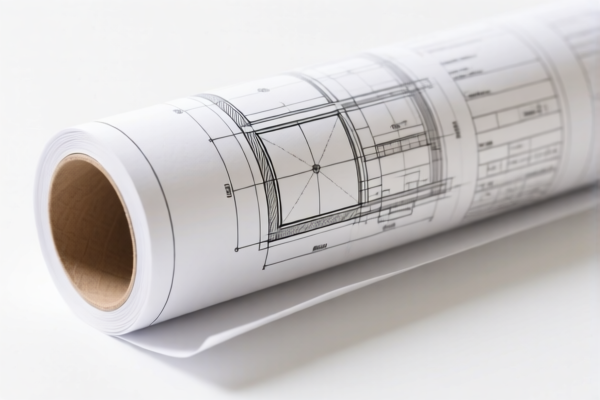
Blueprint Cotton Paper Roll
CN → US| HS Code | Tariff Rate | Origin | Destination | Doc |
|---|---|---|---|---|
| 4811908030 | 35.0% | CN | US | Official Doc |
| 4811904090 | 35.0% | CN | US | Official Doc |
Product Images



AI Analysis
📜 Blueprint Cotton Paper Roll (Architectural & Engineering Drafting Paper)
🌐 HS Code Reference & Customs Clearance Guide | 2026 Latest Tariff Analysis | Professional Clearance Strategy
📌 Part 1: Product Definition & Classification: Do You Really Know "Blueprint Cotton Paper"?
Cotton paper, often referred to as "blueprint paper" in professional contexts, is a high-quality, durable, and acid-free paper made primarily from cotton fibers. It is widely used for architectural blueprints, engineering drawings, fine art reproductions, and archival documents. In international trade, it is categorized under Heading 4811, which covers paper coated, impregnated, covered, surface-colored, surface-decorated, or printed, in rolls or rectangular sheets.
The classification depends on two critical factors: 1. Weight per square meter (g/m²) 2. Dimensions (width or sheet size)
⚠️ Key Distinction:
- If the paper weighs over 30 g/m², it falls under 4811.90.80.30
- If the paper weighs not over 15 g/m², it falls under 4811.90.40.90
- Papers between 15–30 g/m² are not explicitly covered in the provided data, but typically follow similar logic based on specific trade agreements or national interpretations.
📦 Part 2: HS Code Classification Details (2026 Latest Tariff Authority Reference)
| HS Code | Product Description | Application Scenario | Weight |
|---|---|---|---|
4811.90.80.30 |
Direct thermal coated paper, weighing over 30 g/m² | Architectural blueprints, engineering plans, high-end printing | > 30 g/m² |
4811.90.40.90 |
Other paper, paperboard, cellulose wadding, or webs of cellulose fibers, weighing not over 15 g/m² | Lightweight drafting paper, tracing paper, lightweight archival paper | ≤ 15 g/m² |
🔍 Important Note:
- Both codes apply to rolls or sheets exceeding certain dimensions (width >15 cm or one side >36 cm and the other >15 cm).
- "Direct thermal coated paper" under 4811.90.80.30 implies special coating that reacts to heat, commonly used in older fax machines or thermal printers. However, in practice, "blueprint cotton paper" may not be thermal-coated. Ensure your product description matches the actual technical specification.
- If your cotton paper is not directly thermal coated, verify whether it falls under another subheading not listed here.
💰 Part 3: 2026 Latest Tariff Rate Details (Including Additional Taxes)
✅ Applicable Country: United States (US)
✅ Country of Origin: China (CN)
✅ Effective Date: November 10, 2025 onwards (for subsequent imports)
🎯 1. 4811.90.80.30 – Direct Thermal Coated Paper, Weighing Over 30 g/m²
| Item | Content |
|---|---|
| Base Tariff Rate | 0% (ad valorem) |
| Additional Duty | +25% (Section 301 Tariff) |
| Total Tariff Rate | 25% |
| Tax Calculation | CIF Value × 25% |
| De Minimis Exemption Eligible? | ❌ No (not eligible for de minimis relief) |
| Legal Basis Path | Section 301 → HTSUS 4811.90.80.30 |
📌 Explanation:
- The 25% additional duty is imposed under Section 301 of the Trade Act of 1974, targeting specific Chinese imports including coated and printed papers.
- No base tariff is applied, but the 25% surcharge significantly increases import costs.
- This rate applies to both 4811.90.80.30 and 4811.90.40.90, as shown in the data.
🎯 2. 4811.90.40.90 – Other Paper, Weighing Not Over 15 g/m²
| Item | Content |
|---|---|
| Base Tariff Rate | 0% (ad valorem) |
| Additional Duty | +25% (Section 301 Tariff) |
| Total Tariff Rate | 25% |
| Tax Calculation | CIF Value × 25% |
| De Minimis Exemption Eligible? | ❌ No (not eligible for de minimis relief) |
| Legal Basis Path | Section 301 → HTSUS 4811.90.40.90 |
📌 Note:
- Despite being a lighter paper, it is still subject to the same 25% additional duty.
- This highlights the importance of accurate weight declaration and product description to avoid misclassification.
🛠️ Part 4: Customs Clearance Practical Advice (Battlefield Pitfall Avoidance Guide)
✅ 1. Required Documentation Checklist (All Items Mandatory)
| Document | Must Provide | Description |
|---|---|---|
| ✅ Product Specification Sheet | ✔️ | Include weight (g/m²), width, roll length, coating type |
| ✅ Product Photos (with label) | ✔️ | Clear image showing roll end, label, and any markings |
| ✅ Certificate of Origin (CO) | ✔️ | If not originating from China, may qualify for reduced duties |
| ✅ Commercial Invoice | ✔️ | Must clearly state “Blueprint Cotton Paper Roll” or similar accurate description |
| ✅ Packing List | ✔️ | Specify dimensions, weight, and number of rolls |
| ✅ Third-Party Test Report | ✔️ | If applicable, include coating analysis or fiber composition test |
✅ 2. Declaration Tips (Key Mnemonic)
🔥 “Weight first, coating next, dimensions third – declare accurately!”
| Scenario | Correct Declaration | Incorrect Approach |
|---|---|---|
| Paper weighs >30 g/m² and is directly thermal coated | 4811.90.80.30 |
Mislabel as uncoated paper → Risk of penalty |
| Paper weighs ≤15 g/m² | 4811.90.40.90 |
Claim higher weight → Overpay duties or face audit |
| Roll width ≤15 cm or sheet size small | Not covered in this data | Attempt to fit into 4811 categories → Rejected |
| Non-Chinese origin | Seek preferential treatment | Assume same 25% applies |
✅ 3. Special Cases Handling
| Situation | Recommendation |
|---|---|
| Custom-sized rolls | Provide exact dimensions; if outside standard sizes, consult customs broker |
| Non-thermal coated cotton paper | Verify if it belongs to another HS code (e.g., 4802 for uncoated paper) |
| OEM or branded products | Include brand name and model number on invoice |
| Mixed shipments | Clearly separate different HS codes in packing list and invoice |
🌍 Part 5: Global Market Comparison (2026 Latest)
| Country/Region | Recommended HS Code | Tariff | Certification Requirement | Notes |
|---|---|---|---|---|
| 🇺🇸 United States | 4811.90.80.30 or 4811.90.40.90 |
25% (China origin) | None specific | High tariff impact |
| 🇨🇳 China (Import) | Similar codes | 5–10% | CCC (if applicable) | Lower duty burden |
| 🇪🇺 European Union | 4811.90 or 4802 | 0–6.5% | CE (if coated) | Favorable for non-Chinese origin |
| 🇬🇧 United Kingdom | 4811.90 | 0–5% | UKCA (post-Brexit) | Moderate duty |
| 🇯🇵 Japan | 4811.90 | 0–6% | JIS Standard | Strict quality checks |
📌 Conclusion:
- The US imposes a steep 25% surcharge on Chinese-origin coated and printed papers, regardless of weight.
- For exporters targeting the US market, consider sourcing raw materials from non-Chinese suppliers or negotiating cost-sharing with buyers.
📌 Part 6: Common Mistakes & Pitfall Guide (Lessons Learned the Hard Way)
❌ Mistake 1: Declaring "Blueprint Paper" without specifying weight or coating
👉 Result: Customs may reclassify, leading to delayed clearance or penalties
❌ Mistake 2: Assuming all cotton paper is the same
👉 Result: Misclassification → 25% duty vs. 0% base rate
❌ Mistake 3: Omitting roll dimensions
👉 Result: If dimensions fall below threshold, product may not qualify under 4811 → Misdeclaration
❌ Mistake 4: Using vague terms like “Paper Roll”
👉 Result: Ambiguity → Increased scrutiny and possible seizure
✅ Correct Approach:
“Direct Thermal Coated Cotton Paper Roll, 40 g/m², Width 91 cm, Length 100 m, for Architectural Blueprints, Made in China”
🎯 Part 7: Conclusion: Precision in Classification Saves Money!
🎯 Remember the Mantra:
🔹 “Weight defines code, coating defines category, dimensions define eligibility.”
🔹 “HS Code determines destiny, 25% surcharge bites hard, declare precisely, save thousands!”
📌 Pro Tip:
If your cotton paper is originally produced in Vietnam, India, Germany, or the US, you may qualify for lower or zero tariffs under FTAs or general rates.
Consider applying for an Advance Ruling from CBP (U.S. Customs and Border Protection) before shipment to ensure correct classification.
📣 Immediate Action Steps:
📞 Contact a licensed customs broker + Provide product specs + Request HS Code Advance Ruling
🚀 Ensure smooth customs clearance, minimize costs, and protect your profits!
✨ Professional clearance begins with accurate classification!
💼 Every cent of your cost deserves precise calculation!
Customer Reviews
About HS Code Classification
The Harmonized System (HS) is an internationally standardized nomenclature developed by the World Customs Organization (WCO) to classify traded products. Over 200 countries use the HS system as the basis for customs tariffs, trade statistics, and import/export regulations.
Each HS code follows a hierarchical structure:
- Chapter (2 digits) — Broad category of goods (e.g., Chapter 84: Machinery and Mechanical Appliances)
- Heading (4 digits) — More specific grouping within the chapter
- Subheading (6 digits) — Internationally standardized breakdown, used by all WCO member countries
- National subdivisions (8-10 digits) — Country-specific extensions for further classification, such as US HTSUS 10-digit codes
Correct HS code classification is essential for smooth customs clearance, accurate duty payment, and compliance with trade regulations. Misclassification can lead to customs delays, overpayment of duties, or penalties.
When importing from CN to US, the applicable tariff rates may include:
- Most-Favored-Nation (MFN) rate — The standard duty rate applied to WTO members
- General rate — Applied to countries without trade agreements
- Trade remedy duties — Additional tariffs such as Section 301 (anti-dumping), Section 232 (national security), or countervailing duties
The information provided on this page is for reference purposes only. For official classification, please consult with your local customs authority or a licensed customs broker.