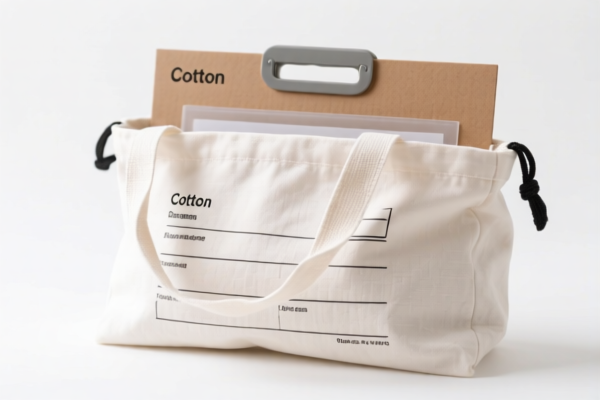
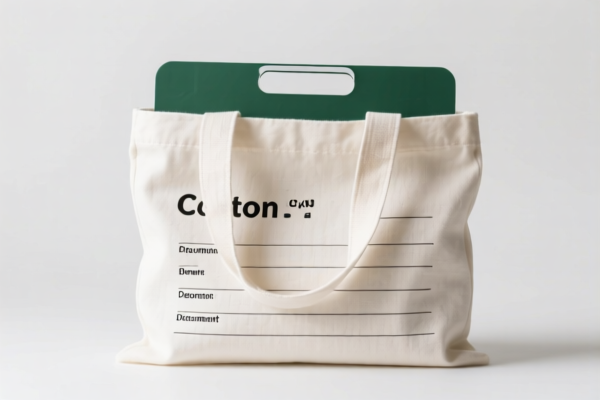
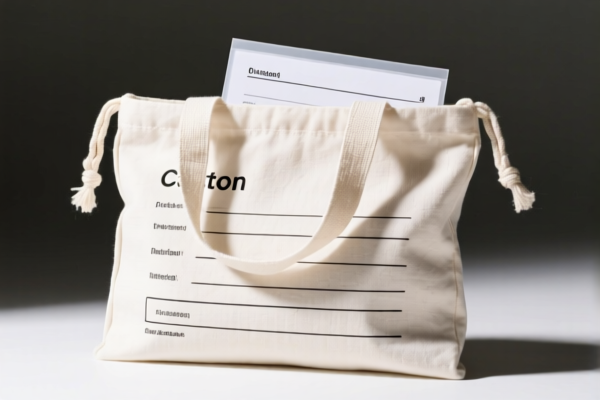
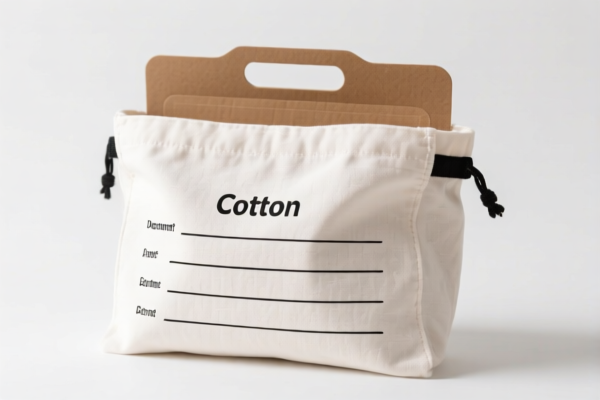
Cotton Document Bag
CN → US| HS Code | Tariff Rate | Origin | Destination | Doc |
|---|---|---|---|---|
| 3926908700 | 40.3% | CN | US | Official Doc |
| 4820900000 | 35.0% | CN | US | Official Doc |
| 3926909989 | 22.8% | CN | US | Official Doc |
| 4202329300 | 52.6% | CN | US | Official Doc |
| 4820300040 | 35.0% | CN | US | Official Doc |
| 4202329900 | 52.6% | CN | US | Official Doc |
Product Images
AI Analysis
📂 Cotton Document Bag (Fabric File Organizer)
🌐 HS Code Reference & Customs Clearance Guide | 2026 Latest Tariff Analysis | Strategic Compliance Strategy
📌 I. Product Definition & Classification: Do You Really Understand the "Cotton Document Bag"?
A Cotton Document Bag is a textile-based storage solution used for organizing, protecting, and transporting documents, contracts, or folders. In international trade, its classification is critical because, although the material is explicitly Cotton (Textile), its function (storage/organizing) can sometimes lead to confusion with paper or plastic goods.
Key Distinction:
Textile Bags (Chapter 42): If the bag has structure, handles, or resembles a briefcase/portfolio style, it falls under Heading 4202 (Trunks, suitcases, vanity cases...).
* Simple Soft Bags: If it is a simple pouch without structural rigidity, it may still fall under Chapter 42 if it resembles a container, or potentially Chapter 63 (Other made-up textile articles), but 4202 is the most common for "document bags" that serve as containers.
* ⚠️ Critical Warning: Do NOT classify under Chapter 48 (Paper) or 39 (Plastic) unless the product is actually* made of paper or plastic, despite the user input specifying "Cotton". Misclassification based on "Document" alone leads to severe penalties.
⚠️ Key Classification Point:
- If it is a textile bag holding documents → Chapter 42 (4202.32) is the primary and most accurate fit.
- If it is merely a paper folder (not cotton) → Chapter 48 (4820).
- If it is plastic (not cotton) → Chapter 39 (3926).
📦 II. HS Code Classification Details (Based on Provided Data)
The provided <DATA> contains several potential HS Codes. However, since the product is explicitly "Cotton" (Textile), we must evaluate which codes are logically consistent with textile materials and which are mismatched based on the "Summary" fields provided.
| HS Code | Product Description | Material Match | Total Tax | Tax Detail |
|---|---|---|---|---|
4202.32.93.00 |
Bags, pouches, etc., with outer surface of textile materials or plastic sheeting | ✅ Yes (Textile/Cotton fits "outer surface of textile") | 52.6% | Base: 17.6%, Add. Tariff: 25.0%, Section 301: 10% |
4202.32.99.00 |
Other bags, pouches, etc., with outer surface of textile materials or plastic sheeting | ✅ Yes (General textile bag category) | 52.6% | Base: 17.6%, Add. Tariff: 25.0%, Section 301: 10% |
3926.90.87.00 |
Other articles of plastics | ❌ No (Product is Cotton, not Plastic) | 40.3% | Base: 5.3%, Add. Tariff: 25.0%, Section 301: 10% |
3926.90.99.89 |
Other articles of plastics | ❌ No (Product is Cotton, not Plastic) | 22.8% | Base: 5.3%, Add. Tariff: 7.5%, Section 301: 10% |
4820.90.00.00 |
Other books, pamphlets, ledgers, etc., or other stationery | ❌ No (Product is Cotton, not Paper/Cardboard) | 35.0% | Base: 0.0%, Add. Tariff: 25.0%, Section 301: 10% |
4820.30.00.40 |
Other folders, file covers, etc., of paper or paperboard | ❌ No (Product is Cotton, not Paper) | 35.0% | Base: 0.0%, Add. Tariff: 25.0%, Section 301: 10% |
🔍 Critical Insight from Data:
- The provided data includes codes for Plastic (3926) and Paper (4820) items.
- Since the product is "Cotton", these codes are INCORRECT.
- ONLY the4202codes (Textile bags) are materially consistent with a "Cotton Document Bag".
- Both4202.32.93.00and4202.32.99.00result in a 52.6% total tax rate.
💰 III. 2026 Latest Tariff Rate Breakdown (For Correct Textile Classification)
✅ Applicable Country: United States (US)
✅ Origin: China (CN) (Assuming standard import scenario for high tariff context)
✅ Effective Date: Post-November 2025 (Including subsequent imports)
🎯 1. 4202.32.93.00 / 4202.32.99.00 —— Textile Document Bags
| Item | Content |
|---|---|
| Base Duty Rate | 17.6% (ad valorem) |
| USITC Additional Tariff | +25.0% (Section 301 Tariff) |
| IEEPA Additional Tariff | +10.0% (Targeting China/HK products, effective Nov 10, 2025) |
| Total Effective Tax Rate | 52.6% |
| Tax Calculation | CIF Value × 52.6% |
| De Minimis Eligibility | ❌ No (deny_de_minimis) |
| Legal Basis Path | IEEPA:9903.01.25 → IEEPA:9903.01.24 → USITC:4202.32.93.00/99.00 → FOOTNOTE:301 |
📌 Explanation:
- The 17.6% is the standard Most Favored Nation (MFN) duty for textile bags.
- The 25% is the standard Section 301 penalty on Chinese textiles.
- The 10% is the new IEEPA surcharge.
- Total 52.6% is extremely high. This makes importing cotton document bags from China to the US very costly.⚠️ Note on Provided Data Mismatch:
The data also lists3926.90.99.89(Plastic) at 22.8% tax. While cheaper, you cannot use this code for Cotton bags. Using it would be customs fraud.
If the bag were Plastic, the tax would be 22.8%.
If the bag is Paper, the tax is 35.0%.
If the bag is Cotton, the tax is 52.6%.
🛠️ IV. Customs Clearance Practical Advice (Battle-Tested Pitfall Guide)
✅ 1. Documentation Checklist (Missing any leads to delays)
| Document | Mandatory? | Notes |
|---|---|---|
| ✅ Product Specification Sheet | ✔️ | Must explicitly state "100% Cotton" or "Textile Material". Do not just say "Document Bag". |
| ✅ Material Composition Label | ✔️ | Photo of the label showing fiber content is crucial. |
| ✅ Commercial Invoice | ✔️ | Must describe as "Textile Document Bag" or "Cotton File Organizer". |
| ✅ Packing List | ✔️ | Must match invoice exactly. |
| ✅ Origin Certificate | ✔️ | If shipped from a non-China country (e.g., Vietnam, Bangladesh), IEEPA 10% tax may be waived. |
✅ 2. Declaration Tips (Key Mantras)
🔥 "Material First, Function Second! Name it 'Textile Bag', not 'Paper Folder'!"
| Scenario | Correct Declaration | Wrong Declaration |
|---|---|---|
| Cotton Bag | 4202.32.93.00 / 4202.32.99.00 |
4820.30.00.40 (Paper) → Penalty + Back Taxes |
| Plastic Bag | 3926.90.87.00 |
4202.32.93.00 (Textile) → Penalty + Back Taxes |
| Mixed Material | Declare main outer surface material | Ambiguous description "Document Holder" → Audit Risk |
✅ 3. Special Handling Cases
| Situation | Handling Advice |
|---|---|
| Origin Change | If produced in Vietnam, India, or Bangladesh, the 10% IEEPA tax may not apply. The 25% Section 301 might still apply depending on specific rules of origin, but verify! |
| OEM Customization | Provide design blueprints to prove it is a "bag" (Chapter 42) and not just a "piece of cloth" (Chapter 60/61). |
| Sample vs. Bulk | Small samples might enter under different provisions, but bulk commercial import must declare accurately. |
🌍 V. Global Market Comparison (2026 Latest)
| Country/Region | Recommended HS Code | Est. Tax Rate (China Origin) | Certification | Notes |
|---|---|---|---|---|
| 🇺🇸 USA | 4202.32.93.00 |
52.6% | None specific | Highest cost driver due to IEEPA + 301 |
| 🇨🇳 China | 4202.32.93.00 |
~17-20% | None | Domestic consumption, no import tax |
| 🇪🇺 EU | 4202.32 |
12-16% | CE (if applicable) | No Section 301 equivalent |
| 🇬🇧 UK | 4202.32 |
12-16% | None | Post-Brexit rules |
| 🇦🇺 Australia | 4202.32 |
5-10% | None | FTA with China possible |
📌 Conclusion:
- The USA is the most hostile market for Chinese-made textile bags due to the 52.6% total tariff.
- Strategy: Consider shifting production to ASEAN countries (Vietnam, Cambodia) to avoid the IEEPA surcharge and potentially mitigate Section 301 risks.
📌 VI. Common Errors & Pitfall Guide (Blood Lessons)
❌ Error 1: Declaring a Cotton Bag as 4820.30.00.40 (Paper Folder) because it holds papers.
👉 Consequence: Customs detects material mismatch → 100% Penalty + Back Taxes ($35% vs $52.6% reversal, but fraud charges).
❌ Error 2: Declaring a Cotton Bag as 3926.90.99.89 (Plastic) to get the lower 22.8% tax.
👉 Consequence: Customs exam reveals cotton fibers → Seizure, Fine, and Loss of Import Privileges.
❌ Error 3: Ignoring the IEEPA 10% surcharge in cost calculations.
👉 Consequence: Margin erosion. Budgeting for 25% only, when reality is 52.6%.
❌ Error 4: Using "Document Bag" as the sole description.
👉 Consequence: Customs officer guesses material → Likely misclassification → Audit.
✅ Correct Practice:
"Cotton Canvas Document Bag, Zippered Closure, Model XYZ, 100% Cotton Outer Shell"
🎯 VII. Conclusion: Professional Declaration, Cost Optimization
🎯 Remember the Mantra:
🔹 "Material Dictates Code! Cotton is Textile (4202), NOT Paper (4820) or Plastic (3926)."
🔹 "US Tariff is 52.6% for Cotton Bags from China. Plan accordingly!"
📌 Pro Tip:
If your cotton document bag is not made in China, you can save 10% (IEEPA) and potentially 25% (301) depending on origin.
✅ Action:
📞 Engage a licensed customs broker.
📄 Request Advance Ruling if volume is high.
🚀 Consider Near-shoring to Vietnam/Mexico to bypass US China-specific tariffs.
✨ Professional Clearance, Start with Accurate Classification!
💼 Every Percentage Point of Tax Saved is Pure Profit!
Customer Reviews
About HS Code Classification
The Harmonized System (HS) is an internationally standardized nomenclature developed by the World Customs Organization (WCO) to classify traded products. Over 200 countries use the HS system as the basis for customs tariffs, trade statistics, and import/export regulations.
Each HS code follows a hierarchical structure:
- Chapter (2 digits) — Broad category of goods (e.g., Chapter 84: Machinery and Mechanical Appliances)
- Heading (4 digits) — More specific grouping within the chapter
- Subheading (6 digits) — Internationally standardized breakdown, used by all WCO member countries
- National subdivisions (8-10 digits) — Country-specific extensions for further classification, such as US HTSUS 10-digit codes
Correct HS code classification is essential for smooth customs clearance, accurate duty payment, and compliance with trade regulations. Misclassification can lead to customs delays, overpayment of duties, or penalties.
When importing from CN to US, the applicable tariff rates may include:
- Most-Favored-Nation (MFN) rate — The standard duty rate applied to WTO members
- General rate — Applied to countries without trade agreements
- Trade remedy duties — Additional tariffs such as Section 301 (anti-dumping), Section 232 (national security), or countervailing duties
The information provided on this page is for reference purposes only. For official classification, please consult with your local customs authority or a licensed customs broker.