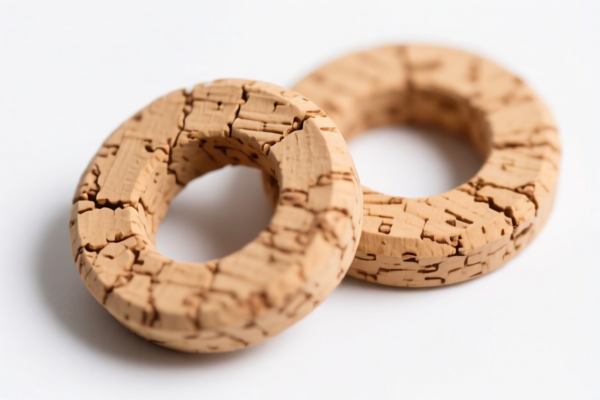
Food Grade Natural Cork Washers
CN → USProduct Images



AI Analysis
🍷 Food Grade Natural Cork Washers
🌐 HS Code Reference & Customs Clearance Guide | 2026 Latest Tariff Analysis | Professional-Level Clearance Strategy
📌 I. Product Definition and Classification: What Exactly Are "Cork Washers"?
Food Grade Natural Cork Washers are circular sealing components made from natural cork (usually Quercus suber bark) specifically treated to meet food safety standards. They are primarily used in beverage industry equipment, such as wine bottling lines, beer kegs, distillery tanks, and food processing machinery, to create tight, leak-proof seals between flanges, valves, and connectors.
In international trade, they are classified based on their material origin, processing level, and intended use:
Natural Cork (Unprocessed/Lightly Processed): Raw cork bark or simple cut shapes without significant chemical modification.
Prepared Cork / Industrial Articles: Cork that has been compressed, cut into specific shapes (washers), bonded with adhesives, or treated for food-grade compliance.
⚠️ Key Distinction Point:
- If the product is simple cut shapes of natural cork with minimal processing → Often classified under Chapter 45 (Natural Cork);
- If the product is vulcanized, bonded with rubber/adhesives, or significantly processed for industrial sealing → May fall under Chapter 40 (Rubber) or Chapter 39 (Plastics), depending on composition;
- Critical Note: For pure "natural cork" washers intended for food contact, HS Code 4503 is the most common classification, provided no other material forms the essential character.
📦 II. HS Code Classification Details (2026 Latest Tariff Authority Comparison)
| HS Code | Product Description | Applicable Scenario | Material Composition | Food Grade Compliance |
|---|---|---|---|---|
4503.00.00.00 |
Natural cork, unwashed, disinfected, or similarly prepared | Pure natural cork washers, cut to shape, untreated or lightly treated | 100% Natural Cork | Must meet FDA/EFSA standards for food contact |
4504.00.00.00 |
Agglomerated cork and articles of agglomerated cork | Compressed cork + adhesive, used for industrial seals | Cork particles + binder (e.g., polyurethane) | Must be food-safe binder |
4016.93.00.00 |
Other articles of vulcanized rubber other than hard rubber | If cork is heavily bonded with rubber for sealing | Cork core + rubber coating/binding | Not purely "cork" |
8481.90.90.00 |
Parts of taps, cocks, valves | If classified as parts of a valve assembly | Varies | Usually not standalone |
🔍 Key Reminder:
-4503.00.00.00is the standard classification for pure natural cork washers.
- If the washers are agglomerated (compressed cork dust + glue), they fall under4504.00.00.00.
- Do not confuse with rubber gaskets (4016) unless rubber is the primary material.
- Food Grade status does not change the HS Code but requires additional documentation (FDA, LFGB, etc.).
💰 III. 2026 Latest Tariff Rate Details (Including Surcharges, Policy Add-ons)
✅ Applicable Country: United States (US)
✅ Country of Origin: China (CN)
✅ Effective Date: From November 10, 2025 (for subsequent imports)
🎯 1. 4503.00.00.00 —— Natural Cork, Prepared
| Item | Content |
|---|---|
| Base Duty Rate | Free (0%) |
| USITC Surcharge | None |
| IEEPA Surcharge | None |
| Total Duty Rate | 0% |
| Tax Calculation | CIF Value × 0% |
| De Minimis Eligible? | ✅ Yes (if value < $800) |
| Legal Basis Path | HTSUS:4503.00.00 → USITC:General |
📌 Explanation:
- Natural cork products generally enjoy zero-duty status under most FTAs and general tariffs.
- No Section 301 or IEEPA surcharges apply to Chapter 45 goods.
- Low risk for tariff escalation.
🎯 2. 4504.00.00.00 —— Agglomerated Cork
| Item | Content |
|---|---|
| Base Duty Rate | Free (0%) |
| USITC Surcharge | None |
| IEEPA Surcharge | None |
| Total Duty Rate | 0% |
| Tax Calculation | CIF Value × 0% |
| De Minimis Eligible? | ✅ Yes (if value < $800) |
| Legal Basis Path | HTSUS:4504.00.00 → USITC:General |
📌 Note:
- Agglomerated cork is also duty-free.
- Ensure the adhesive used is food-safe to avoid regulatory rejection even if duties are zero.
🛠️ IV. Customs Clearance Practical Advice (Real-World Pitfall Avoidance Guide)
✅ 1. Required Documentation Checklist (Non-Negotiable)
| Document | Must Provide | Explanation |
|---|---|---|
| ✅ Material Declaration | ✔️ | Specify "100% Natural Cork" or "Agglomerated Cork + Food-Safe Adhesive" |
| ✅ FDA Compliance Letter | ✔️ | Statement of compliance with 21 CFR 174-178 (Food Contact Substances) |
| ✅ Test Report (LFGB/FDA) | ✔️ | Migration test results for heavy metals, formaldehyde, etc. |
| ✅ Product Photos | ✔️ | Clear images of washer, packaging, and any "Food Grade" labeling |
| ✅ Commercial Invoice | ✔️ | Clearly state "Cork Washers for Food Processing Equipment" |
| ✅ Packing List | ✔️ | Net weight vs. gross weight, dimensions |
| ✅ Certificate of Origin | ✔️ | If claiming preferential tariffs under FTAs (e.g., USMCA if from Mexico) |
✅ 2. Declaration Tips (Key Mantra)
🔥 "Pure Cork is Free, Agglomerated is Free, But Food Safety is Key!"
| Scenario | Correct Declaration | Wrong Practice |
|---|---|---|
| Pure natural cork washers | 4503.00.00.00 |
Misdeclare as "Rubber Gaskets" (4016) → 3.4% duty + potential misclassification |
| Agglomerated cork + glue | 4504.00.00.00 |
Declare as "Wood Products" → Unacceptable, rejected |
| Cork with rubber coating | 4016.93.00.00 |
Declare as "Cork" → Misclassification, penalties |
| Small batch < $800 | Use De Minimis (Section 321) | Over-declare value → Unnecessary duties |
✅ 3. Special Case Handling
| Scenario | Handling Advice |
|---|---|
| Cork + Adhesive | Declare as "Agglomerated Cork" (4504.00.00.00) if adhesive is significant; otherwise, 4503.00.00.00 |
| Food Grade Certification | Provide FDA or EFSA compliance documents; U.S. CBP may request them for random inspections |
| OEM Custom Sizes | Provide drawing or spec sheet; ensure no misleading descriptions like "Wood Washer" |
| Used/Recycled Cork | Must disclose; may require additional phytosanitary or recycling compliance |
🌍 V. Global Major Market Customs Comparison (2026 Latest)
| Country/Region | Recommended HS Code | Duty Rate | Certification Required | Notes |
|---|---|---|---|---|
| 🇺🇸 United States | 4503.00.00.00 |
0% | FDA, LFGB | No surcharges; easy clearance |
| 🇨🇳 China | 4503.00.00.00 |
0% | No special | Import duty-free |
| 🇪🇺 European Union | 4503.00.00 |
0% | REACH, LFGB | Strict on chemical residues |
| 🇬🇧 United Kingdom | 4503.00.00 |
0% | UKCA, Food Standards Agency | Post-Brexit rules apply |
| 🇦🇺 Australia | 4503.00.00 |
0% | FSANZ | Low risk |
| 🇯🇵 Japan | 4503.00.00 |
0% | JFS, Food Sanitation Act | Strict on migration tests |
📌 Conclusion:
- Globally, natural cork washers enjoy 0% duty in major markets.
- The real challenge is not tariff, but compliance: Food-grade certification, chemical migration tests, and proper declaration.
- U.S. market is most straightforward with no surcharges, but FDA documentation is critical.
📌 VI. Common Errors & Pitfall Avoidance (Blood-Teaching Lessons)
❌ Error 1: Declaring as "Wood Products" or "Wood Washers"
👉 Consequence: Rejected by customs; wood is under Chapter 44, cork under Chapter 45. Clearance delay.
❌ Error 2: Misdeclaring as "Rubber Gaskets" (4016)
👉 Consequence: Pay 3.4% duty unnecessarily; if found to be cork, penalties for misclassification.
❌ Error 3: Failing to provide Food Grade Certification
👉 Consequence: FDA may hold shipment for inspection; possible destruction or return.
❌ Error 4: Not disclosing adhesive in agglomerated cork
👉 Consequence: If adhesive is non-food-safe, product banned from food contact.
✅ Correct Practice:
"Natural Cork Washers, 100% Cork, Cut to Shape, FDA Compliant for Food Contact, Not for Industrial Chemical Use"
🎯 VII. Conclusion: Professional Declaration, Save Time, Reduce Cost, Enhance Efficiency!
🎯 Remember the Mantra:
🔹 "Cork is Free, But Food Safety is Key!"
🔹 "HS Code 4503 or 4504, Zero Duty, But Documentation is Mandatory!"
📌 Pro Tip:
If your cork washers are made from recycled cork or contain recycled content, ensure you have recycling compliance documents; some markets require special labeling.
Recommend applying for Advance Ruling if you are unsure about the classification between 4503 and 4504.
📣 Immediate Action:
📞 Contact a professional customs broker + Provide FDA/EFSA Test Reports + Apply for HS Code Advance Ruling
🚀 Let your cork washers clear customs smoothly, efficiently go global, and maximize profit!
✨ Professional Clearance Starts with Accurate Classification!
💼 Every Penny of Your Cost Deserves Precise Calculation!
Customer Reviews
About HS Code Classification
The Harmonized System (HS) is an internationally standardized nomenclature developed by the World Customs Organization (WCO) to classify traded products. Over 200 countries use the HS system as the basis for customs tariffs, trade statistics, and import/export regulations.
Each HS code follows a hierarchical structure:
- Chapter (2 digits) — Broad category of goods (e.g., Chapter 84: Machinery and Mechanical Appliances)
- Heading (4 digits) — More specific grouping within the chapter
- Subheading (6 digits) — Internationally standardized breakdown, used by all WCO member countries
- National subdivisions (8-10 digits) — Country-specific extensions for further classification, such as US HTSUS 10-digit codes
Correct HS code classification is essential for smooth customs clearance, accurate duty payment, and compliance with trade regulations. Misclassification can lead to customs delays, overpayment of duties, or penalties.
When importing from CN to US, the applicable tariff rates may include:
- Most-Favored-Nation (MFN) rate — The standard duty rate applied to WTO members
- General rate — Applied to countries without trade agreements
- Trade remedy duties — Additional tariffs such as Section 301 (anti-dumping), Section 232 (national security), or countervailing duties
The information provided on this page is for reference purposes only. For official classification, please consult with your local customs authority or a licensed customs broker.