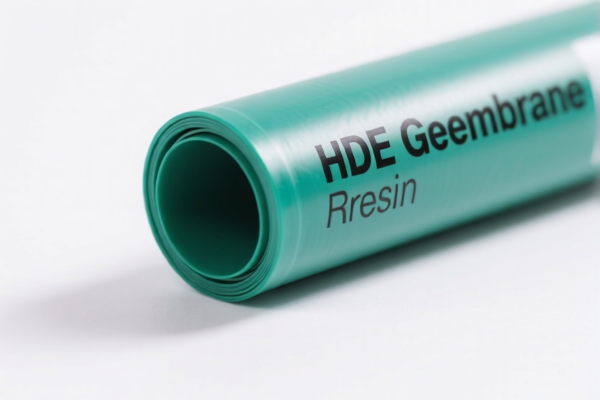
HDPE Geomembrane Resin
CN → US| HS Code | Tariff Rate | Origin | Destination | Doc |
|---|---|---|---|---|
| 3901201000 | 41.5% | CN | US | Official Doc |
| 3901205000 | 41.5% | CN | US | Official Doc |
Product Images



AI Analysis
🧱 HDPE Geomembrane Resin (High-Density Polyethylene)
🌐 HS Code Reference & Customs Clearance Guide | 2026 Latest Tariff Analysis | Professional Clearance Strategy
📌 I. Product Definition: What is "HDPE Geomembrane Resin"?
HDPE Geomembrane Resin refers to polyethylene polymers in primary forms (granules, flakes, or powder) specifically manufactured for extrusion into geomembranes (liners for landfills, ponds, canals, etc.).
Crucial Distinction in Customs Classification: - ❌ NOT the finished Geomembrane sheet (which falls under Chapter 3901.90 or 3920.39). - ✅ IS the raw polymer resin used to make the sheet.
In the context of the provided <DATA>, the classification depends entirely on the Specific Gravity (Density) and Relative Viscosity of the resin. HDPE typically has a specific gravity of 0.94 or more, which places it in the subheading 3901.20.
⚠️ Key Classification Trigger:
- If the resin has a specific gravity ≥ 0.94 AND a relative viscosity ≥ 1.44 → It is classified as a specialized high-performance polyethylene.
- If the resin has a specific gravity ≥ 0.94 but does NOT meet the specific viscosity requirement (or is a general-purpose grade) → It falls under "Other."
📦 II. HS Code Classification Details (Based on Provided <DATA>)
Since HDPE resin is a polymer of ethylene with a specific gravity of 0.94 or more, it is strictly divided into two categories in the provided data:
| HS Code | Product Description | Specific Gravity | Relative Viscosity | Typical Application |
|---|---|---|---|---|
3901.20.10.00 |
Polyethylene having a specific gravity of 0.94 or more Having a relative viscosity of 1.44 or more |
≥ 0.94 | ≥ 1.44 | High-strength geomembranes, industrial liners, heavy-duty containment systems. |
3901.20.50.00 |
Polyethylene having a specific gravity of 0.94 or more Other |
≥ 0.94 | < 1.44 (or unspecified) | Standard HDPE resin, general packaging, standard piping, lower-spec liners. |
🔍 Critical Note:
- The term "Geomembrane Resin" is a commercial name, not a customs technical term. Customs looks at physical properties (Density & Viscosity).
- Most specialized geomembrane resins (used in environmental engineering) are high-melt-strength and often fall into3901.20.10.00due to higher viscosity requirements for extrusion.
- General-purpose HDPE (e.g., for bottles or simple bags) falls into3901.20.50.00.
💰 III. Tariff Rate Details (2026 Analysis)
✅ Source Data Constraint: The provided
<DATA>indicates 0.0% total tax for both codes.
✅ Applicable Context: This implies MFN (Most Favored Nation) rate or a duty-free status under current trade agreements (e.g., US-China, or within certain FTA zones).
⚠️ WARNING: This DOES NOT account for Section 301 tariffs (US) or other potential anti-dumping/countervailing duties (CVD) which may apply depending on the country of origin (e.g., China).
🎯 1. 3901.20.10.00 – High Viscosity HDPE Resin
| Item | Content |
|---|---|
| HS Code | 3901.20.10.00 |
| Description | Polymers of ethylene; specific gravity ≥ 0.94; relative viscosity ≥ 1.44 |
| Basic Tariff | 0.0% |
| Additional Tariff | 0.0% (Per provided data) |
| Total Tax Rate | 0.0% |
| Tax Detail | 基础关税: 0.0%, 加征关税: 0.0% |
📌 Interpretation:
- This code represents a premium, high-performance polyethylene.
- In many jurisdictions, basic tariffs for petrochemicals are low or zero to encourage manufacturing.
- However, if importing into the USA from China, this item may be subject to Section 301 tariffs (typically 7.5% or 25%) on top of the 0% basic rate, which are NOT reflected in the provided<DATA>snippet. Always verify local trade restrictions.
🎯 2. 3901.20.50.00 – Other HDPE Resin (General Purpose)
| Item | Content |
|---|---|
| HS Code | 3901.20.50.00 |
| Description | Polymers of ethylene; specific gravity ≥ 0.94; Other |
| Basic Tariff | 0.0% |
| Additional Tariff | 0.0% (Per provided data) |
| Total Tax Rate | 0.0% |
| Tax Detail | 基础关税: 0.0%, 加征关税: 0.0% |
📌 Interpretation:
- This is the default category for HDPE resins that do not meet the high-viscosity threshold.
- Commonly used for standard plastic bags, bottles, and simple pipes.
- Also subject to potential Section 301 tariffs if originating from China (USA) or other trade-restricted countries.
🛠️ IV. Customs Clearance Practical Advice (Avoiding Pitfalls)
✅ 1. Documentation Checklist (Must-Have)
| Document | Requirement | Purpose |
|---|---|---|
| MSDS / SDS | ✔️ Mandatory | Chemical safety data sheet. |
| Certificate of Analysis (COA) | ✔️ Critical | Must list Specific Gravity (e.g., 0.950) and Melt Flow Index (MFI) or Relative Viscosity. |
| Product Description | ✔️ Precise | Use technical terms: "Polyethylene Resin, HDPE, Primary Form, Granules" – Do NOT just write "Geomembrane Material." |
| Certificate of Origin (CO) | ✔️ If applicable | To claim preferential tariff rates under FTAs (e.g., RCEP, USMCA). |
| Packaging List | ✔️ | Net weight, gross weight, number of bags. |
✅ 2. Declaration Tips (Key Mnemonic)
🔥 "Density Drives Code, Viscosity Splits the Class!"
| Scenario | Correct Declaration | Incorrect Declaration | Risk |
|---|---|---|---|
| Resin for high-strength liners | 3901.20.10.00"HDPE Resin, SG 0.95, Viscosity 1.50" |
3901.20.50.00"HDPE Resin" |
Misclassification: May be audited for under-declaration of tariff if higher duties apply. |
| Standard HDPE resin | 3901.20.50.00 |
3901.20.10.00 |
Unnecessary complexity: No benefit if viscosity is low. |
| Finished Geomembrane Sheet | WRONG CODE3901.20.xxxx |
3920.62.00.00"Plated with plastics, geomembrane" |
Wrong Chapter: Finished sheets are Chapter 3901.90 or 3920.39, NOT 3901. |
✅ 3. Special Case Handling
| Situation | Advice |
|---|---|
| Importing to USA from China | Check Section 301 List. Even if basic tariff is 0%, an additional 7.5% or 25% may apply. The provided <DATA> likely excludes these "punitive" tariffs. |
| Anti-Dumping Duties (ADD) | Some HDPE resins from specific countries may face ADD. Check with a customs broker. |
| Viscosity Measurement | If your COA lists Melt Flow Index (MFI) instead of Relative Viscosity, you may need to convert or provide expert evidence that the product falls under 3901.20.10.00 if it’s a high-performance grade. |
🌍 V. Global Market Comparison (2026 Snapshot)
| Region | HS Code | Basic Tariff | Notes |
|---|---|---|---|
| 🇺🇸 USA | 3901.20.10.00 / 3901.20.50.00 |
0.0% (Base) | +Section 301 Tariffs may apply (up to 25%) for Chinese origin. |
| 🇨🇳 China | 3901.20.10.00 / 3901.20.50.00 |
0.0% - 5.0% | Varies by FTA; generally low for petrochemicals. |
| 🇪🇺 EU | 3901.20.90 |
0.0% - 6.5% | EU uses 8-digit codes; HDPE is generally 6.5% MFN but often 0% under many FTAs. |
| 🇮🇳 India | 3901.20.00 |
5.0% - 10.0% | Higher tariffs to protect domestic industry. |
📌 Conclusion:
- USA: Watch out for Section 301 add-ons.
- EU/China: Generally favorable, but verify FTA eligibility.
- India: Higher duty burden; consider local sourcing.
📌 VI. Common Errors & Pitfalls (Lessons Learned)
❌ Error 1: Declaring "Geomembrane" resin as "Finished Geomembrane Sheet"
👉 Result: Wrong HS Code (e.g., 3920.62), potential delay, re-valuation.
❌ Error 2: Ignoring Relative Viscosity when claiming 3901.20.10.00
👉 Result: Customs may downgrade to 3901.20.50.00 if viscosity < 1.44 is proven, leading to discrepancies in duty calculation if rates differ by country.
❌ Error 3: Assuming "0% Tariff" means "No Costs"
👉 Result: Missing Section 301 (USA) or Anti-Dumping duties, leading to unexpected bills at customs.
✅ Correct Approach:
"HDPE Polymer Resin, Primary Form, Specific Gravity 0.950, Melt Flow Index 2.0 g/10min, for Extrusion into Geomembranes, Model XYZ, Batch No. 12345."
🎯 VII. Conclusion: Precision Saves Money!
🎯 Remember:
🔹 "Resin is not Sheet! Check Density & Viscosity!"
🔹 "0% Base Rate ≠ 0% Final Duty (Check 301/Add-ons)!"
🔹 "COA is King: Provide Specific Gravity & Viscosity Data!"
📌 Pro Tip:
If your HDPE resin is high-viscosity (used for environmental geomembranes), ensure your Certificate of Analysis explicitly states Relative Viscosity ≥ 1.44. This allows you to use 3901.20.10.00, which may have different regulatory or quota implications in some countries compared to general-purpose HDPE (3901.20.50.00).
📣 Immediate Action:
📞 Consult your customs broker for Section 301 applicability.
📄 Obtain a detailed Certificate of Analysis from the manufacturer.
🚀 Declare accurately to avoid delays, fines, and double taxation!
✨ Professional Clearance Starts with Accurate Classification!
💼 Your supply chain efficiency depends on the first 10 digits of the HS Code!
Customer Reviews
About HS Code Classification
The Harmonized System (HS) is an internationally standardized nomenclature developed by the World Customs Organization (WCO) to classify traded products. Over 200 countries use the HS system as the basis for customs tariffs, trade statistics, and import/export regulations.
Each HS code follows a hierarchical structure:
- Chapter (2 digits) — Broad category of goods (e.g., Chapter 84: Machinery and Mechanical Appliances)
- Heading (4 digits) — More specific grouping within the chapter
- Subheading (6 digits) — Internationally standardized breakdown, used by all WCO member countries
- National subdivisions (8-10 digits) — Country-specific extensions for further classification, such as US HTSUS 10-digit codes
Correct HS code classification is essential for smooth customs clearance, accurate duty payment, and compliance with trade regulations. Misclassification can lead to customs delays, overpayment of duties, or penalties.
When importing from CN to US, the applicable tariff rates may include:
- Most-Favored-Nation (MFN) rate — The standard duty rate applied to WTO members
- General rate — Applied to countries without trade agreements
- Trade remedy duties — Additional tariffs such as Section 301 (anti-dumping), Section 232 (national security), or countervailing duties
The information provided on this page is for reference purposes only. For official classification, please consult with your local customs authority or a licensed customs broker.