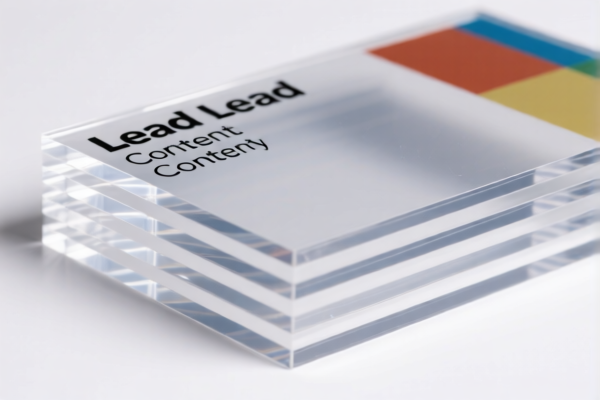
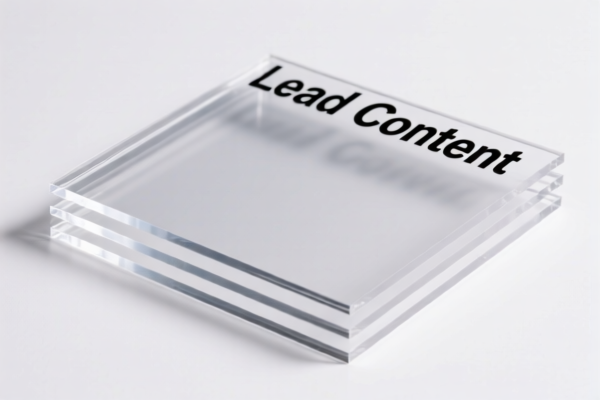
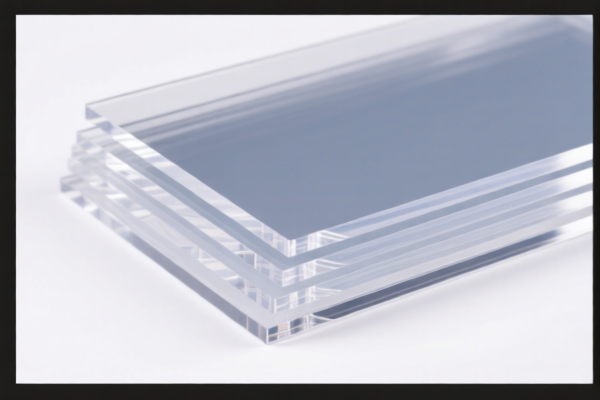
High Lead Content Transparent Acrylic Sheet
CN → US| HS Code | Tariff Rate | Origin | Destination | Doc |
|---|---|---|---|---|
| 3906100000 | 41.3% | CN | US | Official Doc |
| 3921110000 | 40.3% | CN | US | Official Doc |
| 3921190090 | 41.5% | CN | US | Official Doc |
| 3920515090 | 41.5% | CN | US | Official Doc |
| 3906902000 | 41.3% | CN | US | Official Doc |
Product Images

AI Analysis
🖥️ High Lead Content Transparent Acrylic Sheet
🌐 HS Code Reference & Customs Clearance Guide | 2026 Latest Tariff Analysis | Professional Strategy for Radiation Shielding Materials
📌 Part I: Product Definition and Classification: Do You Really Understand "High Lead Acrylic"?
High lead content transparent acrylic sheets are specialized optical materials primarily used in radiation shielding for X-ray rooms, nuclear medicine, and industrial radiography. They offer the visual clarity of glass with the shatter resistance of plastic, while absorbing radiation due to the high density of lead.
In international trade, they are strictly categorized under Plastics, specifically Acrylic Polymers, based on their material composition and lead weight percentage.
⚠️ Critical Distinction:
- High Lead Acrylic (>30% Lead by Weight): Classified under Chapter 39 (Plastics). The high lead content makes it distinct from standard glass or low-density plastics.
- Standard Acrylic (PMMA): Classified under standard acrylic subheadings.
- Lead-Glass or Crystal: Classified under Chapter 70 (Glass).
- Lead Sheets (Metal): Classified under Chapter 78 (Lead).
Key Classification Criteria:
If the product is transparent, made of acrylic polymers, and contains ≥30% lead by weight, it falls into a specific niche under HS Code 3920.59.40.00. This is not a general plastic sheet; it is a specialized shielding material with unique tariff implications.
📦 Part II: HS Code Classification Details (2026 Latest Tariff Authority Comparison)
Based on the provided data, here are the relevant HS Codes and their applications:
| HS Code | Product Description | Application Scenario | Tax Rate (China Origin to US) |
|---|---|---|---|
3920.59.40.00 |
Transparent sheeting of plastics containing 30 percent or more by weight of lead | Radiation shielding panels, X-ray room windows, nuclear safety barriers | 25.0% |
3920.51.50.50 |
Other sheets of acrylic polymers, not flexible, containing flame retardant | Standard fire-retardant acrylic sheets (no high lead) | 0.0% |
3926.90.94.00 |
Transparent sheeting of plastics containing 30%+ lead (Other articles of plastics) | Note: This code also covers high-lead acrylics as "Other articles" | 25.0% |
3926.90.99.89 |
Other articles of plastics (Generic fallback) | Non-specific plastic goods not covered above | 12.8% |
🔍 Critical Alert:
-3920.59.40.00is the most accurate and specific code for "High Lead Content Transparent Acrylic Sheet."
-3926.90.94.00is also valid for "transparent sheeting" but is a broader category under "Other articles."
- DO NOT use3920.51.50.50unless the sheet is flame retardant AND does NOT contain ≥30% lead. Misclassifying high-lead sheets here could lead to severe penalties for under-declaration.
- DO NOT use3926.90.99.89unless the product fails all specific criteria. It is a higher-risk, less specific code.
💰 Part III: 2026 Latest Tariff Rate Details (Including Additional Taxes & Policy Surcharges)
✅ Applicable Country: United States (US)
✅ Country of Origin: China (CN)
✅ Effective Date: From November 10, 2025 (for subsequent imports)
🎯 1. 3920.59.40.00 — High Lead Acrylic Sheet (≥30% Lead)
| Item | Content |
|---|---|
| Base Tariff Rate | 0.0% (Ad valorem) |
| USITC Additional Duty (Section 301) | +25.0% |
| Total Tax Rate | 25.0% |
| Tax Calculation | CIF Value × 25% |
| De Minimis Exemption | ❌ Not Applicable |
| Legal Basis Path | USITC:3920.59.40.00 → Footnote: 9903.88.01 (Section 301 List 4) |
📌 Explanation:
- Although the base tariff is 0%, the Section 301 additional duty of 25% applies to all plastic sheets from China, including those with high lead content.
- This is a flat 25% surcharge on the customs value.
- No IEEPA 10% additional duty is listed for this specific code in the provided data, unlike some other electronics or panels. Stick to the provided data: Total = 25%.
🎯 2. 3926.90.94.00 — Other Articles (Including High Lead Sheets)
| Item | Content |
|---|---|
| Base Tariff Rate | 0.0% |
| USITC Additional Duty (Section 301) | +25.0% |
| Total Tax Rate | 25.0% |
| Tax Calculation | CIF Value × 25% |
| De Minimis Exemption | ❌ Not Applicable |
📌 Note: Same tax burden as
3920.59.40.00. However,3920.59.40.00is more specific and reduces the risk of customs questioning.
🎯 3. 3920.51.50.50 — Flame Retardant Acrylic (No High Lead)
| Item | Content |
|---|---|
| Base Tariff Rate | 0.0% |
| USITC Additional Duty | 0.0% |
| Total Tax Rate | 0.0% |
| Tax Calculation | CIF Value × 0% |
| De Minimis Exemption | ✅ Applicable (if < $800) |
📌 Warning: If you are shipping high lead sheets but declare them under this code to get 0% tax, you are committing customs fraud. Customs can detect lead content via X-ray or density tests.
🛠️ Part IV: Customs Clearance Practical Advice (Real-World Pitfall Avoidance)
✅ 1. Required Documentation Checklist (Non-Negotiable)
| Document | Must Provide | Explanation |
|---|---|---|
| ✅ Product Specification Sheet | ✔️ | Must explicitly state: "Acrylic Polymer," "Lead Content: ≥30% by weight," "Transparent," "Thickness." |
| ✅ Material Safety Data Sheet (MSDS) | ✔️ | Confirms chemical composition and lead content. |
| ✅ Declaration of Conformity | ✔️ | Statement that the product matches HS Code 3920.59.40.00. |
| ✅ Commercial Invoice | ✔️ | Clear description: "High Lead Content Transparent Acrylic Sheet, for Radiation Shielding." |
| ✅ Packing List | ✔️ | Detail weight per sheet and total lead content if required. |
| ✅ Test Report | ✔️ | Third-party lab report confirming lead weight percentage (≥30%). |
✅ 2. Declaration Tips (Key Mnemonics)
🔥 "Lead >30%, Declare 3920.59.40.00! Do Not Hide Lead, Or You Will Lose!"
| Scenario | Correct Declaration | Wrong Approach | Consequence |
|---|---|---|---|
| High Lead Acrylic (≥30%) | 3920.59.40.00 |
3920.51.50.50 (Flame Retardant) |
25% Tax Evasion + Fines + Seizure |
| Standard Acrylic (No Lead) | 3920.51.00.00 or similar |
3920.59.40.00 |
Overpayment of 25% unnecessarily |
| Mixed Package (Lead + Non-Lead) | Separate HS Codes | Combined under one code | Confusion, Delay, Potential Penalty |
| "Acrylic Window" (Vague) | Specific: "Radiation Shielding Sheet" | Generic: "Plastic Window" | Customs Re-classification → Higher Risk |
✅ 3. Special Handling Cases
| Case | Handling Advice |
|---|---|
| Lead Content Verification | Be prepared for customs to request a density test or XRF analysis to verify lead content. Provide test reports upfront. |
| Radiation Safety Certification | If intended for medical use, provide FDA/CE certifications for radiation safety. This adds credibility to the "specialized use" claim. |
| Fragility Note | Acrylic is less fragile than lead glass but still requires careful packaging. Declare as "Fragile" if necessary, but this does not affect HS Code. |
| Origin Labeling | Clearly mark "Made in China" on each sheet or packaging. Mislabeling origin can trigger additional penalties. |
🌍 Part V: Global Market Comparison (2026 Latest)
| Country/Region | Recommended HS Code | Tariff (China Origin) | Certification | Remarks |
|---|---|---|---|---|
| 🇺🇸 USA | 3920.59.40.00 |
25% (Section 301) | FDA (if medical), UL | High risk of customs audit due to high tariff. |
| 🇨🇳 China | 3920.59.40.00 |
0% | CCC (if applicable) | No additional duties. |
| 🇪🇺 EU | 3920.59.90 |
~6.5% | REACH, RoHS | Lead content must comply with REACH restrictions. |
| 🇯🇵 Japan | 3920.59.00 |
~6.0% | PSE, JLPA | Strict lead usage regulations in some applications. |
| 🇦🇺 Australia | 3920.59.00 |
5% | AS/NZS Standards | Radiation safety compliance required. |
📌 Conclusion:
- USA imposes the highest barrier with a flat 25% additional duty.
- EU and Japan have stricter environmental regulations on lead. Ensure REACH/RoHS compliance if exporting to Europe/Asia.
- Accurate classification is critical in the US to avoid audits and back taxes.
📌 Part VI: Common Mistakes & Pitfalls (Lessons Learned)
❌ Mistake 1: Declaring high-lead acrylic as "General Plastic Sheet" (3920.90.00)
👉 Consequence: Incorrect code, potential 25% tax evasion penalty. Customs may re-classify and charge back taxes + interest.
❌ Mistake 2: Hiding lead content to qualify for 0% tax codes
👉 Consequence: Seizure of goods, fines, and possible blacklisting of the importer. Lead content is easily detectable.
❌ Mistake 3: Vague descriptions like "Acrylic Sheet" without specifying lead content
👉 Consequence: Customs may request additional documentation, causing delays and storage fees.
❌ Mistake 4: Confusing "High Lead Acrylic" with "Lead-Glass"
👉 Consequence: Wrong HS Code (7007 vs 3920). Different tariffs and regulatory requirements.
✅ Correct Action:
"Transparent Acrylic Sheet, PMMA, Lead Content: 30% by Weight, Thickness: 10mm, for X-Ray Shielding, Model XYZ, Made in China"
🎯 Part VII: Conclusion: Professional Declaration, Save Time, Reduce Cost!
🎯 Remember the Mantra:
🔹 "Lead >30%, Declare 3920.59.40.00!"
🔹 "No Lead, Look for 3920.51!"
🔹 "Misclassification is Expensive!"
📌 Pro Tip:
If your product contains <30% lead, do NOT use 3920.59.40.00. Instead, evaluate if it qualifies for 3920.51.50.50 (if flame retardant) or other standard acrylic codes to save 25% in tariffs. Accuracy saves money.
📣 Immediate Action:
📞 Contact your customs broker with the MSDS and lead content test report.
📋 Apply for a binding customs ruling if unsure.
🚀 Ensure smooth clearance, avoid penalties, and protect your profit margins.
✨ Professional customs clearance starts with precise classification!
💼 Every dollar of tariff matters—get it right the first time!
Customer Reviews
About HS Code Classification
The Harmonized System (HS) is an internationally standardized nomenclature developed by the World Customs Organization (WCO) to classify traded products. Over 200 countries use the HS system as the basis for customs tariffs, trade statistics, and import/export regulations.
Each HS code follows a hierarchical structure:
- Chapter (2 digits) — Broad category of goods (e.g., Chapter 84: Machinery and Mechanical Appliances)
- Heading (4 digits) — More specific grouping within the chapter
- Subheading (6 digits) — Internationally standardized breakdown, used by all WCO member countries
- National subdivisions (8-10 digits) — Country-specific extensions for further classification, such as US HTSUS 10-digit codes
Correct HS code classification is essential for smooth customs clearance, accurate duty payment, and compliance with trade regulations. Misclassification can lead to customs delays, overpayment of duties, or penalties.
When importing from CN to US, the applicable tariff rates may include:
- Most-Favored-Nation (MFN) rate — The standard duty rate applied to WTO members
- General rate — Applied to countries without trade agreements
- Trade remedy duties — Additional tariffs such as Section 301 (anti-dumping), Section 232 (national security), or countervailing duties
The information provided on this page is for reference purposes only. For official classification, please consult with your local customs authority or a licensed customs broker.