Indenocoumarone Resin
CN → USProduct Images


AI Analysis
🌿 Indenocoumarone Resin (Hydrocarbon Resins)
🌐 HS Code Reference & Clearance Guide | 2026 Latest Tariff Analysis | Professional Compliance Strategy
📌 I. Product Definition & Classification: What is Indenocoumarone Resin?
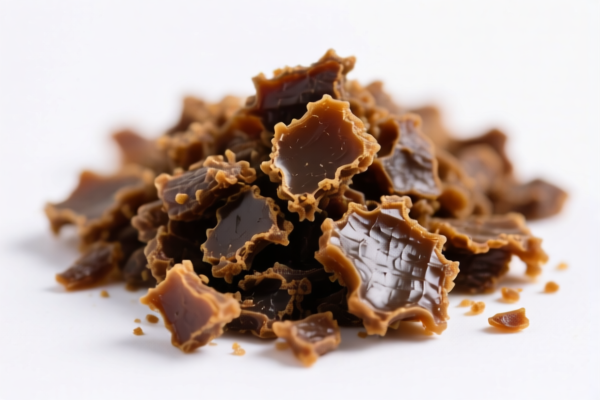
Indenocoumarone Resin (often referred to as ICR or Coumarone-Indene Resin) is a thermoplastic aromatic hydrocarbon resin produced by the polymerization of indene and coumarone (1,2-dihydrobenzofuran) fractions, typically obtained from coal tar distillation or petroleum cracking. It is distinct from simple C5 or C9 hydrocarbon resins due to its higher glass transition temperature ($T_g$), superior heat resistance, and darker color (ranging from amber to black).
In international trade, it is classified primarily as a Polymerized Aromatic Hydrocarbon. The key distinction lies in whether it is a crude polymerization product or a prepared/adhesive formulation.
⚠️ Key Distinction Points:
- Raw Resin: Pure polymerized indene/coumarone mixtures → Classified under 3907 (Primary Forms of Plastics).
- Prepared Adhesives/Glues: If mixed with solvents, tackifiers, or other agents for immediate use as an adhesive → Classified under 3506 (Prepared Glues) or 3305/3307 depending on end-use (e.g., hair care).
- Note: Most bulk industrial exports are "Raw Resin," falling under Chapter 39.
📦 II. HS Code Classification Details (2026 Latest Tariff Authority)
| HS Code | Product Description | Application Scenario | State of Material |
|---|---|---|---|
3907.21.00.00 |
Polyacetals, other primary epoxides, polycarbonates, alkyd resins, polyesters, polyethers, polyacetals, polyphthalates, polycarbonate polyethers, polysulfones, polyarylates, polyimides, polybenzimidazoles, polysiloxanes, polymers of vinyl chloride or of other halogenated olefins, copolymerizations thereof, in primary forms. (Note: Specific subheadings vary by country, but generally falls under "Other Polymers of Vinyl Chloride or other Halogenated Olefins" OR "Other Polymers" depending on specific national tariff lines. In US HTS, Indenocoumarone is often classified under 3907.60 or 3907.90 as "Other Polymers".) |
Bulk industrial resin for adhesives, inks, sealants. | ✅ Raw/Primary Form |
3907.60.00.00 |
Other polymers, in primary forms | The most common classification for Indenocoumarone in many jurisdictions (e.g., US) as it doesn't fit specific vinyl/epoxy/unsaturated polyester categories strictly. | ✅ Raw/Primary Form |
3907.90.00.00 |
Other polymers (if not covered by 3907.60) | Alternative classification if national rules distinguish based on source (coal tar vs. petrochemical). | ✅ Raw/Primary Form |
3506.91.00.00 |
Prepared glues and other prepared adhesives, whether or not on a support; other prepared numbers, for use as books or for similar purposes, whether or not on a support | If sold as a ready-to-use adhesive (mixed with solvents/tackifiers). | ❌ Prepared Mixture |
3824.99.94.00 |
Other chemical products and preparations (non-prescribed) | If sold as a blended additive or modified resin not primarily for plasticization. | ❌ Blended/Modified |
🔍 Critical Reminder:
- Bulk Resin must be declared as3907.60.00.00(or equivalent "Other Polymer") in its primary form (liquid, granules, flakes, powder).
- Do NOT classify ready-to-use glues as raw resin. This is a common error leading to misdeclaration penalties.
- If the resin is dissolved in solvents for immediate shipping (slurry), consult customs: it may be considered a "preparation" (Chapter 38) rather than a "plastic" (Chapter 39).
💰 III. 2026 Latest Tariff Rate Breakdown (Including Surcharges)
✅ Applicable Country: United States (US)
✅ Country of Origin: China (CN)
✅ Effective Date: Post-2025 tariff adjustments (Section 301 & IEEPA)
🎯 1. 3907.60.00.00 —— Indenocoumarone Resin (Other Polymers, Primary Forms)
| Item | Content |
|---|---|
| Base Tariff Rate | 5.3% (Ad Valorem, General Rate) |
| USITC Supplementary Tariff | +25% (Section 301 List 4A - Specific to certain plastics/resins) |
| IEEPA Supplementary Tariff | +10% (针对中国产品,自2025年11月10日起生效) |
| Total Effective Rate | ~40.3% |
| Tax Calculation | CIF Value × 40.3% |
| De Minimis Eligibility | ❌ Not Eligible (Deny De Minimis for Section 301 goods) |
| Legal Basis Path | USITC:3907.60.00.00 → SECTION301:FOOTNOTE.4A → IEEPA:9903.01.24 |
📌 Explanation:
- Base Rate (5.3%): Standard MFN rate for "Other Polymers."
- Section 301 (25%): Many hydrocarbon resins are subject to the 25% tariff under List 4A due to China's export dominance.
- IEEPA (10%): Additional surcharge under the International Emergency Economic Powers Act for Chinese-origin goods.
- Total Impact: A $100,000 shipment incurs ~$40,300 in duties alone. Cost optimization is critical.
🎯 2. 3506.91.00.00 —— Prepared Adhesives (If applicable)
| Item | Content |
|---|---|
| Base Tariff Rate | 5.7% |
| USITC Supplementary Tariff | 0% (Many adhesives are exempt from Section 301) |
| IEEPA Supplementary Tariff | +10% (Still applies to CN origin) |
| Total Effective Rate | ~15.7% |
| Tax Calculation | CIF Value × 15.7% |
| De Minimis Eligibility | ❌ Not Eligible (If Section 301 applies, but often exempt) |
| Legal Basis Path | USITC:3506.91.00.00 → IEEPA:9901.25 |
📌 Strategic Insight:
- If the product is pre-mixed as an adhesive, the total tariff drops significantly (from ~40% to ~16%).
- Risk: Must prove the product is a "prepared glue" and not a raw resin being sold in bulk. Customs may challenge this if packaged in large industrial drums without solvent evidence.
🛠️ IV. Clearance Practical Advice (Pitfall Avoidance Guide)
✅ 1. Required Documentation Checklist (Mandatory)
| Document | Must Provide | Description |
|---|---|---|
| ✅ MSDS / SDS | ✔️ | Critical. Must indicate flammability, flash point, and composition. Indenocoumarone can be hazardous. |
| ✅ Product Specification Sheet | ✔️ | Include molecular weight range, $T_g$, softening point, and color. |
| ✅ Production Process Description | ✔️ | Clarify if it is "coal tar derived" or "petrochemical derived." |
| ✅ Commercial Invoice | ✔️ | Clearly state "Indenocoumarone Resin, Primary Form, Not Prepared Adhesive." |
| ✅ Bill of Lading | ✔️ | Ensure cargo weight matches invoice. |
| ✅ Certificate of Origin | ✔️ | Essential for applying/rebutting Section 301 tariffs. |
| ✅ FSC (Freight Security Declaration) | ✔️ | For US Customs. |
✅ 2. Declaration Strategy (Key Mnemonics)
🔥 "Raw Form is 39, Glue is 35; Don't Mix, Or You'll Pay 40!"
| Scenario | Correct Declaration | Wrong Action | Consequence |
|---|---|---|---|
| Bulk resin in drums/ton bags | 3907.60.00.00 (Raw Resin) |
Declaring as "Adhesive" | Penalty for Misclassification; potential audit |
| Pre-mixed glue in tubes/jars | 3506.91.00.00 (Prepared Glue) |
Declaring as "Resin" | Underpayment of Duty if resin rate is higher, or Overpayment if glue rate is lower (but risky) |
| Resin dissolved in Solvent | 3824.99.94.00 (Chemical Prep) |
Declaring as "Plastic" | Wrong Chapter; requires different HS and potentially different tariffs |
| Coal Tar Derived Resin | 3907.60.00.00 |
Not specifying origin | No Issue, but must declare CN origin for tariff calc |
✅ 3. Special Case Handling
| Situation | Handling Advice |
|---|---|
| OEM Private Label | Provide contract with US buyer. Ensure description matches generic "Indenocoumarone Resin." |
| High-Viscosity Liquid vs. Solid Flakes | Both fall under 3907.60.00.00 as "Primary Forms." No distinction in HS code. |
| Recycled/Black Resin | If heavily contaminated or mixed with non-resin debris, may fall under 3824.99.94.00. Ensure purity >90%. |
| Sample Shipments | Still subject to duties. Do not use "Gift" or "Sample" to evade taxes unless value is truly negligible (under $800 for de minimis, but IEEPA denies this for CN). |
🌍 V. Global Market Clearance Comparison (2026 Latest)
| Country/Region | Recommended HS Code | Tariff Rate | Certification Requirements | Notes |
|---|---|---|---|---|
| 🇺🇸 USA | 3907.60.00.00 |
~40.3% | FDA (if food contact), MSDS | High tariff due to Section 301. |
| 🇨🇳 China | 3907.60.00.00 |
6.5% | None | Import duty is moderate. |
| 🇪🇺 EU | 3907.60.00.00 |
6.5% | REACH Registration (ECHA) | REACH compliance is mandatory. Must appoint an Only Representative if no EU entity. |
| 🇦🇺 Australia | 3907.60.00.00 |
5% | none | Low tariff. |
| 🇯🇵 Japan | 3907.60.00.00 |
4.0% | PRTR Reporting | Low tariff, but strict environmental reporting. |
| 🇮🇳 India | 3907.60.00.00 |
7.5% | BIS (if applicable) | Variable duties; check latest ITC-HS. |
📌 Conclusion:
- USA is the most expensive market due to Section 301 + IEEPA.
- EU requires REACH registration, which is a high compliance barrier but low tariff.
- Asia offers competitive tariffs.
- Strategy: For US market, consider duty drawback or substantial transformation in a third country (e.g., Vietnam, Thailand) if feasible, though "Resin" is hard to transform without physical change.
📌 VI. Common Mistakes & Pitfall Guide (Blood & Tears Lessons)
❌ Mistake 1: Declaring "Indenocoumarone" as "Coumarone-Indene Rubber" under 4002 (Rubber)
👉 Consequence: Wrong HS Code. It is a thermoplastic resin, not an elastomer/rubber. Duty may be different, and penalties apply.
❌ Mistake 2: Ignoring REACH for EU shipments
👉 Consequence: Goods held at customs, fined, or returned. REACH registration is required for substances >1 ton/year.
❌ Mistake 3: Mixing "Raw Resin" with "Solvents" and declaring as "Resin"
👉 Consequence: Customs may classify as 3824 (Chemical Preparation) and charge different duties + require additional environmental permits.
❌ Mistake 4: Under-declaring Value to avoid 40% US Tariff
👉 Consequence: Fraud. Heavy fines, seizure, and potential criminal charges under US CBP regulations.
✅ Correct Practice:
"Indenocoumarone Resin, Primary Form, Coal Tar Derived, HS 3907.60.00.00, MSDS Provided, REACH Compliant (for EU)"
🎯 VII. Conclusion: Precision in Declaration, Savings in Cost!
🎯 Remember Mnemonic:
🔹 "Resin is 39, Glue is 35; Solvent Mix is 38."
🔹 "US Tariff is High, Check 301; EU Needs REACH, Don't Delay."
🔹 "MSDS is Key, Flammability Matters; Clear Description Saves Dollars."
📌 Pro Tip:
- If shipping to the USA, calculate the total landed cost with the ~40% tariff.
- Consider HTSUS Subheading 3907.60.50 or similar specific national sub-codes if they offer lower rates (e.g., if produced in a Free Trade Agreement country).
- For EU, ensure your Only Representative (OR) has updated the REACH registration for Indenocoumarone Resin before shipment.
📣 Immediate Action:
📞 Contact your Freight Forwarder + Provide MSDS + Verify REACH status
🚀 Ensure smooth clearance, avoid delays, and maximize profit margins!
✨ Professional Clearance Starts with Accurate Classification!
💼 Every Dollar of Duty Saved is Pure Profit!
Customer Reviews
About HS Code Classification
The Harmonized System (HS) is an internationally standardized nomenclature developed by the World Customs Organization (WCO) to classify traded products. Over 200 countries use the HS system as the basis for customs tariffs, trade statistics, and import/export regulations.
Each HS code follows a hierarchical structure:
- Chapter (2 digits) — Broad category of goods (e.g., Chapter 84: Machinery and Mechanical Appliances)
- Heading (4 digits) — More specific grouping within the chapter
- Subheading (6 digits) — Internationally standardized breakdown, used by all WCO member countries
- National subdivisions (8-10 digits) — Country-specific extensions for further classification, such as US HTSUS 10-digit codes
Correct HS code classification is essential for smooth customs clearance, accurate duty payment, and compliance with trade regulations. Misclassification can lead to customs delays, overpayment of duties, or penalties.
When importing from CN to US, the applicable tariff rates may include:
- Most-Favored-Nation (MFN) rate — The standard duty rate applied to WTO members
- General rate — Applied to countries without trade agreements
- Trade remedy duties — Additional tariffs such as Section 301 (anti-dumping), Section 232 (national security), or countervailing duties
The information provided on this page is for reference purposes only. For official classification, please consult with your local customs authority or a licensed customs broker.