Leather Document Organizer Bag
CN → US| HS Code | Tariff Rate | Origin | Destination | Doc |
|---|---|---|---|---|
| 4202110030 | 43.0% | CN | US | Official Doc |
| 4202110090 | 43.0% | CN | US | Official Doc |
Product Images
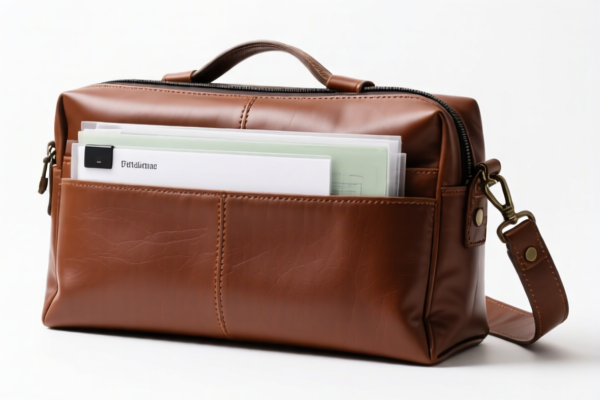
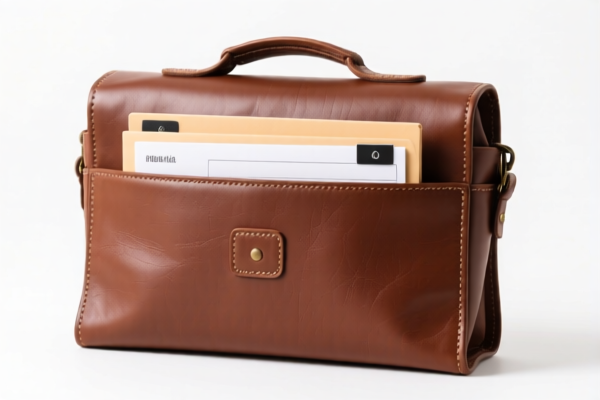
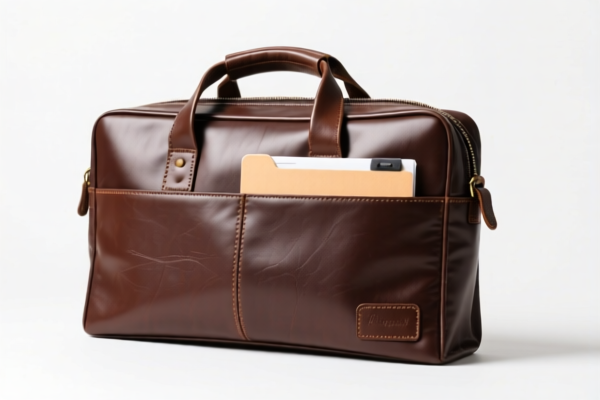
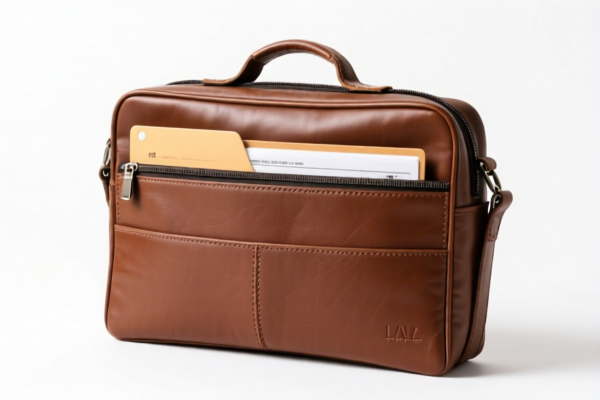
AI Analysis
👜 Leather Document Organizer Bag (Luggage & Handbag Category)
🌐 HS Code Reference & Customs Clearance Guide | 2026 Latest Tariff Analysis | Professional Clearance Strategy 📌 I. Product Definition & Classification: Do You Really Understand "Leather Document Organizers"?
A Leather Document Organizer Bag is a specialized container designed to hold documents, business cards, pens, and other office essentials. In international trade, these items fall under the broad category of "Articles of Luggage" or "Similar Containers."
The classification depends heavily on two factors: 1. Material: Outer surface must be leather or composition leather (as per the provided data). 2. Form/Function: Is it a structured "briefcase-style" container or a "wallet/pouch-style" item?
⚠️ Key Distinction Point: - If the item is structured like a briefcase, attache case, or school satchel (even if used for documents) → Goes to 4202.11.00.30. - If the item is a flat organizer, wallet, or pouch without the rigid structure of a briefcase → Goes to 4202.11.00.90.
📦 II. HS Code Classification Details (2026 Latest Tariff Authority Comparison)
| HS Code | Product Description | Applicable Scenario | Material Requirement | Tax Rate |
|---|---|---|---|---|
4202.11.00.30 |
Attache cases, briefcases, school satchels, occupational luggage cases, and similar containers | Structured document holders, professional briefcase-style organizers, "business carriers" that function as occupational luggage | Outer surface of leather or composition leather | 0.0% |
4202.11.00.90 |
Other (Trunks, suitcases, vanity cases, etc., other than those specified above) | Flat document organizers, wallet-style leather folders, soft-sided document pouches, accessory bags that do not qualify as "occupational luggage cases" | Outer surface of leather or composition leather | 0.0% |
🔍 Critical Reminder: - Both codes fall under the broader category: "Trunks, suitcases... of leather or of composition leather." - The primary differentiator is whether the item is considered an "occupational luggage case" (structured, portable work container) vs. a "similar container" (like a wallet or flat folder). - Both HS Codes listed in the data carry a Total Tax Rate of 0.0%.
💰 III. 2026 Latest Tariff Rate Details (Including Surtax & Policy Add-ons)
✅ Applicable Countries: Data provided indicates general tariff structures. ✅ Origin: Assuming China (CN) based on typical import/export contexts for these goods. ✅ Effective Time: Current standard rates.
🎯 1. 4202.11.00.30 —— Attache Cases, Briefcases, School Satchels, Occupational Luggage Cases
| Item | Content |
|---|---|
| Base Tariff | 0.0% |
| Additional Surtax (e.g., Section 301/IEEPA) | 0.0% (As per provided data) |
| Total Tax Rate | 0.0% |
| Tax Calculation | CIF Value × 0.0% = $0.00 |
| De Minimis Eligibility | ✅ Yes (Generally, low-value shipments may qualify, but verify carrier rules) |
| Legal Basis Path | 4202.11.00.30 → Tax Detail: Base 0.0%, Surtax 0.0% |
📌 Explanation: - This code covers structured leather document containers that are considered "occupational luggage." - Zero Duty makes this highly competitive for business-to-business (B2B) exports. - Note: Always verify if specific country agreements (like USMCA or EU-China agreements) offer preferential rates, though the base rate is already 0%.
🎯 2. 4202.11.00.90 —— Other Leather Containers (Flat Organizers, Pouches, Wallets)
| Item | Content |
|---|---|
| Base Tariff | 0.0% |
| Additional Surtax | 0.0% (As per provided data) |
| Total Tax Rate | 0.0% |
| Tax Calculation | CIF Value × 0.0% = $0.00 |
| De Minimis Eligibility | ✅ Yes (Often eligible for low-value exemptions in many jurisdictions) |
| Legal Basis Path | 4202.11.00.90 → Tax Detail: Base 0.0%, Surtax 0.0% |
📌 Note: - This code is for non-structured or less rigid leather document organizers (e.g., a slim leather folder, a passport holder, a soft document pouch). - Like the previous code, it enjoys a 0% tax rate, simplifying customs clearance significantly.
🛠️ IV. Customs Clearance Practical Advice (Real-World Pitfall Guide)
✅ 1. Essential Documentation Checklist (None Can Be Skipped)
| Document | Required | Explanation |
|---|---|---|
| ✅ Product Specification Sheet | ✔️ | Must clearly state: "Outer Material: Leather/Composition Leather," "Inner Material: Textile/Plastic," "Usage: Document Organizer." |
| ✅ Material Composition Statement | ✔️ | Confirm % of leather vs. synthetic lining. HS 4202.11 specifically requires leather outer surface. |
| ✅ Product Photos (Clear) | ✔️ | Show the item from multiple angles. Does it have handles? Zippers? Rigid structure? Helps customs determine if it's a "briefcase" or "wallet." |
| ✅ Commercial Invoice | ✔️ | Clearly describe as "Leather Document Organizer" or "Leather Briefcase/Attache Case." Avoid vague terms like "Bag." |
| ✅ Packing List | ✔️ | Include quantity, weight, and dimensions. |
| ✅ Certificate of Origin (CO) | ✔️ | May be required to prove eligibility for preferential rates (though base rate is 0%, some countries still require proof). |
✅ 2. Declaration Tips (Key Mantras)
🔥 "Structure Determines Code, Material Determines Chapter, Accuracy Saves Time!"
| Scenario | Correct Declaration | Wrong Practice |
|---|---|---|
| Rigid Document Holder with Handles | 4202.11.00.30 (Attache/Briefcase) |
Declare as "Wallet" → Potential misclassification |
| Slim, Soft Leather Document Sleeve | 4202.11.00.90 (Other) |
Declare as "Briefcase" → Unjustified higher scrutiny |
| Synthetic Leather (PU/PVC) Outer | NOT 4202.11 (Check 4202.21/22/29) | Claim "Leather" when it's Synthetic → Customs Fraud Risk! |
| Textile Outer with Leather Trim | NOT 4202.11 (Check 4202.32/39) | Claim "Leather" when textile is main material → Delay/Refusal |
✅ 3. Special Handling Cases
| Scenario | Handling Advice |
|---|---|
| Leather Mixture | If outer surface is partly leather, partly synthetic, and leather is not the primary material, do NOT use 4202.11. Use textile or plastic codes instead. |
| Gift Items / Samples | Even for samples, declare accurately. Mislabeling as "gift" to avoid taxes is illegal. |
| Wooden/Plastic Frames | If the bag has a rigid plastic or wood frame but the outer surface is still leather, it may still qualify for 4202.11. If the frame is the main structural component, re-evaluate. |
| Branded vs. Generic | Brand does not affect HS Code, but ensure the invoice reflects the true value to avoid under-valuation penalties. |
🌍 V. Global Market Clearance Comparison (2026 Latest)
| Country/Region | Recommended HS Code | Tariff (CN Origin) | Certification | Notes |
|---|---|---|---|---|
| 🇺🇸 USA | 4202.11.00.30 / .90 |
0% | None generally required for leather goods | No Section 301 surtax on leather goods in this category (based on provided data) |
| 🇪🇺 EU | 4202.11.00 |
0% - 4% | CE (if applicable), REACH (chemicals in leather) | Varies by exact subheading; verify local EU Tariff Book |
| 🇨🇳 China | 4202.11.00 |
0% - 10% | CCC (if electronic components inside, e.g., heated wallets) | Standard import duties apply; check FTA benefits if applicable |
| 🇬🇧 UK | 4202.11.00 |
0% - 4% | UKCA (if applicable) | Post-Brexit tariffs may differ; check UK Trade Tariff |
📌 Conclusion: - Leather document organizers generally enjoy low to zero tariffs globally. - Accuracy in material declaration is paramount. Misdeclaring synthetic leather as genuine leather can lead to severe penalties. - Structure matters: Choose between
.30(briefcase-style) and.90(other) based on physical form.
📌 VI. Common Errors & Pitfall Guide (Blood & Tears Lessons)
❌ Error 1: Declaring a PU Leather (Synthetic) bag as "Leather" 👉 Consequence: Customs inspection reveals material mismatch → Fine + Delay + Potential Deportation! 👉 Fix: If outer is PU, use 4202.21.00 (Sheeting of Plastics) or 4202.32 (Textile Materials).
❌ Error 2: Using "Bag" as a generic description 👉 Consequence: Customs officer may classify under a higher-duty category due to ambiguity. 👉 Fix: Use specific terms: "Leather Document Organizer," "Leather Attache Case," "Leather Wallet."
❌ Error 3: Ignoring the "Outer Surface" requirement 👉 Consequence: If the bag is mostly textile with a leather flap, it might not qualify for 4202.11. 👉 Fix: Ensure >50% of outer surface is leather to safely use 4202.11.
✅ Correct Declaration Example:
"Men's Genuine Leather Document Organizer, Soft-Sided, with Zipper Closure, Interior Fabric Lining, Model: DOC-01, No Electronic Components"
🎯 VII. Conclusion: Professional Declaration, Time-Saving, Cost-Effective!
🎯 Remember the Mantra:
🔹 "Leather Outer = 4202.11; Structure Defines .30 or .90; Zero Duty if Accurate!" 🔹 "HS Code is Life; Tax is Zero; Mistake is Costly!"
📌 Pro Tip: If your product is 100% Genuine Leather, ensure you have a Material Test Report from a certified lab (e.g., SGS, Intertek) to prove the outer surface is indeed leather. This speeds up customs clearance significantly.
📣 Immediate Action:
📞 Contact your freight forwarder with Product Photos and Material Specs 🚀 Clear Customs Smoothly, Export Efficiently, Maximize Profit!
✨ Professional Clearance Starts with Accurate Classification! 💼 Your Every Cent of Cost Deserves Precise Calculation!
Customer Reviews
About HS Code Classification
The Harmonized System (HS) is an internationally standardized nomenclature developed by the World Customs Organization (WCO) to classify traded products. Over 200 countries use the HS system as the basis for customs tariffs, trade statistics, and import/export regulations.
Each HS code follows a hierarchical structure:
- Chapter (2 digits) — Broad category of goods (e.g., Chapter 84: Machinery and Mechanical Appliances)
- Heading (4 digits) — More specific grouping within the chapter
- Subheading (6 digits) — Internationally standardized breakdown, used by all WCO member countries
- National subdivisions (8-10 digits) — Country-specific extensions for further classification, such as US HTSUS 10-digit codes
Correct HS code classification is essential for smooth customs clearance, accurate duty payment, and compliance with trade regulations. Misclassification can lead to customs delays, overpayment of duties, or penalties.
When importing from CN to US, the applicable tariff rates may include:
- Most-Favored-Nation (MFN) rate — The standard duty rate applied to WTO members
- General rate — Applied to countries without trade agreements
- Trade remedy duties — Additional tariffs such as Section 301 (anti-dumping), Section 232 (national security), or countervailing duties
The information provided on this page is for reference purposes only. For official classification, please consult with your local customs authority or a licensed customs broker.