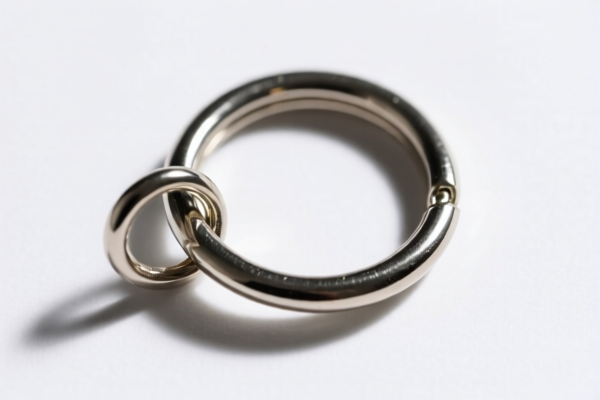
Open Counting Ring
CN → US| HS Code | Tariff Rate | Origin | Destination | Doc |
|---|---|---|---|---|
| 8308100000 | 0.0% | CN | US | Official Doc |
| 7326908688 | 87.9% | CN | US | Official Doc |
| 9606308000 | 41.0% | CN | US | Official Doc |
| 7326190080 | 87.9% | CN | US | Official Doc |
Product Images



AI Analysis
🔗 Open Counting Rings (Metal Snap Rings / E-Rings)
🌐 HS Code Reference & Customs Clearance Guide | 2026 Latest Tariff Analysis | Professional Entry Strategies
📌 Part 1: Product Definition & Classification: What Exactly is an "Open Counting Ring"?
In international trade, an "Open Counting Ring" is a generic term often referring to Open Snap Rings, E-Rings, or Retaining Rings. These are C-shaped or circular metal rings with an open gap, used primarily to secure components on shafts or in housings.
However, because they can serve different functions, customs authorities classify them differently based on Material, Function, and Specific Use. Misclassification is the #1 cause of duty shocks.
⚠️ Key Distinction Points:
- Are they fasteners? → Likely HS 8308.10 (Hooks, eyes, buttons, snap fasteners, etc.).
- Are they generic iron/steel parts? → Likely HS 7326.90 or HS 7326.19 (General articles of iron/steel).
- Are they used specifically for buttons/clothing accessories? → Likely HS 9606.30 (Button-like articles).
📦 Part 2: HS Code Classification Matrix (2026 Latest Tariff Alignment)
| HS Code | Product Description (Customs Definition) | Applicable Scenario | Total Tax Rate (China→US) |
|---|---|---|---|
8308.10.00.00 |
Metal Open Counting Rings: Classed as hooks, eyes, buttons, or snap fasteners. | Used as decorative or functional fasteners in fashion, bags, or hardware; classified under "accessories of base metal." | 1.1¢/kg + 2.9% + 35.0% |
7326.90.86.88 |
Metal Open Rings: Specifically Iron/Steel, classified as "Other articles of iron or steel." | Generic industrial retaining rings, not specifically for clothing/fasteners; general steel hardware. | 87.9% |
9606.30.80.00 |
Metal Open Rings: Classified under "Buttons, press-fasteners" as metal ring-shaped parts. | Used as components for buttons or snap-fasteners in garments; niche classification for button accessories. | 41.0% |
7326.19.00.80 |
Metal Open Rings: Classified as "Other articles of iron or steel" (non-specific use). | Similar to 7326.90 but under a different sub-heading for general steel articles not elsewhere specified. | 87.9% |
🔍 Critical Warning:
- HS 8308.10 is the most favorable for rings classified as "fasteners/accessories" if they fit the definition of hooks/eyes/snap fasteners.
- HS 7326.xxxx (Iron/Steel) incurs massive additional tariffs (50% for steel/aluminum/copper under Section 122/301) + base tariffs, resulting in ~87.9% total.
- HS 9606.30 is a middle-ground, but only if the ring is explicitly part of a button assembly.
💰 Part 3: 2026 Tariff Breakdown (Detailed Tax Clauses)
✅ Applicable Country: United States (US)
✅ Origin: China (CN)
✅ Effective Date: Ongoing (Subject to USITC & USTR rulings)
🎯 1. 8308.10.00.00 —— Metal Open Counting Rings (Fastener Category)
| Item | Detail |
|---|---|
| Base Duty | 2.9% (ad valorem) |
| Section 301 Tariff | +25.0% |
| Section 122 Tariff | +10.0% |
| Per Kg Surcharge | 1.1¢/kg (Specific duty) |
| Total Effective Rate | ~38.0% + 1.1¢/kg (Depending on value vs. weight) |
| Tax Calculation | (CIF Value × 38.0%) + (Weight in kg × $0.011) |
| De Minimis Exemption | ❌ Not Eligible (Deny de minimis) |
| Legal Basis | USITC:8308.10.00.00 → Section 301: Footnote 9903.88.01 → Section 122 |
📌 Explanation:
- This classification benefits from being viewed as "fasteners" rather than "steel articles."
- Note: The 1.1¢/kg is a specific duty added on top of the ad valorem percentage. For lightweight, high-value rings, this is negligible. For heavy, low-value rings, it adds up.
🎯 2. 7326.90.86.88 & 7326.19.00.80 —— Iron/Steel Articles (High Risk)
| Item | Detail |
|---|---|
| Base Duty | 2.9% |
| Section 301 Tariff | +25.0% |
| Section 122 Tariff | +10.0% |
| Steel/Aluminum/Copper Surcharge | +50.0% (Under specific USITC rulings for steel/aluminum/copper products) |
| Total Effective Rate | 87.9% |
| Tax Calculation | CIF Value × 87.9% |
| De Minimis Exemption | ❌ Not Eligible |
| Legal Basis | USITC:7326.90.86.88 / 7326.19.00.80 → Section 301 → Section 122 → Steel Surcharge (50%) |
📌 Explanation:
- These codes are classified as generic steel/iron articles.
- The 50% additional tariff is the killer here. It applies to many steel articles under current US trade policies.
- Result: Nearly double-digit percentage tax. Avoid if possible.
🎯 3. 9606.30.80.00 —— Button-Like Metal Rings
| Item | Detail |
|---|---|
| Base Duty | 6.0% |
| Section 301 Tariff | +25.0% |
| Section 122 Tariff | +10.0% |
| Total Effective Rate | 41.0% |
| Tax Calculation | CIF Value × 41.0% |
| De Minimis Exemption | ❌ Not Eligible |
| Legal Basis | USITC:9606.30.80.00 → Section 301 → Section 122 |
📌 Explanation:
- Only applicable if the ring is integral to a button or snap-fastener assembly.
- Higher base duty (6%) than HS 8308, but avoids the 50% steel surcharge.
- A viable alternative if HS 8308.10 is rejected by customs.
🛠️ Part 4: Customs Clearance Practical Advice (Avoiding Pitfalls)
✅ 1. Documentation Checklist (Must-Haves)
| Document | Required? | Notes |
|---|---|---|
| Product Specifications | ✔️ | Include material (e.g., "Stainless Steel 304"), dimensions, and function. |
| Function Declaration | ✔️ | Clearly state: "Used as a fastener/accessory," NOT "General steel part." |
| Photos | ✔️ | Show the ring installed on a shaft or in a garment to prove use case. |
| Material Cert | ✔️ | Prove material composition to avoid "unknown metal" classification. |
| Commercial Invoice | ✔️ | Use precise description: "Metal Snap Ring, Fastener Accessory, Stainless Steel." |
✅ 2. Declaration Strategy (Key Mnemonic)
🔥 "Declare Fastener, Not Steel! Use 'Hook/Eye' Language!"
| Scenario | Correct Declaration | Wrong Declaration |
|---|---|---|
| Metal ring for clothing/bags | "Metal Snap Fastener / Hook & Eye Accessory" |
"Steel Ring" or "Iron Hardware" |
| Metal ring for machinery | "Retaining Ring, Stainless Steel, Fastener Component" |
"Steel Article, General Use" |
| Button component | "Metal Ring for Press-Snap Button" |
"Metal Part" |
📌 Why it matters:
- If you say "Steel Article," customs may assign HS 7326 → 87.9% tax.
- If you say "Fastener/Hook/Eye," customs may assign HS 8308 → ~38% tax.
- Savings: Up to 50% difference in duty!
✅ 3. Special Cases
| Case | Handling Advice |
|---|---|
| Stainless Steel Rings | Emphasize "Fastener" function. Stainless steel is still subject to 301/122 if misclassified as general steel. |
| Plastic-Coated Rings | May fall under HS 3926 (Plastic articles) or HS 8308 depending on primary material. Check coating thickness. |
| OEM/Custom Sizes | Provide engineering drawings. Custom sizes do NOT change classification, but prove specific use. |
| Large Volumes | Consider Advance Ruling from CBP to lock in HS 8308.10 and avoid post-audit penalties. |
🌍 Part 5: Global Market Comparison (2026)
| Market | Recommended HS Code | Est. Total Duty (China Origin) | Notes |
|---|---|---|---|
| 🇺🇸 USA | 8308.10.00.00 |
~38.0% + 1.1¢/kg | Avoid HS 7326 (87.9%)! |
| 🇪🇺 EU | 7318.29.00 (Retaining Rings) |
1.7% | Much lower duties in EU if correctly classified as retaining rings. |
| 🇨🇳 China | 7318.29.00 |
0% (Import Duty) | Low barrier for entry into China. |
| 🇬🇧 UK | 7318.29.00 |
1.7% | Post-Brexit, aligned with old EU rates for this category. |
📌 Key Insight:
- USA is the hardest market due to Section 301 and Section 122 tariffs.
- EU/UK have simpler, lower tariffs for retaining rings if classified correctly.
📌 Part 6: Common Errors & Pitfalls (Blood Lessons)
❌ Error 1: Declaring as "Steel Wire Ring" or "Iron Hardware"
👉 Consequence: Customs assigns HS 7326 → 87.9% duty.
👉 Fix: Change description to "Fastener Accessory" or "Snap Ring for Clothing/Bag".
❌ Error 2: Using vague terms like "Metal Part" or "Ring"
👉 Consequence: CBP has discretion to assign the highest applicable duty rate.
👉 Fix: Be specific. Use "Hook and Eye," "Snap Fastener," or "Retaining Ring."
❌ Error 3: Ignoring the 1.1¢/kg surcharge in HS 8308
👉 Consequence: For low-value, heavy rings (e.g., large industrial retaining rings), the per-kg fee can spike costs.
👉 Fix: Calculate total landed cost including specific duties.
✅ Best Practice:
"Open Counting Ring, Stainless Steel, Fastener Accessory, Model XYZ, For Use in Garments/Bags"
🎯 Part 7: Conclusion: Precision Saves Money!
🎯 Remember the Golden Rule:
🔹 "Fastener = 38% | Steel Part = 88% | Button Part = 41%"
🔹 "Don't let 'Steel' drive your duty to 87.9%!"
📌 Pro Tip:
- If your rings are large industrial retaining rings, try to argue they are "Parts of Machines" (if applicable) or stick to HS 8308 if they function as fasteners.
- Always request a CBP Advance Ruling for high-volume imports to secure the lower HS 8308.10 classification.
📣 Action Step:
📞 Contact a Customs Broker today.
📄 Submit Product Photos + Function Description.
🚀 Secure HS 8308.10.00.00 and save ~50% in duties!
✨ Accurate Classification is Your Best Profit Protector!
💼 Every cent saved in duty is pure margin!
Customer Reviews
About HS Code Classification
The Harmonized System (HS) is an internationally standardized nomenclature developed by the World Customs Organization (WCO) to classify traded products. Over 200 countries use the HS system as the basis for customs tariffs, trade statistics, and import/export regulations.
Each HS code follows a hierarchical structure:
- Chapter (2 digits) — Broad category of goods (e.g., Chapter 84: Machinery and Mechanical Appliances)
- Heading (4 digits) — More specific grouping within the chapter
- Subheading (6 digits) — Internationally standardized breakdown, used by all WCO member countries
- National subdivisions (8-10 digits) — Country-specific extensions for further classification, such as US HTSUS 10-digit codes
Correct HS code classification is essential for smooth customs clearance, accurate duty payment, and compliance with trade regulations. Misclassification can lead to customs delays, overpayment of duties, or penalties.
When importing from CN to US, the applicable tariff rates may include:
- Most-Favored-Nation (MFN) rate — The standard duty rate applied to WTO members
- General rate — Applied to countries without trade agreements
- Trade remedy duties — Additional tariffs such as Section 301 (anti-dumping), Section 232 (national security), or countervailing duties
The information provided on this page is for reference purposes only. For official classification, please consult with your local customs authority or a licensed customs broker.