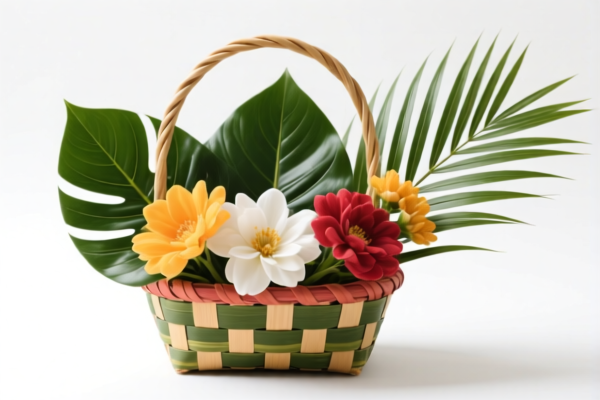
Palm Leaf Flower Basket
CN → US| HS Code | Tariff Rate | Origin | Destination | Doc |
|---|---|---|---|---|
| 1404904000 | 37.3% | CN | US | Official Doc |
| 4601922000 | 41.6% | CN | US | Official Doc |
| 4602191600 | 40.0% | CN | US | Official Doc |
| 1404909090 | 35.0% | CN | US | Official Doc |
| 4602191400 | 35.0% | CN | US | Official Doc |
Product Images



AI Analysis
🌿 Palm Leaf Flower Basket (Handwoven Baskets & Plant Fiber Products)
🌐 HS Code Reference & Customs Clearance Guide | 2026 Latest Tariff Analysis | Professional Entry Strategy
📌 I. Product Definition & Classification: What Exactly Is a "Palm Leaf Basket"?
In international trade, "Palm Leaf Flower Basket" is a broad term that can encompass raw materials, semi-finished weaving materials, or finished woven goods. The correct HS Code depends strictly on the level of processing and the specific product form:
- Raw/Mastered Plant Fibers: If the palm leaves are merely cleaned, dried, or softened but not yet woven into a structured basket.
- Classification: Vegetable products / Plant fibers not further worked than cleaned, bleached, dyed, etc.
- Weaving Materials: If the palm leaves are processed into strips, strips, or mats suitable for weaving, but not yet formed into a specific container shape.
- Classification: Woven fabric/plant materials.
- Finished Woven Goods: If the palm leaves are interwoven into a specific basket shape (with or without handles, lids, or linings).
- Classification: Articles of wickerwork, basketry, or plaits.
⚠️ Key Distinction:
- If it is just loose leaves or raw strips → Go to Chapter 14.
- If it is finished woven structure (basket shape) → Go to Chapter 46 or 4602.
- Note: The classification significantly impacts the duty rate due to Section 301 and IEEPA tariffs.
📦 II. HS Code Classification Details (2026 Latest Tariff Authority Comparison)
Based on the provided data, here is the breakdown of how "Palm Leaf Flower Basket" can be classified depending on its specific manufacturing stage and description:
| HS Code | Product Description | Application Scenario | Tax Profile |
|---|---|---|---|
1404.90.40.00 |
Palm leaf material, classified as plant fiber products | Raw, cleaned, or softened palm leaves; not yet woven | 🌿 37.3% Total Tax |
4601.92.20.00 |
Palm leaf woven制品, classified as other woven material products | Woven mats, panels, or semi-finished weaving materials | 🧶 41.6% Total Tax |
4602.19.16.00 |
Palm leaf basket, meets material and product category definition | Finished woven baskets, specific use defined | 🧺 40.0% Total Tax |
1404.90.90.90 |
Palm leaf plant product, classified as other plant products | Raw or minimally processed palm leaf parts not fitting other subheadings | 🌱 35.0% Total Tax |
4602.19.14.00 |
Palm leaf basket, meets material and product type requirements | Finished woven baskets, general classification | 🧺 35.0% Total Tax |
🔍 Critical Insight:
- Chapter 14 (1404.xx) covers plant fibers/products (raw/semi-raw).
- Chapter 46 (4601/4602) covers woven products/articles (finished processed goods).
- Why the tax difference? Woven goods (Ch 46) often have higher base duties but specific sub-headings may offer lower rates depending on exact definition. Raw materials (Ch 14) have lower base duties but still face high附加 tariffs.
💰 III. 2026 Latest Tariff Rate Details (Including Additional Taxes, Policy Add-ons)
✅ Applicable Country: United States (US)
✅ Origin: China (CN)
✅ Effective Date: 2025年11月10日起 (and subsequent imports)
🎯 1. 1404.90.90.90 —— Palm Leaf Plant Product (Other Plant Products)
Best for: Raw or minimally processed palm leaves.
| Item | Content |
|---|---|
| Base Duty Rate | 0.0% (Ad Valorem) |
| Section 301 Additional Duty | +25.0% |
| 122-Clause Duty | +10.0% |
| Total Tax Rate | 35.0% |
| Tax Calculation | CIF Value × 35.0% |
| De Minimis Exemption | ❌ Not Available (Deny De Minimis for CN origin under current rules) |
| Legal Basis Path | Section 301 → 122-Clause → HS:1404.90.90.90 |
📌 Explanation:
- Base Duty 0%: Raw plant products often have low base duties.
- 25% Section 301: Standard US tariff on Chinese goods under Trade Act of 1974 Section 301.
- 10% 122-Clause: Specific additional duty imposed on certain Chinese imports.
- Total 35%: Still the lowest total tax rate in the list, making it attractive if the product qualifies as "other plant product."
🎯 2. 4602.19.14.00 —— Palm Leaf Basket (Product Type Requirement Met)
Best for: Finished woven baskets meeting specific type criteria.
| Item | Content |
|---|---|
| Base Duty Rate | 0.0% (Ad Valorem) |
| Section 301 Additional Duty | +25.0% |
| 122-Clause Duty | +10.0% |
| Total Tax Rate | 35.0% |
| Tax Calculation | CIF Value × 35.0% |
| De Minimis Exemption | ❌ Not Available |
| Legal Basis Path | Section 301 → 122-Clause → HS:4602.19.14.00 |
📌 Explanation:
- Interestingly, this finished product has the same total tax rate (35%) as the raw material1404.90.90.90.
- This occurs because both have 0% base duty under this specific tariff structure.
- Crucial: You must prove the item is a "basket" meeting the definition for4602.19.14.00to avoid being reclassified to a higher-tax woven category.
🎯 3. 4602.19.16.00 —— Palm Leaf Basket (Material & Category Defined)
Best for: Finished baskets with specific material/category definition.
| Item | Content |
|---|---|
| Base Duty Rate | 5.0% (Ad Valorem) |
| Section 301 Additional Duty | +25.0% |
| 122-Clause Duty | +10.0% |
| Total Tax Rate | 40.0% |
| Tax Calculation | CIF Value × 40.0% |
| De Minimis Exemption | ❌ Not Available |
| Legal Basis Path | Section 301 → 122-Clause → HS:4602.19.16.00 |
📌 Note:
- Higher base duty (5%) leads to a higher total rate.
- Only choose if4602.19.14.00is not applicable due to specific product features.
🎯 4. 1404.90.40.00 —— Palm Leaf Material (Plant Fiber Products)
Best for: Processed plant fibers.
| Item | Content |
|---|---|
| Base Duty Rate | 2.3% (Ad Valorem) |
| Section 301 Additional Duty | +25.0% |
| 122-Clause Duty | +10.0% |
| Total Tax Rate | 37.3% |
| Tax Calculation | CIF Value × 37.3% |
| De Minimis Exemption | ❌ Not Available |
| Legal Basis Path | Section 301 → 122-Clause → HS:1404.90.40.00 |
📌 Note:
- Base duty is 2.3%, leading to a 37.3% total rate.
- Suitable if the product is clearly "plant fiber" but not a finished basket.
🎯 5. 4601.92.20.00 —— Palm Leaf Woven Product (Other Woven Materials)
Best for: Semi-finished woven mats/panels.
| Item | Content |
|---|---|
| Base Duty Rate | 6.6% (Ad Valorem) |
| Section 301 Additional Duty | +25.0% |
| 122-Clause Duty | +10.0% |
| Total Tax Rate | 41.6% |
| Tax Calculation | CIF Value × 41.6% |
| De Minimis Exemption | ❌ Not Available |
| Legal Basis Path | Section 301 → 122-Clause → HS:4601.92.20.00 |
📌 Note:
- Highest tax rate in the list.
- Avoid unless the product is explicitly a woven material and not a finished basket.
🛠️ IV. Customs Clearance Practical Advice (Battle-Tested Pitfall Avoidance Guide)
✅ 1. Preparation Checklist (All Required)
| Document | Mandatory | Notes |
|---|---|---|
| ✅ Product Specifications | ✔️ | Include dimensions, weaving density, material type (e.g., Areca palm, Betel palm). |
| ✅ Product Photos (Clear) | ✔️ | Show the entire basket, weave pattern, and any handles/lids. |
| ✅ Commercial Invoice | ✔️ | Clearly state "Palm Leaf Woven Basket" or "Palm Leaf Material" based on classification. |
| ✅ Packing List | ✔️ | Detail packaging to prevent damage claims and verify quantity. |
| ✅ Origin Certificate | ✔️ | Critical for verifying CN origin and applying correct 301/122 clauses. |
| ✅ Supply Chain Declaration | ✔️ | Confirm all palm leaves are from China to avoid misclassification risks. |
✅ 2. Declaration Strategy (Key Mantra)
🔥 "Raw = Ch 14, Woven = Ch 46, Finish = 4602, Declare Accurately!"
| Scenario | Correct Declaration | Wrong Practice |
|---|---|---|
| Finished Woven Basket | 4602.19.14.00 (35%) or 4602.19.16.00 (40%) |
Misdeclare as raw material → Risk of penalty & back taxes. |
| Raw/Softened Leaves | 1404.90.90.90 (35%) |
Misdeclare as woven → Higher duty risk if inspected. |
| Woven Mat/Panel | 4601.92.20.00 (41.6%) |
Misdeclare as basket → Classification error. |
| Mixed Shipment | Split invoices per HS Code | Lump together → Customs rejection or audit. |
📌 Key Tip:
- If the basket has lining, handles, or metal reinforcements, it may still be4602but could face stricter scrutiny.
- If it is purely palm leaf, emphasize "Natural Fiber" and "Handwoven" in description.
✅ 3. Special Cases Handling
| Scenario | Recommendation |
|---|---|
| Decorative vs. Functional | Both fall under 4602 if woven. Describe usage clearly (e.g., "Flower Arrangement Holder"). |
| Mixed Materials | If basket has plastic lining or metal handle, still likely 4602 but base duty may vary. Check HTSUS notes. |
| Small Sample Shipments | No De Minimis exemption for CN origin under current 301/122 rules. Pay full 35-41.6%. |
| Pre-Cutting/Pre-Weaving | If shipped as strips for customer to weave → Use 1404 or 4601. If fully woven → Use 4602. |
🌍 V. Global Market Comparison (2026 Latest)
| Country/Region | Recommended HS Code | Total Tariff (CN Origin) | Notes |
|---|---|---|---|
| 🇺🇸 United States | 4602.19.14.00 / 1404.90.90.90 |
35.0% | Lowest among options. 301 + 122 clauses apply. |
| 🇪🇺 European Union | 4602.19 |
~6-12% | No Section 301. Base duty only. |
| 🇨🇳 China | 4602.19 |
~5-10% | Import duty varies. Domestic consumption may have different rates. |
| 🇬🇧 United Kingdom | 4602.19 |
~6% | Post-Brexit tariff. No 301 equivalent. |
| 🇨🇦 Canada | 4602.19 |
~0-5% | Check CUSMA eligibility if applicable. |
📌 Conclusion:
- USA is the most costly market due to additional punitive tariffs.
- Total tax of 35% is relatively favorable compared to other woven goods (41.6%), so aim for4602.19.14.00or1404.90.90.90.
📌 VI. Common Mistakes & Pitfalls (Lessons Learned)
❌ Mistake 1: Declaring a finished basket as "Plant Fiber" (1404.xx) to avoid "Woven" classification.
👉 Consequence: Customs inspection reveals woven structure → Reclassification to 4602 → Possible penalties.
❌ Mistake 2: Using vague descriptions like "Eco-friendly Basket".
👉 Consequence: Customs cannot determine material → Delayed clearance, request for additional info.
❌ Mistake 3: Ignoring 122-Clause Duties.
👉 Consequence: Underpayment of taxes → Audit & Back Taxes + Interest.
❌ Mistake 4: Assuming De Minimis applies.
👉 Consequence: Small packages from CN are NOT exempt under current 301/122 rules.
✅ Correct Practice:
"Palm Leaf Woven Flower Basket, Natural Color, Handmade, Dimensions: 10x8 inches, No Linings, Model PLB-01"
🎯 VII. Conclusion: Professional Declaration, Cost Savings!
🎯 Remember the Mantra:
🔹 "Raw = 35%, Woven Basket = 35%, Woven Material = 41.6%, Finish Basket = 40%."
🔹 "Aim for4602.19.14.00or1404.90.90.90for 35% Total Tax."
🔹 "301 + 122 = 35-41.6%. Plan Ahead!"
📌 Pro Tip:
- If you have large volume shipments, consider Advance Rulings from US CBP to lock in the HS Code and tariff rate.
- For small businesses, ensure your customs broker is aware of the 35% vs 41.6% difference — choosing the right subheading can save 6.6% on CIF value.
📣 Immediate Action:
📞 Contact your customs broker + Provide product photos + Apply for HS Code Advance Ruling
🚀 Ensure your Palm Leaf Flower Basket clears smoothly with optimized taxes!
✨ Professional Clearance Starts with Accurate Classification!
💼 Every Percent Saved Counts!
Customer Reviews
About HS Code Classification
The Harmonized System (HS) is an internationally standardized nomenclature developed by the World Customs Organization (WCO) to classify traded products. Over 200 countries use the HS system as the basis for customs tariffs, trade statistics, and import/export regulations.
Each HS code follows a hierarchical structure:
- Chapter (2 digits) — Broad category of goods (e.g., Chapter 84: Machinery and Mechanical Appliances)
- Heading (4 digits) — More specific grouping within the chapter
- Subheading (6 digits) — Internationally standardized breakdown, used by all WCO member countries
- National subdivisions (8-10 digits) — Country-specific extensions for further classification, such as US HTSUS 10-digit codes
Correct HS code classification is essential for smooth customs clearance, accurate duty payment, and compliance with trade regulations. Misclassification can lead to customs delays, overpayment of duties, or penalties.
When importing from CN to US, the applicable tariff rates may include:
- Most-Favored-Nation (MFN) rate — The standard duty rate applied to WTO members
- General rate — Applied to countries without trade agreements
- Trade remedy duties — Additional tariffs such as Section 301 (anti-dumping), Section 232 (national security), or countervailing duties
The information provided on this page is for reference purposes only. For official classification, please consult with your local customs authority or a licensed customs broker.