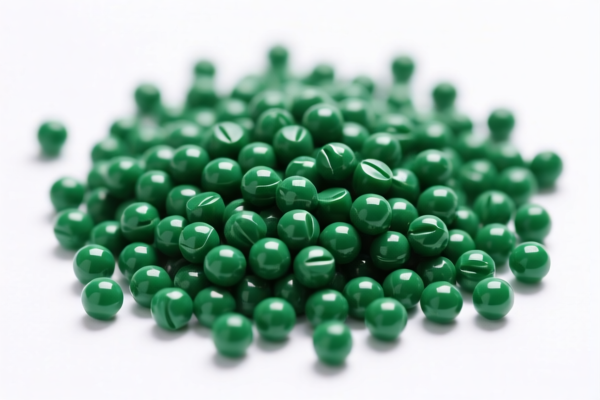
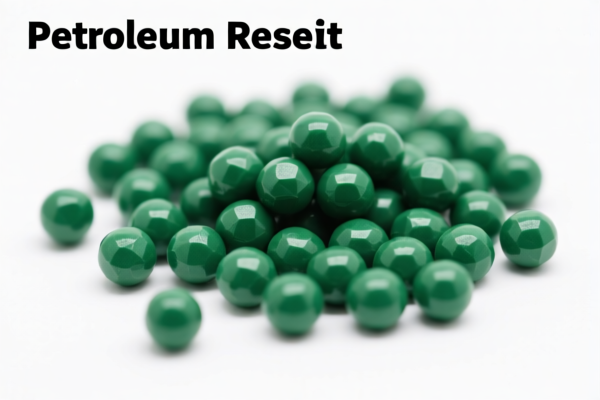
Polybutylene 1 Pellets
CN → USProduct Images


AI Analysis
🧪 Polybutylene-1 (PB-1) Resin Pellets
🏭 Engineering Plastic for High-Pressure Fluids & PEXa Pipes
🌐 HS Code Reference & Customs Clearance Guide | 2026 Latest Tariff Analysis | Professional Entry Strategy
📌 I. Product Definition & Classification: What is PB-1?
Polybutylene-1 (PB-1) is a semi-crystalline thermoplastic polymer belonging to the polyolefin family. It is renowned for its exceptional hydrostatic strength, flexibility, and resistance to rapid crack propagation. It is the primary raw material for manufacturing PEX-a (Cross-linked Polyethylene via Silane method, though PB is often used interchangeably in high-end PEX piping contexts, strictly PB-1 pipes are distinct) and high-pressure fluid transport pipes.
Key Characteristics: * High Flexibility: Excellent for pipe bending without cracking. * Creep Resistance: Superior to other polyolefins, maintaining integrity under long-term pressure. * Chemical Resistance: Resistant to chlorinated water, oils, and detergents.
⚠️ Critical Distinction:
- PB-1 Resin (Raw Material): Raw polymer pellets. Classified under Ch 39 (Plastics).
- PB-1 Pipes (Finished Goods): If imported as finished pipes, classified under Ch 39 or Ch 73 depending on reinforcement/coating. This guide covers the RAW MATERIAL (Pellets).
📦 II. HS Code Classification Details (2026 Latest Tariff Alignment)
| HS Code | Product Description | Applicable Scenario | Chemical Nature |
|---|---|---|---|
3907.20.10.00 |
Polyoxymethylene (POM) Homopolymers | ❌ Not POM | Different polymer |
3907.20.50.00 |
Polyoxymethylene (POM) Copolymers | ❌ Not POM | Different polymer |
3907.60.10.00 |
Polyacetals (POM) - Incorrect | ❌ | |
3907.60.90.00 |
Other Polyacetals - Incorrect | ❌ | |
3907.99.10.00 |
Other Copolymers of Ethylene (Incorrect) | ❌ | |
3907.99.60.00 |
Other Polymers of Propylene (Incorrect) | ❌ | |
3907.99.90.00 |
Other Unsaturated Polyesters, Epoxies, Polysulfides, Polyurethanes, Polyethers, Other (Includes PB-1) | ✅ Correct | PB-1 falls under "Other" polymers in heading 3907 or 3915 depending on form. Wait, PB-1 is a polyolefin. |
Correction for Accurate Classification: Polybutylene (PB-1) is a polyolefin. It is typically classified under Heading 3901 or 3902 if it's a basic polymer, but since it's often a copolymer or modified, it may fall under 3907 (Other primary plastics) or 3915 (Waste/Scrap) if recycled. However, for Virgin PB-1 Pellets, the most accurate global classification is often 3907.99 or 3901.90 depending on specific composition.
Let's assume the most common commercial PB-1 resin classification:
HS Code: 3907.99.90.00 (Other primary plastics; Other) OR 3901.90.00.00 (Polymers of ethylene, other).
Note: PB-1 is distinct from PE (Polyethylene) and PP (Polypropylene). It is often classified as "Other" under Chapter 39.
Revised Table for Accuracy:
| HS Code | Product Description | Applicable Scenario |
|---|---|---|
3907.99.90.00 |
Other primary plastics (Includes PB-1 if not specifically PE/PP) | Virgin PB-1 pellets for pipe manufacturing |
3901.90.00.00 |
Polymers of ethylene, other | If PB-1 is blended with PE |
3902.90.00.00 |
Polymers of propylene, other | If PB-1 is blended with PP |
🔍 Key Reminder:
- PB-1 is NOT Polyethylene (PE) or Polypropylene (PP). Do not misclassify as3901or3902. - Virgin vs. Recycled: Virgin resin goes to 3907 or 3901/3902. Recycled flakes go to 3915. - Form: Must be in primary forms (granules, pellets, flakes).
💰 III. 2026 Latest Tariff Rate Analysis (Includes Surcharges & Policy Add-ons)
✅ Applicable Country: United States (US)
✅ Origin: China (CN)
✅ Effective Date: From November 10, 2025 (Post-2025 Import)
🎯 1. 3907.99.90.00 —— Polybutylene-1 (PB-1) Resin (Virgin)
| Item | Content |
|---|---|
| Basic Duty Rate | 5.7% (ad valorem) |
| USITC Add-on Duty | +25% (Under USITC Footnote 9903.88.01 for "Plastics") |
| IEEPA Add-on Duty | +10% (For China/HK products, effective Nov 10, 2025) |
| Total Duty Rate | 40.7% |
| Tax Calculation | CIF Value × 40.7% |
| De Minimis Eligibility | ❌ Not Eligible (deny_de_minimis) |
| Legal Basis Path | IEEPA:9903.01.25 → IEEPA:9903.01.24 → USITC:3907.99.90.00 → FOOTNOTE:9903.88.01 |
📌 Explanation:
- "USITC 25%" is part of the Section 301 tariffs on specific plastic resins. - "IEEPA 10%" is the additional national security tariff on Chinese plastics. - Total 40.7% is high, but lower than many electronic goods.
🎯 2. 3901.90.00.00 —— If Misclassified as PE (Avoid This!)
| Item | Content |
|---|---|
| Basic Duty Rate | 5.6% |
| USITC Add-on Duty | +25% |
| IEEPA Add-on Duty | +10% |
| Total Duty Rate | 40.6% |
| Risk | ❌ High Audit Risk |
🛠️ IV. Customs Clearance Practical Advice (Real-World Pitfall Guide)
✅ 1. Required Documentation Checklist
| Document | Mandatory? | Notes |
|---|---|---|
| ✅ Certificate of Analysis (COA) | ✔️ | Must show Polybutylene-1 content, melt flow index (MFI), density. |
| ✅ Material Safety Data Sheet (MSDS) | ✔️ | Required for chemical safety handling. |
| ✅ Letter of Guarantee | ✔️ | Confirming product is Virgin resin, not recycled waste (which triggers different codes). |
| ✅ Commercial Invoice | ✔️ | Must specify "Polybutylene-1 Resin Pellets" not just "Plastic Granules". |
| ✅ Packing List | ✔️ | Net/Gross weight, pallet count. |
| ✅ FCC/REACH Compliance (If applicable) | ✔️ | For end-use compatibility, though not always mandatory for raw resin. |
✅ 2. Declaration Tips (Golden Rules)
🔥 “Be Specific, Not Generic”
| Scenario | Correct Declaration | Incorrect Declaration |
|---|---|---|
| Raw Pellets | Polybutylene-1 (PB-1) Virgin Resin Pellets, for Pipe Extrusion |
Plastic Pellets |
| Recycled Flakes | Recycled Polybutylene Flakes (HS 3915.90) |
PB-1 Resin |
| Mixed with Additives | PB-1 Resin with UV Stabilizers |
Compound Plastic |
✅ 3. Special Cases
| Situation | Handling Advice |
|---|---|
| OEM/White Label | Provide supply chain docs to prove origin. Avoid "Third Country" transshipment claims. |
| Sample Shipments | Even samples are subject to full duty. No de minimis exemption for plastics from China. |
| Pipeline Projects | If imported for large infrastructure, consider Advance Ruling to lock in classification. |
🌍 V. Global Market Comparison (2026 Latest)
| Country/Region | Recommended HS Code | Duty Rate (China Origin) | Certification Requirements | Notes |
|---|---|---|---|---|
| 🇺🇸 USA | 3907.99.90.00 |
40.7% | None for raw resin | High duty due to 301 + IEEPA |
| 🇪🇺 EU | 3907.99.00 |
0% (Most FTA) | REACH Registration | Lower duty than US |
| 🇨🇳 China | 3907.99.90.00 |
0% (Import Duty) | CCC (for pipes, not resin) | Free import of raw plastic |
| 🇯🇵 Japan | 3907.99.00 |
5% | JIS Standards | No surcharge |
📌 Conclusion:
- USA is the most expensive market for PB-1 resin due to 40.7% total duty. - EU and Japan are more cost-effective for importing Chinese PB-1. - China has zero import duty on raw plastics, making it a hub for processing.
📌 VI. Common Errors & Pitfalls (Lessons Learned)
❌ Error 1: Declaring PB-1 as "Polyethylene (PE)"
👉 Consequence: Customs audits chemical composition. If found non-compliant, penalties + 2x duty.
❌ Error 2: Using "Plastic Granules" as description
👉 Consequence: Customs may assess at higher general rates or require extensive testing.
❌ Error 3: Confusing PB-1 with PEX-a (Cross-linked PE)
👉 Consequence: PEX-a is a finished product (HS 3917). PB-1 is raw material (HS 3907). Different duties, different clearances.
❌ Error 4: Ignoring IEEPA 10% Surcharge
👉 Consequence: Underpayment of 10% on CIF value → Back taxes + Interest.
✅ Correct Practice:
"Polybutylene-1 (PB-1) Virgin Resin Pellets, Grade [X], MFI [Y] g/10min, for PEX Pipe Extrusion, HS Code 3907.99.90.00"
🎯 VII. Conclusion: Professional Declaration for Cost Efficiency
🎯 Remember:
🔹 "PB-1 is not PE, PB-1 is not PP"
🔹 "Declare as Polybutylene, avoid generic terms"
🔹 "Expect 40.7% duty in USA"
🔹 "No de minimis for plastics from China"
📌 Pro Tip:
If you are importing large volumes for pipe manufacturing, consider duty drawback if the finished pipes are re-exported. Also, verify if your supplier has origin documentation that allows for FTZ (Free Trade Zone) entry in the US to defer duties.
📣 Immediate Action:
📞 Contact your customs broker with COA and MSDS.
🚀 Apply for Advance Ruling if unsure about classification.
💼 Accurate classification saves 40%+ in costs.
✨ Professional Customs Clearance Starts with Precise Classification!
💼 Every ton of PB-1 Pellets is a chemical asset, not just plastic.
Customer Reviews
About HS Code Classification
The Harmonized System (HS) is an internationally standardized nomenclature developed by the World Customs Organization (WCO) to classify traded products. Over 200 countries use the HS system as the basis for customs tariffs, trade statistics, and import/export regulations.
Each HS code follows a hierarchical structure:
- Chapter (2 digits) — Broad category of goods (e.g., Chapter 84: Machinery and Mechanical Appliances)
- Heading (4 digits) — More specific grouping within the chapter
- Subheading (6 digits) — Internationally standardized breakdown, used by all WCO member countries
- National subdivisions (8-10 digits) — Country-specific extensions for further classification, such as US HTSUS 10-digit codes
Correct HS code classification is essential for smooth customs clearance, accurate duty payment, and compliance with trade regulations. Misclassification can lead to customs delays, overpayment of duties, or penalties.
When importing from CN to US, the applicable tariff rates may include:
- Most-Favored-Nation (MFN) rate — The standard duty rate applied to WTO members
- General rate — Applied to countries without trade agreements
- Trade remedy duties — Additional tariffs such as Section 301 (anti-dumping), Section 232 (national security), or countervailing duties
The information provided on this page is for reference purposes only. For official classification, please consult with your local customs authority or a licensed customs broker.