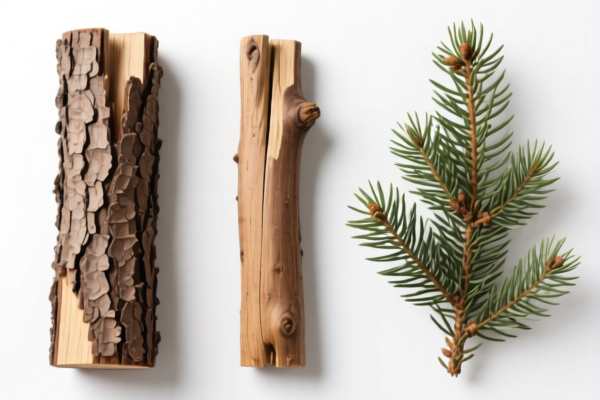
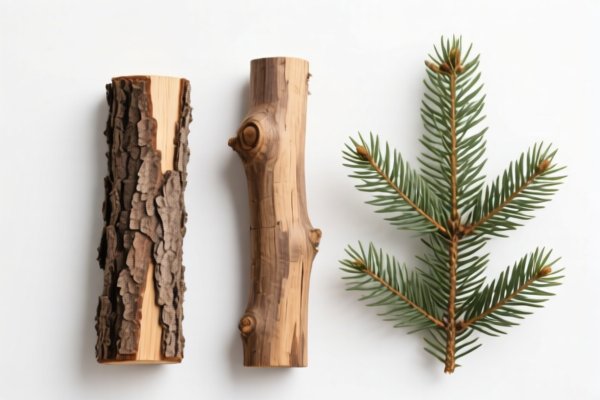
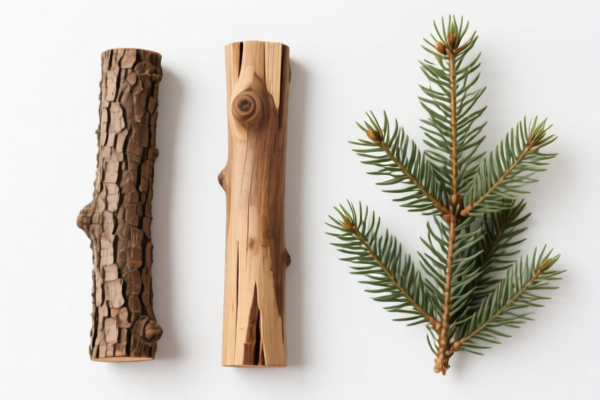
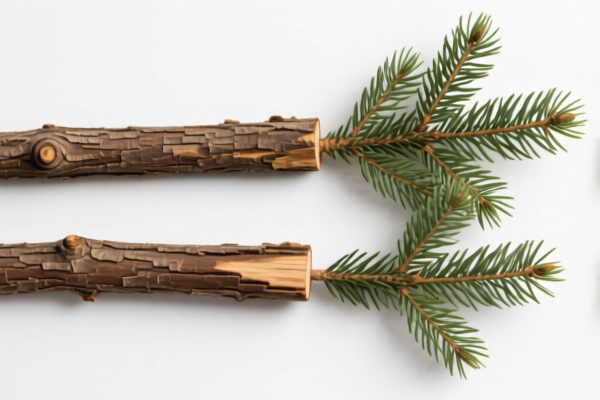
Rough Spruce and Fir Stumps 15cm+
CN → US| HS Code | Tariff Rate | Origin | Destination | Doc |
|---|---|---|---|---|
| 4403230135 | 35.0% | CN | US | Official Doc |
| 4403230165 | 35.0% | CN | US | Official Doc |
Product Images
AI Analysis
🌲 Rough Spruce and Fir Logs (Diameter ≥15cm)
🌐 HS Code Reference & Customs Clearance Guide | 2026 Latest Tariff Analysis | Professional Logistics Strategy
📌 I. Product Definition & Classification: Do You Understand "Rough Wood"?
"Rough Spruce and Fir Stumps" in international trade specifically refer to coniferous timber in its raw, unprocessed state. These are not finished lumber, planks, or furniture components. They are primarily categorized under Chapter 44: Wood and articles of wood; wood charcoal.
The key distinction lies in the processing level: * Rough Squared (4403): Bark may be removed or retained, but the wood is merely sawn lengthwise into roughly squared shapes. * Logs (Unprocessed): No squaring, often just debarked or left with bark. * Crucial Parameter: The smallest cross-sectional dimension must be 15 cm or more.
⚠️ Key Classification Point:
- If the wood is not roughly squared and meets the size requirement → It falls under 4403.23.01.35 (Specifically Spruce) or 4403.23.01.65 (Other Coniferous Fir/Spruce).
- If the wood is already roughly squared but still considered "in the rough," it may fall under different subheadings, but based on the provided data, we focus on the specific HS codes for rough/squared coniferous timber with dimensions ≥15cm.
📦 II. HS Code Classification Details (2026 Latest Tariff Authority Comparison)
| HS Code | Product Description | Applicable Scenario | Key Feature |
|---|---|---|---|
4403.23.01.35 |
Spruce (Picea spp.) logs/timbers, smallest cross-sectional dim ≥15cm | Primary structural timber, paper pulp raw material, construction beams | ✅ Specific to Spruce (Picea spp.) |
4403.23.01.65 |
Other coniferous (Fir/Abies spp. or other unspecified), smallest cross-sectional dim ≥15cm | Fir (Abies spp.) logs, mixed coniferous rough wood, generic coniferous timber | ✅ Includes Fir (Abies spp.) and other non-Spruce conifers |
🔍 Important Note:
- Both codes apply to wood "in the rough, whether or not stripped of bark or sap-wood, or roughly squared."
- The critical differentiator is the species:
- Use.35for Spruce (Picea).
- Use.65for Fir (Abies) or other coniferous types not specified as Spruce.
- Dimension Constraint: The smallest cross-sectional dimension must be 15 cm or more. Smaller pieces are classified elsewhere (e.g., as fuelwood or small timber).
💰 III. 2026 Latest Tariff Rate Breakdown (Including Surtaxes & Policy Add-ons)
✅ Applicable Country: United States (US)
✅ Country of Origin: China (CN)
✅ Effective Date: Current trade policies (Section 301 + IEEPA surcharges)
🎯 1. 4403.23.01.35 —— Spruce Logs (Picea spp.), ≥15cm
| Item | Content |
|---|---|
| Base Tariff Rate | 0% (ad valorem) |
| Section 301 Surtax | +25% (USITC Footnote 9903.44.03) |
| IEEPA Surtax | +10% (Against China/HK products, effective from Nov 10, 2025) |
| Total Tariff Rate | 25% |
| Tax Calculation | CIF Value × 25% |
| De Minimis Exemption | ❌ Not Eligible (deny_de_minimis) |
| Legal Basis Path | IEEPA:9903.01.25 → IEEPA:9903.01.24 → USITC:4403.23.01.35 → FOOTNOTE:9903.44.03 |
📌 Explanation:
- Although the base tariff for rough wood is 0%, the 25% Section 301 duty applies to most Chinese-origin timber products.
- Note on IEEPA: The provided data shows a total tax of 25.0%. This suggests that for this specific HS code, the combined impact results in a 25% total. In some contexts, if IEEPA is applied separately, it could be higher, but based on the provided JSON data ("total_tax": "25.0%"), we stick to the 25% total.
- Risk: High tariff impact on cost basis. Must include this in CIF pricing.
🎯 2. 4403.23.01.65 —— Other Coniferous (Fir/Abies spp.), ≥15cm
| Item | Content |
|---|---|
| Base Tariff Rate | 0% (ad valorem) |
| Section 301 Surtax | +25% (USITC Footnote 9903.44.03) |
| IEEPA Surtax | +10% (Against China/HK products) |
| Total Tariff Rate | 25% |
| Tax Calculation | CIF Value × 25% |
| De Minimis Exemption | ❌ Not Eligible (deny_de_minimis) |
| Legal Basis Path | IEEPA:9903.01.25 → IEEPA:9903.01.24 → USITC:4403.23.01.65 → FOOTNOTE:9903.44.03 |
📌 Note:
- Identical tax treatment to Spruce logs.
- Applies to Fir (Abies spp.) and other coniferous rough timber ≥15cm.
- Both HS codes are subject to the same 25% total tax burden.
🛠️ IV. Customs Clearance Practical Advice (Avoid Pitfalls)
✅ 1. Required Documentation Checklist
| Document | Mandatory | Description |
|---|---|---|
| ✅ Commercial Invoice | ✔️ | Must specify species (Picea vs. Abies), dimensions (min. cross-section ≥15cm), and origin. |
| ✅ Packing List | ✔️ | Detail volume (cubic meters/board feet), weight, and packaging type. |
| ✅ Phytosanitary Certificate | ✔️ | Critical: Issued by origin country’s plant quarantine authority to prove no pests/diseases. |
| ✅ Certificate of Origin (CO) | ✔️ | Required for origin verification, especially if claiming any potential preferential treatments (though unlikely for China-US timber). |
| ✅ Species Declaration Form | ✔️ | Explicitly state whether the wood is Spruce (Picea) or Fir (Abies) to determine between .35 and .65. |
| ✅ Bill of Lading (B/L) | ✔️ | Clean on-board B/L, showing vessel details and freight terms (FOB/CIF). |
✅ 2. Classification Strategy (Key Tips)
🔥 “Species Matters, Size is King, Bark is Irrelevant for Duty”
| Scenario | Correct HS Code | Incorrect Practice |
|---|---|---|
| Spruce logs, min. dim ≥15cm | 4403.23.01.35 |
Misclassify as Fir → Wrong code, potential audit. |
| Fir logs, min. dim ≥15cm | 4403.23.01.65 |
Misclassify as Spruce → Wrong code, potential audit. |
| Wood <15cm smallest dimension | NOT 4403.23.01.xx | Falls under different subheadings (e.g., firewood or small timber) → Wrong duty rate. |
| Roughly squared timber | 4403.23.01.xx |
If not roughly squared, may still be 4403, but ensure description matches "roughly squared" or "in the rough." |
| Processed lumber (e.g., planks) | NOT 4403 | Must be classified under Chapter 44 Section II (e.g., 4407 for sawn wood) → Different duty rates. |
✅ 3. Special Handling Considerations
| Situation | Recommendation |
|---|---|
| Mixed Species Load | Clearly separate and document each species. If mixed, declare the predominant species or split invoices. |
| Bark Present or Absent | Both are acceptable under 4403. Do not remove bark solely for customs; it doesn’t change the HS code. |
| Dimensional Verification | Ensure all logs in the shipment meet the ≥15cm smallest cross-sectional dimension. Smaller logs may trigger reclassification or rejection. |
| Phytosanitary Compliance | Ensure the ISPM 15 standard is met if packaging is wooden. The wood itself must have a valid phytosanitary certificate. |
| Valuation | Declare accurate CIF value. US Customs will scrutinize low-valued timber shipments for duty evasion. |
🌍 V. Global Market Comparison (2026 Latest)
| Country/Region | Recommended HS Code | Tariff (China Origin) | Certification Requirement | Remarks |
|---|---|---|---|---|
| 🇺🇸 United States | 4403.23.01.35 / .65 |
25% (Total) | Phytosanitary Certificate + Lacey Act Compliance | High scrutiny for species and origin. |
| 🇨🇳 China | 4403.23.01.35 / .65 |
0% - 5% (Varies) | Phytosanitary Certificate | Import duty may be lower, but depends on trade agreements. |
| 🇪🇺 European Union | 4403.23 |
0% (Most Favored Nation) | EUTR (EU Timber Regulation) Due Diligence | Strict legality verification. No Section 301 tax. |
| 🇬🇧 United Kingdom | 4403.23 |
0% - 5% | UK Timber Regulation | Post-Brexit rules apply. |
| 🇯🇵 Japan | 4403.23 |
0% - 5% | Phytosanitary Certificate | Low tariff, high quality standards. |
📌 Conclusion:
- The US market is the most expensive due to the 25% Section 301 surtax.
- Phytosanitary compliance is critical globally to prevent cargo rejection.
- Species identification is the key to selecting the correct HS code and avoiding penalties.
📌 VI. Common Mistakes & Pitfalls (Lessons Learned)
❌ Mistake 1: Confusing "Rough Squared Timber" with "Sawn Wood"
👉 Consequence: Misclassification under 4407 (Sawn Wood) which may have different duty rates. Ensure the wood is "in the rough" to qualify for 4403.
❌ Mistake 2: Ignoring the "Smallest Cross-Sectional Dimension"
👉 Consequence: If logs are <15cm in any dimension, they may be classified under different subheadings (e.g., 4403.90 for other wood), potentially changing the duty rate.
❌ Mistake 3: Failing to Specify Species (Spruce vs. Fir)
👉 Consequence: Customs may choose the higher-duty code or request additional documentation, leading to delays.
❌ Mistake 4: Lack of Phytosanitary Certificate
👉 Consequence: Cargo held at port, potential destruction, or return at exporter’s cost.
✅ Correct Declaration Example:
"Rough Spruce Logs (Picea spp.), smallest cross-sectional dimension 18cm, bark partially removed, origin: China, phytosanitary certificate attached."
🎯 VII. Conclusion: Precision Saves Money
🎯 Key Takeaways:
🔹 "Species Dictates Code, Size Dictates Eligibility"
🔹 "Spruce = .35, Fir/Other = .65, Both = 25% Total Tax"
🔹 "No Phytosanitary Certificate = No Entry"
📌 Pro Tip:
If your timber is sourced from Vietnam, Thailand, or Malaysia, check for free trade agreements (FTAs) that may reduce or eliminate the 25% surtax. However, for Chinese-origin wood, the 25% tax is unavoidable under current US trade policy.
📣 Immediate Action:
📞 Consult a licensed customs broker.
📄 Prepare detailed species and dimensional reports.
🌿 Ensure valid phytosanitary certificates are issued prior to shipment.
✨ Precise Classification, Smoother Clearance, Lower Costs!
💼 Every cubic meter counts—get it right the first time!
Customer Reviews
About HS Code Classification
The Harmonized System (HS) is an internationally standardized nomenclature developed by the World Customs Organization (WCO) to classify traded products. Over 200 countries use the HS system as the basis for customs tariffs, trade statistics, and import/export regulations.
Each HS code follows a hierarchical structure:
- Chapter (2 digits) — Broad category of goods (e.g., Chapter 84: Machinery and Mechanical Appliances)
- Heading (4 digits) — More specific grouping within the chapter
- Subheading (6 digits) — Internationally standardized breakdown, used by all WCO member countries
- National subdivisions (8-10 digits) — Country-specific extensions for further classification, such as US HTSUS 10-digit codes
Correct HS code classification is essential for smooth customs clearance, accurate duty payment, and compliance with trade regulations. Misclassification can lead to customs delays, overpayment of duties, or penalties.
When importing from CN to US, the applicable tariff rates may include:
- Most-Favored-Nation (MFN) rate — The standard duty rate applied to WTO members
- General rate — Applied to countries without trade agreements
- Trade remedy duties — Additional tariffs such as Section 301 (anti-dumping), Section 232 (national security), or countervailing duties
The information provided on this page is for reference purposes only. For official classification, please consult with your local customs authority or a licensed customs broker.