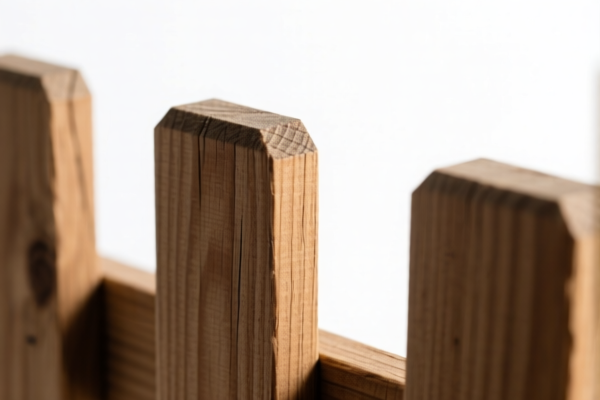
Rough Square Wooden Fence Post
CN → US| HS Code | Tariff Rate | Origin | Destination | Doc |
|---|---|---|---|---|
| 4407190055 | 35.0% | CN | US | Official Doc |
| 4407190056 | 35.0% | CN | US | Official Doc |
Product Images



AI Analysis
🪵 Rough Square Wooden Fence Post (Douglas-fir)
🌐 HS Code Reference & Customs Clearance Guide | 2026 Latest Tariff Analysis | Professional Entry Strategy
📌 1. Product Definition and Classification: Is it Wood or Just a Post?
Rough square wooden fence posts, specifically those made of Douglas-fir (Pseudotsuga menziesii), fall under the broader category of "Wood sawn or chipped lengthwise... of a thickness exceeding 6 mm." In international trade, these are classified as sawn wood products, not manufactured furniture or construction assemblies, because they are processed primarily by sawing/planing without complex joining or painting.
Key Distinction:
- Rough/Unfinished: Planed or sanded but not treated (no pressure treatment, preservatives, or paint).
- Coniferous: Specifically Douglas-fir, a common softwood for fencing.
- Size Matters: The minimum dimension (width or thickness) determines the specific subheading.
⚠️ Critical Differentiator:
- If the wood is treated (e.g., with creosote or copper azole), it may fall under different codes (e.g., 4407.19.00.30).
- If the wood is not treated and rough/squared, it falls under 4407.19.00.55 or 4407.19.00.56, depending on size.
- Do not classify as "fence posts" under chapter 44 if they are merely sawn wood; the description must reflect the sawn wood nature.
📦 2. HS Code Classification Details (2026 Latest Tariff Authority Comparison)
| HS Code | Product Description | Size Criteria | Treatment Status |
|---|---|---|---|
4407.19.00.55 |
Rough Douglas-fir Sawed Wood | Min dimension ≥5.1 cm and <12.7 cm | Not Treated |
4407.19.00.56 |
Rough Douglas-fir Sawed Wood | Min dimension ≥12.7 cm | Not Treated |
🔍 Important Note:
- Both codes apply to Douglas-fir (Pseudotsuga menziesii).
- "Rough" implies the wood is planed or sanded but not further processed into finished goods (like decking or beams).
- If the post is treated (e.g., for ground contact), it does NOT fit these codes. It would likely fall under4407.19.00.30(Treated).
- If the wood is not Douglas-fir (e.g., Pine, Spruce), different subcodes under 4407.19 apply.
💰 3. 2026 Latest Tariff Rate Breakdown (Including Supplementary Duties)
✅ Applicable Country: United States (US)
✅ Country of Origin: China (CN)
✅ Effective Date: November 10, 2025 (and onwards)
🎯 1. 4407.19.00.55 — Rough Douglas-fir, Min Dim 5.1cm – 12.7cm (Not Treated)
| Item | Details |
|---|---|
| Base Duty Rate | 0.0% (Most Favored Nation rate) |
| Section 301 Supplementary Duty | +25.0% |
| Total Tariff Rate | 25.0% |
| Tax Calculation | CIF Value × 25% |
| De Minimis Eligibility | ❌ Not Eligible (Valued goods subject to Section 301 do not qualify for de minimis exemption if >$800, but even if <800, Section 301 may apply depending on enforcement; however, typically Section 301 applies to all imports from China regardless of value unless specifically exempted. Note: As of 2025, Section 301 applies broadly.) |
| Legal Basis | USITC:4407.19.00.55 → Section 301: Footnote 9903.88.01 |
📌 Explanation:
- The 0% base rate reflects the MFN tariff for unprocessed/semi-processed coniferous wood.
- The 25% additional duty is imposed under Section 301 of the Trade Act of 1974, targeting Chinese-origin goods.
- Total cost impact: 25% of the declared value.
🎯 2. 4407.19.00.56 — Rough Douglas-fir, Min Dim ≥12.7cm (Not Treated)
| Item | Details |
|---|---|
| Base Duty Rate | 0.0% |
| Section 301 Supplementary Duty | +25.0% |
| Total Tariff Rate | 25.0% |
| Tax Calculation | CIF Value × 25% |
| De Minimis Eligibility | ❌ Not Eligible |
| Legal Basis | USITC:4407.19.00.56 → Section 301: Footnote 9903.88.01 |
📌 Note:
- Identical tax treatment as4407.19.00.55.
- Size does not affect the tariff rate for this category.
🛠️ 4. Customs Clearance Practical Advice (Field Pitfall Avoidance Guide)
✅ 1. Required Documentation Checklist (No Exceptions)
| Document | Required | Explanation |
|---|---|---|
| ✅ Commercial Invoice | ✔️ | Must clearly state: "Rough Square Douglas-fir Fence Post," dimensions, volume, and value. |
| ✅ Packing List | ✔️ | Detail number of posts per bundle, total bundles, gross/net weight. |
| ✅ Species Declaration | ✔️ | Explicitly state: Pseudotsuga menziesii (Douglas-fir). Misidentification can lead to misclassification. |
| ✅ Treatment Certificate | ✔️ | Confirm NO chemical treatment (creosote, copper, etc.) if claiming "Not Treated." |
| ✅ Fumigation Certificate | ✔️ | Required for all wood products entering the US to prevent pest infestation (ISPM 15 compliant if packaging is wood). |
| ✅ Bill of Lading/Air Waybill | ✔️ | Standard shipping document. |
✅ 2. Declaration Tips (Key Mnemonic)
🔥 "Size Dictates Code, Treatment Blocks Entry, Name Must Match!"
| Scenario | Correct HS Code | Wrong Practice |
|---|---|---|
| Post <12.7cm min dim, untreated | 4407.19.00.55 |
Use 4407.19.00.56 → Overpayment risk or audit flag |
| Post ≥12.7cm min dim, untreated | 4407.19.00.56 |
Use 4407.19.00.55 → Incorrect size classification |
| Post is TREATED (e.g., green-tinted) | NOT 4407.19.00.55/56 | Use 4407.19.00.55/56 → Seizure risk! Must use treated wood code (e.g., 4407.19.00.30) |
| Post is not Douglas-fir (e.g., Pine) | Different Code | Use 4407.19.00.55 → Misdeclaration, penalties |
✅ 3. Special Cases Handling
| Case | Recommendation |
|---|---|
| Mixed Sizes in Shipment | If shipment contains both <12.7cm and ≥12.7cm posts, you MUST split the declaration into two HS codes (4407.19.00.55 and 4407.19.00.56) based on value/quantity. Do not average them. |
| End-Jointed Posts | If posts are glued/lengthened, they may still fall under 4407 if the primary character is sawn wood. Ensure the description says "End-Jointed Douglas-fir" to avoid being classified as engineered wood (Chapter 44 or 47). |
| Fumigation Issue | Without an ISPM 15 fumigation certificate, customs may refuse entry or require re-export at your cost. |
| Value Declaration | Ensure CIF value includes freight and insurance. Under-declaring value can lead to severe penalties under Section 301 calculations. |
🌍 5. Global Market Comparison (2026 Latest)
| Country/Region | Recommended HS Code | Tariff Rate | Certification | Remarks |
|---|---|---|---|---|
| 🇺🇸 USA | 4407.19.00.55 / 4407.19.00.56 |
25% (Section 301) | ISPM 15 | High tariff due to trade tensions. |
| 🇨🇳 China | 4407.19.00.55 / 4407.19.00.56 |
0% (Import duty) | Fumigation | No supplementary duties on imports. |
| 🇪🇺 EU | 4407.19.90 |
2.5% | Fumigation | No Section 301 equivalent. |
| 🇬🇧 UK | 4407.19.90 |
2.5% | Fumigation | Post-Brexit tariffs. |
📌 Conclusion:
- USA is the most expensive market for Chinese-sourced Douglas-fir fence posts due to the 25% Section 301 duty.
- Consider supply chain diversification (e.g., sourcing from Canada or Vietnam) if possible to avoid Section 301, though verify origin rules carefully.
- EU/UK have low base rates but require strict phytosanitary compliance.
📌 6. Common Errors & Pitfalls (Lessons Learned)
❌ Error 1: Declaring "Fence Posts" without specifying "Sawn Wood"
👉 Consequence: Customs may misclassify as manufactured goods (higher duty) or reject for lack of detail.
✅ Fix: Use precise description: "Rough Square Douglas-fir Sawed Wood, Not Treated."
❌ Error 2: Mixing Treated and Untreated Posts in One Declaration
👉 Consequence: Seizure. Treated wood requires different HS codes (e.g., 4407.19.00.30) and may contain hazardous substances.
✅ Fix: Separate shipments or declare with precise treatment status.
❌ Error 3: Ignoring Minimum Dimension Threshold
👉 Consequence: Misclassification between .55 and .56. While tax is same, audit risk increases.
✅ Fix: Measure every batch. If 50% of posts are <12.7cm, declare separately.
❌ Error 4: No Fumigation Certificate
👉 Consequence: Entry Refusal or forced re-export.
✅ Fix: Ensure all wood packaging and the wood itself (if required) are ISPM 15 compliant.
🎯 7. Conclusion: Precise Classification Saves 25%!
🎯 Remember the Mnemonic:
🔹 "Douglas-fir, Rough, Untreated, Size Rules: <12.7cm is .55, ≥12.7cm is .56."
🔹 "25% Tax Looms, Declare Value, Avoid Mislabeling."
🔹 "Treated Wood is a Different Story – Don't Mix Them!"
📌 Pro Tip:
- If your fence posts are pressure-treated (common for ground contact), you MUST use a different HS code (likely 4407.19.00.30), which may have different tax implications.
- For unterminated (untreated) posts, the 25% Section 301 duty is unavoidable for Chinese origin.
- Consider Advance Ruling from US Customs if your shipment has mixed dimensions or complex treatments.
📣 Immediate Action:
📞 Contact your freight forwarder + Provide species certification + Ensure ISPM 15 fumigation.
🚀 Accurate classification = Smooth clearance + Predictable costs!
✨ Professional clearance starts with precise classification!
💼 Every percent of duty counts in your profit margin!
Customer Reviews
About HS Code Classification
The Harmonized System (HS) is an internationally standardized nomenclature developed by the World Customs Organization (WCO) to classify traded products. Over 200 countries use the HS system as the basis for customs tariffs, trade statistics, and import/export regulations.
Each HS code follows a hierarchical structure:
- Chapter (2 digits) — Broad category of goods (e.g., Chapter 84: Machinery and Mechanical Appliances)
- Heading (4 digits) — More specific grouping within the chapter
- Subheading (6 digits) — Internationally standardized breakdown, used by all WCO member countries
- National subdivisions (8-10 digits) — Country-specific extensions for further classification, such as US HTSUS 10-digit codes
Correct HS code classification is essential for smooth customs clearance, accurate duty payment, and compliance with trade regulations. Misclassification can lead to customs delays, overpayment of duties, or penalties.
When importing from CN to US, the applicable tariff rates may include:
- Most-Favored-Nation (MFN) rate — The standard duty rate applied to WTO members
- General rate — Applied to countries without trade agreements
- Trade remedy duties — Additional tariffs such as Section 301 (anti-dumping), Section 232 (national security), or countervailing duties
The information provided on this page is for reference purposes only. For official classification, please consult with your local customs authority or a licensed customs broker.