Wardrobe
CN → US| HS Code | Tariff Rate | Origin | Destination | Doc |
|---|---|---|---|---|
| 9403509080 | 35.0% | CN | US | Official Doc |
| 9403608093 | 35.0% | CN | US | Official Doc |
| 9403994080 | 35.0% | CN | US | Official Doc |
Product Images
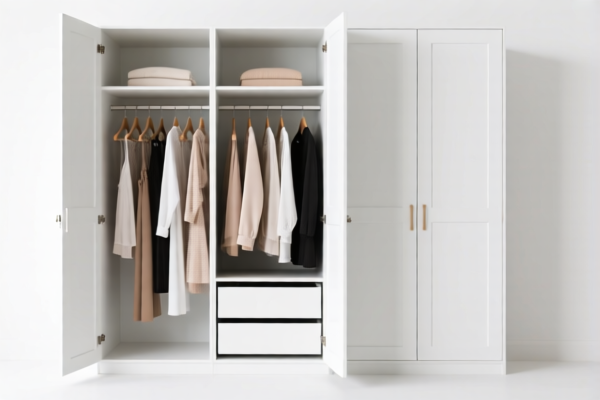


AI Analysis
🚪 Wardrobe (Wooden Furniture for Bedroom)
🌐 HS Code Reference & Customs Clearance Guide | 2026 Latest Tariff Analysis | Professional Entry Strategy
📌 I. Product Definition & Classification: Do You Really Know Your "Wardrobe"?
A wardrobe is a staple of bedroom furniture, designed for storing clothes, linens, and personal items. In international trade, wardrobes are categorized primarily by their material and construction type.
The data provided highlights three specific scenarios for wooden wardrobes: 1. Standard Wooden Wardrobe: A finished bedroom furniture piece, falling under "Other" non-bed furniture. 2. Inferred Wooden Wardrobe: A general "Other Wooden Furniture" category based on material inference, excluding specific sub-items. 3. Lift-Down/Mechanical Wardrobe: A furniture piece with mechanical parts (lifters), classified under "Other Furniture and Parts."
⚠️ Key Classification Logic: - Material: All cases assume Wooden construction. - Category: Fits under Chapter 94 (Furniture): - 9403.50: "Other wooden furniture" (Standard wardrobes). - 9403.99: "Parts of furniture" (Specifically for lift-mechanism wardrobes or mixed assemblies). - Exclusion: Must be distinguished from "Beds" (9403.20) and "Metal Furniture" (9403.10/9403.30).
📦 II. HS Code Classification Details (Based on Provided Data)
The following codes apply strictly to the provided dataset. All listed items are subject to a Total Tax Rate of 35.0%.
| HS Code | Product Description & Logic | Applicable Scenario | Material Assumption |
|---|---|---|---|
| 9403.50.90.80 | Wardrobe (Bedroom Furniture) Classified as "Other" non-bed wooden furniture. |
Standard wooden wardrobes used in bedrooms. | Wood |
| 9403.60.80.93 | Other Wooden Furniture Inferred from common sense; excludes specific sub-categories. |
General wooden wardrobes where specific sub-items do not apply. | Wood |
| 9403.99.40.80 | Lift-Down Wardrobe (Finished Product) Includes furniture parts/mechanisms; "Other furniture and parts." |
Wardrobes with integrated lift mechanisms or complex parts. | Wood (with mechanical parts) |
🔍 Critical Note:
- 9403.50.90.80 is the standard classification for finished wooden wardrobes. - 9403.99.40.80 is critical for "Lift-Down" wardrobes, as the inclusion of mechanical parts pushes it into the "Other parts" category, yet it is still taxed as a finished furniture item in this dataset. - 9403.60.80.93 acts as a fallback for wooden furniture that doesn't fit the exact "bedroom" or "lift" definitions but is clearly wood.
💰 III. 2026 Latest Tariff Rate Breakdown (Including Surcharges & Policy Add-ons)
✅ Applicable Context: US Import from China (Inferred from tariff details like "122 Clause").
✅ Total Tax Rate: 35.0% (Consistent across all three HS Codes).
🎯 Tax Structure Analysis
| Tax Component | Rate | Legal Basis / Description |
|---|---|---|
| Base Duty (MFN) | 0.0% | The standard "Most Favored Nation" tariff for wooden furniture (Chapter 94) is typically duty-free or very low. |
| Section 301 / Section 232 Surcharge | +25.0% | Added Tariff: Likely refers to Section 301 tariffs on Chinese goods, specifically "Section 232" or specific "301 List 4A" items affecting furniture. |
| Section 122 Tariff (122-Clause) | +10.0% | 122 Clause Tariff: A specific policy add-on (often linked to specific trade remedy investigations or emergency measures) applicable to China-origin goods. |
| TOTAL | 35.0% | Base (0%) + Add-on 25% + Clause 10% |
📌 Detailed Explanation:
- 0% Base: Wood furniture is generally not subject to high base duties. - 25% Surcharge: This is the heavy lifter. It represents the Section 301 punitive tariff designed to counteract trade imbalances. - 10% "122-Clause": This specific clause (likely a reference to a specific legislative section or administrative code like19 USC 232or a specific "122" provision in recent trade notices) adds an additional 10% on top of the 301 rate. - Combined Impact: Even though the base is 0%, the 35% total effective rate makes importing these wardrobes expensive.
🛠️ IV. Customs Clearance Practical Advice (Avoid Pitfalls)
✅ 1. Essential Documentation Checklist
| Document | Requirement | Why It Matters |
|---|---|---|
| Detailed Product Description | ✔️ Must specify "Wardrobe" vs. "Cabinet" vs. "Shelving Unit" | Ensures correct HS Code (9403.50 vs 9403.99). |
| Material Declaration | ✔️ Explicitly state "100% Wood" or "Wood Composition" | Triggers the 9403 chapter. If metal is present >50%, classification changes entirely. |
| Mechanical Parts List | ✔️ If "Lift-Down" (9403.99), detail the motor/lift mechanism | Justifies the 9403.99.40.80 code over a standard furniture code. |
| Country of Origin (COO) | ✔️ Must be China (CN) | Confirms applicability of the 25% + 10% surcharges. |
| Commercial Invoice | ✔️ Value must be CIF | Tax is calculated on CIF value. |
✅ 2. Declaration Strategy (The "Golden Rule")
🔥 "Accurate Material + Precise Function = Correct Code"
| Scenario | Correct Declaration | Risk if Incorrect |
|---|---|---|
| Standard Wooden Wardrobe | Use 9403.50.90.80 | Risk: Misclassifying as "parts" (9403.99) might cause delays, but tax is same here. |
| Wardrobe with Lift Mechanism | Use 9403.99.40.80 | Risk: Classifying as simple furniture (9403.50) might lead to questions about the mechanical parts, but tax remains 35%. |
| Mixed Material (Wood + Metal) | Avoid if possible | If metal >50%, code might shift to 9403.30, which could have different (potentially lower or higher) tariffs. |
| "Other" Wood Furniture | Use 9403.60.80.93 | Use only if the specific "bedroom" definition (9403.50) is technically disputed. |
✅ 3. Special Handling for "Lift-Down" Wardrobes (9403.99.40.80)
- Definition: These are finished furniture items that include complex parts (lifters, motors).
- Strategy: Ensure the mechanical parts are not declared as separate accessories. They must be declared as part of the "Furniture" unit.
- Reasoning: The dataset explicitly states this is a "Finished Product" (成品). If you declare the lift motor separately, you risk higher duties on the electronic/mechanical part.
🌍 V. Global Market Comparison (Focus on US Tariffs)
| Market | Recommended HS Code | Base Rate | Surcharge | Total Rate |
|---|---|---|---|---|
| 🇺🇸 USA | 9403.50.90.80 / 9403.99.40.80 | 0% | +35% (25% + 10%) | 35% |
| 🇨🇳 China (Export) | Same | 0% | 0% | 0% |
| 🇪🇺 EU | 9403.50 | 0% - 5% | Varies | Low/Moderate |
| 🇨🇦 Canada | 9403.50 | 0% | None | 0% |
📌 Key Takeaway:
The 35% tax burden is specific to the US-China trade context (implied by "122 Clause" and "Add-on 25%"). - If you are shipping to the US, the 35% cost must be factored into your pricing. - For other markets (EU, Canada), these specific surcharges likely do not apply, resulting in significantly lower landed costs.
📌 VI. Common Pitfalls & Solutions
❌ Mistake 1: Ignoring the "Lift" Mechanism
👉 Consequence: If you declare a lift-down wardrobe as a simple wardrobe (9403.50), customs might flag it for "Missing Parts" or "Misdeclaration," leading to inspections.
✅ Fix: Always use 9403.99.40.80 for lift-down wardrobes to capture the "Parts/Furniture" definition accurately.
❌ Mistake 2: Assuming Base Duty is 35%
👉 Consequence: Over-estimating costs if you think 35% is a standard rate, or under-estimating if you forget the add-ons.
✅ Fix: Remember: 0% Base + 25% Surcharge + 10% Clause = 35%. The 35% is entirely punitive, not standard.
❌ Mistake 3: Vague Material Description
👉 Consequence: If you just say "Wooden Furniture" without specifying "Bedroom" or "Wardrobe," customs may default to a generic code.
✅ Fix: Be specific: "Wooden Wardrobe for Bedroom, with Lift Mechanism (if applicable)."
🎯 VII. Conclusion: Strategic Sourcing & Compliance
🎯 Final Summary:
🔹 Total Duty: 35.0% (0% Base + 25% Surcharge + 10% Clause).
🔹 HS Codes: 9403.50.90.80, 9403.60.80.93, 9403.99.40.80.
🔹 Strategy:
1. Verify Material: Must be primarily wood. 2. Identify Function: Standard (9403.50) vs. Mechanical (9403.99). 3. Calculate Landed Cost: Factor in the 35% tax immediately. 4. Pre-Clearance: Consider applying for a Binding Tariff Information (BTI) or Advance Ruling to confirm the 9403.99.40.80 classification for lift-down units.🚀 Action Plan:
For US imports, the 35% tax is significant. Consider: - Diversifying Suppliers: Look for non-China origins (Vietnam, Mexico) to avoid the "China-Specific" 35% surcharges. - Product Redesign: If possible, simplify to avoid the "122 Clause" triggers (though rare for standard furniture). - Price Adjustment: Build the 35% duty into your final price to maintain margins.
📌 Pro Tip:
"The 35% tax is the price of doing business with China in the US for furniture. If you can't absorb it, look for a supply chain shift!"
✨ Professional Customs Compliance Starts Here!
💼 Your Profit Margin Depends on Precision!
Customer Reviews
About HS Code Classification
The Harmonized System (HS) is an internationally standardized nomenclature developed by the World Customs Organization (WCO) to classify traded products. Over 200 countries use the HS system as the basis for customs tariffs, trade statistics, and import/export regulations.
Each HS code follows a hierarchical structure:
- Chapter (2 digits) — Broad category of goods (e.g., Chapter 84: Machinery and Mechanical Appliances)
- Heading (4 digits) — More specific grouping within the chapter
- Subheading (6 digits) — Internationally standardized breakdown, used by all WCO member countries
- National subdivisions (8-10 digits) — Country-specific extensions for further classification, such as US HTSUS 10-digit codes
Correct HS code classification is essential for smooth customs clearance, accurate duty payment, and compliance with trade regulations. Misclassification can lead to customs delays, overpayment of duties, or penalties.
When importing from CN to US, the applicable tariff rates may include:
- Most-Favored-Nation (MFN) rate — The standard duty rate applied to WTO members
- General rate — Applied to countries without trade agreements
- Trade remedy duties — Additional tariffs such as Section 301 (anti-dumping), Section 232 (national security), or countervailing duties
The information provided on this page is for reference purposes only. For official classification, please consult with your local customs authority or a licensed customs broker.