Waste Papermaking Solvent Mixture
CN → US| HS Code | Tariff Rate | Origin | Destination | Doc |
|---|---|---|---|---|
| 3825490000 | 35.0% | CN | US | Official Doc |
| 3915900090 | 35.0% | CN | US | Official Doc |
| 3824994900 | 41.5% | CN | US | Official Doc |
| 3824992900 | 41.5% | CN | US | Official Doc |
| 3915900090 | 35.0% | CN | US | Official Doc |
Product Images


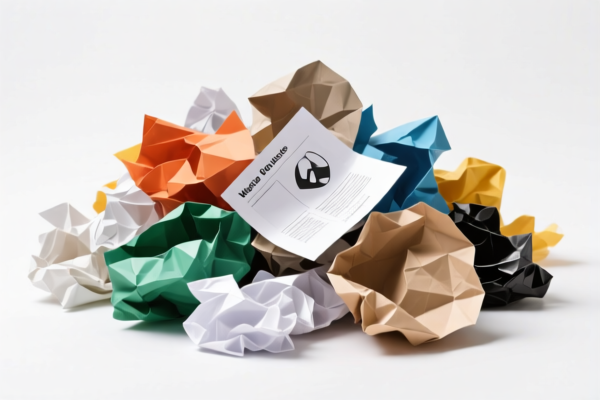

AI Analysis
🧪 Waste Papermaking Solvent Mixture
🌐 HS Code Reference & Customs Clearance Guide | 2026 Latest Tariff Analysis | Professional Clearance Strategy
📌 I. Product Definition: What Exactly is "Waste Papermaking Solvent Mixture"?
This product is a complex chemical residue generated during the paper manufacturing process. It is not a single pure substance but a mixture containing: 1. Waste Solvents: Used organic solvents extracted from pulp or paper treatment. 2. Plastic/Resin Residues: Micro-particles, fragments, or sludge containing synthetic resins used in coating or sizing. 3. Chemical By-products: Hydrocarbon mixtures and other chemical industry residuals.
⚠️ Key Classification Challenge:
- Is it primarily "Waste Solvent" (chemical residue)?
- Is it primarily "Plastic Waste" (recyclable material)?
- Or is it a "Non-Listed Chemical Mixture" (catch-all category)?
The HS Code depends on the dominant characteristic and regulatory interpretation of "waste" vs. "residue".
📦 II. HS Code Classification Details (2026 Latest Tariff Authority Comparison)
Based on the provided data, four potential HS Codes are identified. Note that 3915.90.00.90 appears twice with different summaries but identical tax rates.
| HS Code | Product Description & Rationale | Applicable Scenario | Material Conflict? |
|---|---|---|---|
3825.49.00.00 |
Waste Solvents & Solvent Mixtures Matches "Waste Solvent" key material. Fits characteristics of chemical industry residues and waste organic solvents. No obvious material conflict. |
Primary waste from solvent extraction processes in papermaking. | ❌ No |
3915.90.00.90 |
Waste, Scrap & Off-Cuts of Plastics Matches material (Plastic) and form (Waste/Flakes/Scrap). Even if containing solvents, it is treated as a mixture of plastic waste. No material conflict. |
Plastic-rich sludge or resin waste where plastic is the dominant solid fraction. | ❌ No |
3915.90.00.90 |
Plastic Waste (Resin-Based) Product name "Resin" is plastic material. "Mixture" form fits "Waste, Scrap & Off-cuts". Reasonable inference based on material. |
Similar to above; emphasizes the "Resin" content. | ❌ No |
3824.99.49.00 |
Prepared Binders for Foundry Molds; Chemical Products Not Elsewhere Specified (B兜底) Matches: Hydrocarbon mixture (Plastic + Solvent usually hydrocarbon-based). Fits "Not elsewhere specified" logic. No material conflict. |
Complex mixture where neither solvent nor plastic is strictly dominant or separable. | ❌ No |
3824.99.29.00 |
Chemical Products & Preparations (Mixture) Matches: Chemical industry-related mixture. Core form is "Mixture". Fits description of "Chemical products... not elsewhere specified". No metal/specific finished good conflict. |
General chemical waste mixture where specific solvent/plastic classification is ambiguous. | ❌ No |
🔍 Critical Insight:
-3825.49.00.00is the most direct fit for solvent-heavy waste.
-3915.90.00.90is the best fit if the waste is plastic/resin-heavy.
-3824.99.49.00/3824.99.29.00are fallback categories for complex mixtures where the dominant component is unclear or it is a non-listed chemical preparation.
- All options involve US Import Duties (Section 301 & IEEPA).
💰 III. 2026 Latest Tariff Rate Breakdown (Including Surtaxes & Policy Add-ons)
✅ Applicable Country: United States (US)
✅ Origin: China (CN)
✅ Effective Date: From November 10, 2025 (including subsequent imports)
🎯 1. 3825.49.00.00 —— Waste Solvents
| Item | Content |
|---|---|
| Base Duty Rate | 0% (ad valorem) |
| USITC Additional Duty | +25% (Section 301 Tariffs) |
| IEEPA Additional Duty | +10% (China/HK products, effective Nov 10, 2025) |
| Total Tax Rate | 35.0% |
| Tax Calculation | CIF Value × 35% |
| De Minimis Exemption | ❌ Not Applicable (deny_de_minimis) |
| Legal Basis Path | USITC:3825.49.00.00 → FOOTNOTE:301_3825 → IEEPA:9903.01.24 |
📌 Explanation:
- Waste solvents are classified as chemical residues.
- 0% base is common for waste/recyclables, but 35% total is due to US-China trade tensions.
- High risk of inspection due to environmental regulations (EPA) and hazardous waste declarations.
🎯 2. 3915.90.00.90 —— Plastic Waste (Resin/Scrap)
| Item | Content |
|---|---|
| Base Duty Rate | 0% (ad valorem) |
| USITC Additional Duty | +25% (Section 301 Tariffs) |
| IEEPA Additional Duty | +10% (China/HK products) |
| Total Tax Rate | 35.0% |
| Tax Calculation | CIF Value × 35% |
| De Minimis Exemption | ❌ Not Applicable |
| Legal Basis Path | USITC:3915.90.00.90 → FOOTNOTE:301_3915 → IEEPA:9903.01.24 |
📌 Note:
- If classified as plastic waste, the tax is also 35%.
- Requires strict environmental compliance documentation (e.g., proof of recyclability, non-hazardous status).
- Customs may scrutinize for "fake plastic waste" to avoid higher duties.
🎯 3. 3824.99.49.00 & 3824.99.29.00 —— Chemical Mixtures (Other)
| Item | Content |
|---|---|
| Base Duty Rate | 6.5% (ad valorem) |
| USITC Additional Duty | +25% (Section 301 Tariffs) |
| IEEPA Additional Duty | +10% (China/HK products) |
| Total Tax Rate | 41.5% |
| Tax Calculation | CIF Value × 41.5% |
| De Minimis Exemption | ❌ Not Applicable |
| Legal Basis Path | USITC:3824.99.49.00 / 3824.99.29.00 → FOOTNOTE:301_3824 → IEEPA:9903.01.24 |
📌 Explanation:
- These are "catch-all" chemical categories.
- Higher base rate (6.5%) results in a 41.5% total tax.
- Used when the mixture is complex and doesn't fit purely as "solvent" or "plastic waste".
- Higher cost than solvent/plastic categories, but may be necessary if composition is ambiguous.
🛠️ IV. Customs Clearance Practical Advice (Battle-Tested Pitfall Guide)
✅ 1. Required Documentation (Non-Negotiable)
| Document | Mandatory? | Description |
|---|---|---|
| ✅ MSDS (Material Safety Data Sheet) | ✔️ | Crucial. Must detail chemical composition, hazardous properties, and solvents. |
| ✅ Certificate of Recycling/Non-Hazardous | ✔️ | Prove the waste is recyclable or non-hazardous under EPA standards. |
| ✅ Detailed Composition Analysis | ✔️ | % of solvents, % of plastics, % of other chemicals. |
| ✅ Commercial Invoice | ✔️ | Clearly state "Waste Papermaking Solvent Mixture" – DO NOT use vague terms like "Chemical Sludge". |
| ✅ Bill of Lading | ✔️ | Ensure freight forwarder knows it's chemical waste (requires proper handling). |
| ✅ EPA Notification (if hazardous) | ✔️ | If classified as hazardous, prior notification to EPA is required. |
✅ 2. Declaration Strategy (Key Tips)
🔥 “Be Specific, Prove Composition, Avoid Ambiguity!”
| Scenario | Correct Declaration | Wrong Practice |
|---|---|---|
| Solvent-Dominated Waste | 3825.49.00.00 |
Calling it "Plastic Waste" → 35% tax, but risk of reclassification. |
| Plastic/Resin-Dominated | 3915.90.00.90 |
Calling it "Solvent" → 35% tax, but risk of EPA scrutiny. |
| Complex Mixture | 3824.99.49.00 or 3824.99.29.00 |
Using wrong code → 41.5% tax, potential penalties. |
| Hazardous Waste | Do Not Import Without EPA Permit | Attempting to clear as "Non-Hazardous" → Seizure & Fine! |
📌 Key Reminder:
- US Customs (CBP) will cross-check MSDS with the declared HS Code.
- If the MSDS shows high solvent content but you declare3915(Plastic), CBP may reassess to3825or3824.
- Pre-Ruling: Strongly recommend applying for a Binding Ruling from US CBP if the composition is mixed.
✅ 3. Special Handling Notes
| Scenario | Advice |
|---|---|
| Hazardous Classification | If MSDS indicates flammability, toxicity, or reactivity, it may be Hazardous Waste. Importing hazardous waste is highly restricted under EPA and RCRA. Consult a Hazmat Specialist. |
| Environmental Compliance | Ensure the waste meets US recycling standards. If it’s considered "junk," it may be rejected. |
| Freight Forwarding | Notify carrier immediately. Chemical waste requires proper labeling (UN Number) and hazardous goods documentation. |
🌍 V. Global Market Clearance Comparison (2026 Latest)
| Country/Region | Recommended HS Code | Duty Rate (China Origin) | Certification/Notes |
|---|---|---|---|
| 🇺🇸 USA | 3825.49.00.00 (Solvent) or 3915.90.00.90 (Plastic) |
35% | EPA Notification Required. High inspection rate. |
| 🇺🇸 USA | 3824.99.49.00 (Mixture) |
41.5% | Fallback option. Higher tax. |
| 🇨🇳 China | 3825.49.00.00 |
~0% - 5% | Domestic recycling incentives may apply. |
| 🇪🇺 EU | 3825.40.00 (Solvent Waste) |
0% (if non-hazardous) | Strict WEEE/REACH compliance. Hazardous waste import ban. |
📌 Conclusion:
- USA is the most complex market due to Section 301 and IEEPA tariffs.
- Tax rates are high (35%-41.5%).
- Environmental regulations are the biggest hurdle, not just tariffs.
📌 VI. Common Mistakes & Pitfalls (Lessons Learned)
❌ Mistake 1: Declaring "Chemical Sludge" as "Plastic Waste" (3915) when it’s mostly solvents.
👉 Consequence: CBP reclassifies to 3825 or 3824, potentially adds penalties.
❌ Mistake 2: Failing to provide MSDS.
👉 Consequence: Shipment detained at port. Costly storage fees and potential return.
❌ Mistake 3: Ignoring EPA Hazardous Waste status.
👉 Consequence: Seizure and Destruction of goods. Fines up to $10,000+ per day.
❌ Mistake 4: Using vague invoice descriptions.
👉 Consequence: CBP demands additional info, delaying clearance by weeks.
✅ Correct Approach:
"Waste Papermaking Solvent Mixture, Non-Hazardous (per MSDS), Recyclable Plastic & Solvent Residue, HS Code 3825.49.00.00, MSDS Attached, EPA Compliant."
🎯 VII. Conclusion: Precise Classification Saves Money & Avoids Delays!
🎯 Remember:
🔹 "Solvent Waste = 35%, Plastic Waste = 35%, Mixture = 41.5%. Pick the right one!"
🔹 "MSDS is King! No MSDS = No Entry!"
🔹 "Environmental Compliance > Tariff Rate! Get EPA Right First!"
📌 Pro Tip:
If your waste is recyclable and you have certified buyers in the US, consider applying for EPA Notification in advance.
For mixed compositions, Pre-Ruling from CBP is worth the fee to avoid 41.5% tax or penalties.
📣 Immediate Action:
📞 Contact a Customs Broker + Hazmat Specialist
📄 Prepare MSDS + Composition Report
🚀 Secure EPA Notification (if required)
✅ Apply for CBP Pre-Ruling if composition is ambiguous
✨ Professional Clearance Starts with Accurate Classification!
💼 Every Percent of Duty Matters in the Chemical Waste Trade!
Customer Reviews
About HS Code Classification
The Harmonized System (HS) is an internationally standardized nomenclature developed by the World Customs Organization (WCO) to classify traded products. Over 200 countries use the HS system as the basis for customs tariffs, trade statistics, and import/export regulations.
Each HS code follows a hierarchical structure:
- Chapter (2 digits) — Broad category of goods (e.g., Chapter 84: Machinery and Mechanical Appliances)
- Heading (4 digits) — More specific grouping within the chapter
- Subheading (6 digits) — Internationally standardized breakdown, used by all WCO member countries
- National subdivisions (8-10 digits) — Country-specific extensions for further classification, such as US HTSUS 10-digit codes
Correct HS code classification is essential for smooth customs clearance, accurate duty payment, and compliance with trade regulations. Misclassification can lead to customs delays, overpayment of duties, or penalties.
When importing from CN to US, the applicable tariff rates may include:
- Most-Favored-Nation (MFN) rate — The standard duty rate applied to WTO members
- General rate — Applied to countries without trade agreements
- Trade remedy duties — Additional tariffs such as Section 301 (anti-dumping), Section 232 (national security), or countervailing duties
The information provided on this page is for reference purposes only. For official classification, please consult with your local customs authority or a licensed customs broker.