Water soluble Embroidery Lace
CN → US| HS Code | Tariff Rate | Origin | Destination | Doc |
|---|---|---|---|---|
| 5806400000 | 43.0% | CN | US | Official Doc |
| 5806393080 | 35.0% | CN | US | Official Doc |
Product Images
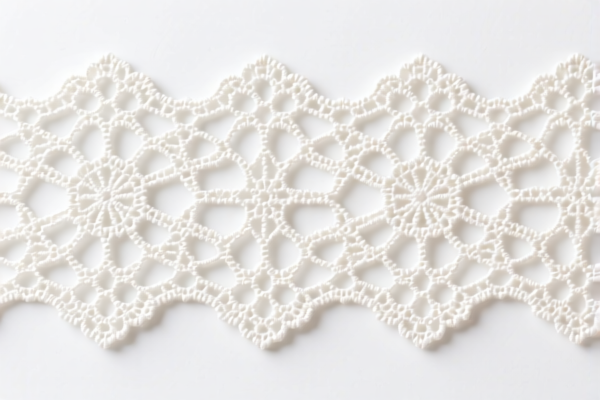
AI Analysis
🧵 Water-Soluble Embroidery Lace (Cut-Work Lace Base)
🌐 HS Code Reference & Customs Clearance Guide | 2026 Latest Tariff Analysis | Professional Compliance Strategy
📌 I. Product Definition & Classification: What Exactly is "Water-Soluble Lace"?
Water-soluble embroidery lace, often referred to as cut-work lace base, dissolvable net, or sugar net, is a specialized textile material used in high-end fashion, lingerie, and costume design.
It consists of a patterned open-mesh fabric made from water-soluble polymers (typically polyvinyl alcohol - PVA or polyethylene oxide). During the manufacturing process, embroidery thread is stitched onto this soluble base. After embroidery, the fabric is washed in water, dissolving the base mesh and leaving only the embroidered pattern as a standalone, delicate lace structure.
Key Distinction in Customs Classification:
In international trade, this product is NOT classified as "embroidery finished goods" (which would be higher tax) but rather as "Narrow woven fabrics" or "Fabrics consisting of warp without weft assembled by adhesive", depending on its construction. The critical factor is whether it is woven (warp/weft interlaced) or non-woven/adhesive-bound.
⚠️ Critical Classification Point:
- If the base is a woven mesh (warp and weft threads interlaced) before embroidery → Classified under 5806 (Narrow woven fabrics).
- If the base is a non-woven mesh held together by adhesive (no weaving) → Classified under 5806.40 (Bolducs).
- Most commercial "water-soluble laces" are woven bases, thus falling under 5806.39 or 5806.40.
📦 II. HS Code Classification Details (2026 Latest Tariff Authority)
Based on the provided data, two primary HS codes apply to narrow woven fabrics and similar lace bases. Here is the breakdown:
| HS Code | Product Description | Applicability | Tax Rate (US/China) |
|---|---|---|---|
| 5806.40.00.00 | Narrow woven fabrics... Fabrics consisting of warp without weft assembled by means of an adhesive (bolducs) | ✅ Applies if: The lace base is non-woven and held together by adhesive (e.g., some "sugar nets" that are not traditional weaves). This is rare for high-quality embroidery bases but possible for simpler applications. | 0.0% |
| 5806.39.30.80 | Other woven fabrics: Of other textile materials: Other Other: Other (899) | ✅ Applies if: The lace base is a traditional woven mesh (warp and weft interlaced) made of synthetic fibers (polyester, nylon, etc.), which is then embroidered and dissolved. This is the most common classification for water-soluble embroidery lace. | 25.0% |
🔍 Key Interpretation:
- 5806.40.00.00: For "bolducs" – narrow fabrics where the structure relies on adhesive to hold warp threads together without a weft. If your water-soluble lace is a true "adhesive-based non-woven" mesh, use this. Tax: 0%.
- 5806.39.30.80: For other narrow woven fabrics of synthetic materials. Since most water-soluble lace bases are woven polymers (PVA nets), they fall here. Tax: 25%.📌 Warning:
- Do NOT classify as "Embroidery Goods" (e.g., 5810) if the product is sold as a blank lace base for further processing. Once embroidered and sold as a finished embroidered fabric, it may shift to 5810. However, the provided data only covers 5806 (narrow woven fabrics).
- If the product is sold as finished embroidered lace (already embroidered and washed), it may fall under 5810.99 (Embroidery), which is not in the provided data. Always confirm if the product is "blank base" or "finished embroidered lace".
💰 III. 2026 Tariff Rate Breakdown (Detailed)
✅ Applicable Country: United States (US)
✅ Origin: China (CN)
✅ Effective Date: 2025–2026 (Subject to ongoing trade policies)
🎯 1. 5806.40.00.00 —— Adhesive-Bound Narrow Fabrics (Bolducs)
| Item | Detail |
|---|---|
| Base Duty Rate | 0.0% |
| Section 301 Tariff | 0.0% |
| Total Duty Rate | 0.0% |
| Calculation | CIF Value × 0% = $0 |
| De Minimis Eligibility | ❌ No (Section 301 goods generally excluded from de minimis if duty >0, but here duty is 0; however, check IEEPA rules) |
| Legal Basis | USITC 5806.40.00.00, No Footnote 301 penalty |
📌 Explanation:
- This code benefits from 0% total duty because it is classified as a narrow fabric of non-woven/adhesive type, which is not targeted by current Section 301 tariffs on "textiles" in the same way as woven fabrics.
- Ideal for importers if the product qualifies as "bolduc" (adhesive-bound).
🎯 2. 5806.39.30.80 —— Other Narrow Woven Fabrics (Synthetic)
| Item | Detail |
|---|---|
| Base Duty Rate | 0.0% |
| Section 301 Tariff | +25.0% |
| IEEPA Surcharge | 0.0% (No additional IEEPA for this code) |
| Total Duty Rate | 25.0% |
| Calculation | CIF Value × 25% |
| De Minimis Eligibility | ❌ No (Section 301 goods are excluded from de minimis exemption under current US rules for China-origin goods) |
| Legal Basis | Section 301: 9903.88.01 → USITC: 5806.39.30.80 |
📌 Explanation:
- This is the most likely classification for water-soluble lace made from woven synthetic mesh (polyester/PVA).
- Subject to 25% Section 301 tariff as a "textile product" from China.
- High cost impact: A $1,000 shipment incurs $250 in duties.
🛠️ IV. Customs Clearance Practical Advice
✅ 1. Documentation Checklist
| Document | Required? | Notes |
|---|---|---|
| Commercial Invoice | ✅ | Must specify "Water-Soluble Embroidery Lace Base" or "Dissolvable Lace Mesh". Avoid vague terms like "lace fabric". |
| Product Specifications | ✅ | Include material composition (e.g., 100% PVA, 100% Polyester), weight per square meter, and whether it is woven or adhesive-bound. |
| Photo of Product | ✅ | Show the mesh structure clearly. If woven, highlight the weave. If adhesive, show the non-woven texture. |
| Certificate of Origin | ✅ | Required for Section 301 determination. |
| Embroidery Status Declaration | ✅ | Crucial: State whether the product is sold as blank base (for further embroidery) or finished embroidered lace. If finished, HS code may change to 5810. |
✅ 2. Classification Strategy (Key Decision Tree)
🔥 "Woven or Adhesive? That is the Question!"
| Scenario | Recommended HS Code | Duty Rate | Why? |
|---|---|---|---|
| Woven Mesh Base (Warp & Weft interlaced) | 5806.39.30.80 |
25% | Most common for high-quality water-soluble lace. Falls under "Other woven fabrics". |
| Adhesive-Bound Non-Woven (No weaving) | 5806.40.00.00 |
0% | Rare, but if the base is held by glue/adhesive without weaving, it qualifies as "bolduc". |
| Finished Embroidered Lace (Already embroidered & washed) | Not in Data (Likely 5810) | Varies | If already embroidered, it is no longer a "narrow fabric" but an "embroidery good". Not covered in provided data. |
| Small Quantity (< $800) | N/A | 0% | If shipped under de minimis, Section 301 may not apply, but risk of audit is high. |
📌 Critical Tip:
- If you can prove the lace base is "adhesive-bound" (bolduc) instead of woven, you save 25% duty.
- To do this, provide technical documents showing no weft threads and adhesive binding.
- If the lace is woven (standard PVA mesh), you must pay 25%.
✅ 3. Common Mistakes to Avoid
| Mistake | Consequence | Correct Action |
|---|---|---|
| Misclassifying as "Embroidery" (5810) | If sold as blank base, customs may reclassify to 5806 + penalties | Clearly state "Blank Embroidery Base" in invoice |
| Claiming 0% Duty for Woven Lace | Customs will assess 25% + back taxes + penalties | Use 5806.39.30.80 for woven types |
| Ignoring "Finished vs. Blank" Status | Finished lace may fall under different HS code (5810) | Declare accurately based on final product state |
| Using Vague Descriptions | "Lace fabric" → Custom officer decides → Risk of highest duty | Use specific: "Water-Soluble Polyamide Lace Base, Woven, Blank" |
🌍 V. Global Market Comparison (2026)
| Region | Likely HS Code | Duty Rate | Notes |
|---|---|---|---|
| 🇺🇸 USA | 5806.39.30.80 |
25% | Section 301 applies to woven synthetic narrow fabrics. |
| 🇪🇺 EU | 5806.32 | 0–4% | No Section 301 equivalent. Duty depends on fiber content (synthetic). |
| 🇨🇳 China (Import) | 5806.32 | 5–10% | Higher duties for synthetic narrow fabrics. |
| 🇦🇺 Australia | 5806.32 | 5% | Moderate duty. |
| 🇯🇵 Japan | 5806.32 | 0–5% | Low duty for textiles. |
📌 Conclusion:
- USA is the most expensive market for water-soluble lace due to 25% Section 301 tariff.
- EU and Japan offer lower duties (0–5%).
- Strategy: Consider sourcing from non-China countries (e.g., Vietnam, India) to avoid 301 tariffs if exporting to the US.
📌 VI. Final Recommendations for Importers
- Determine Construction: Confirm if your water-soluble lace is woven or adhesive-bound. This is the single biggest factor in duty rate (0% vs. 25%).
- Clarify Product State: Is it sold as blank base or finished embroidered lace? Blank base →
5806. Finished → Likely5810(not in provided data). - Document Thoroughly: Provide technical specs showing weave structure. If adhesive-bound, highlight this to qualify for
5806.40.00.00. - Consider Supply Chain Diversification: If 25% duty is too high, explore suppliers from Vietnam or India to avoid Section 301 tariffs.
- Pre-Ruling Application: For large volumes, apply for an Adverse Binding Tariff Information (ABTI) ruling from US Customs to confirm classification and avoid surprises.
🎯 Summary:
- Woven Water-Soluble Lace: 5806.39.30.80 → 25% Duty
- Adhesive-Bound Non-Woven Lace: 5806.40.00.00 → 0% Duty
💡 Pro Tip:
If your lace is woven, negotiate with suppliers to ship from a third country (e.g., Vietnam) to avoid the 25% tariff. If it’s adhesive-bound, you’re in luck—0% duty!
📣 Action Item:
📞 Contact Customs Broker to confirm if your specific lace product is woven or adhesive-bound.
📄 Prepare Technical Documentation showing structure and composition.
🚀 Avoid Misclassification to prevent 25% duty shocks and delays.
✨ Precise Classification Saves 25% in Duties!
💼 Know Your Weave, Know Your Tax!
Customer Reviews
About HS Code Classification
The Harmonized System (HS) is an internationally standardized nomenclature developed by the World Customs Organization (WCO) to classify traded products. Over 200 countries use the HS system as the basis for customs tariffs, trade statistics, and import/export regulations.
Each HS code follows a hierarchical structure:
- Chapter (2 digits) — Broad category of goods (e.g., Chapter 84: Machinery and Mechanical Appliances)
- Heading (4 digits) — More specific grouping within the chapter
- Subheading (6 digits) — Internationally standardized breakdown, used by all WCO member countries
- National subdivisions (8-10 digits) — Country-specific extensions for further classification, such as US HTSUS 10-digit codes
Correct HS code classification is essential for smooth customs clearance, accurate duty payment, and compliance with trade regulations. Misclassification can lead to customs delays, overpayment of duties, or penalties.
When importing from CN to US, the applicable tariff rates may include:
- Most-Favored-Nation (MFN) rate — The standard duty rate applied to WTO members
- General rate — Applied to countries without trade agreements
- Trade remedy duties — Additional tariffs such as Section 301 (anti-dumping), Section 232 (national security), or countervailing duties
The information provided on this page is for reference purposes only. For official classification, please consult with your local customs authority or a licensed customs broker.