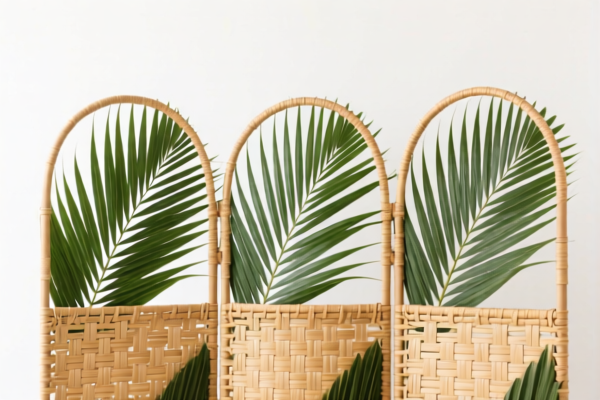
Woven Palm Leaf Wall Screen
CN → US| HS Code | Tariff Rate | Origin | Destination | Doc |
|---|---|---|---|---|
| 4602198000 | 37.3% | CN | US | Official Doc |
| 4602193500 | 35.0% | CN | US | Official Doc |
| 4601296000 | 39.8% | CN | US | Official Doc |
| 4601299000 | 43.0% | CN | US | Official Doc |
Product Images



AI Analysis
🌿 Woven Palm Leaf Wall Screen (Wall Screens of Vegetable Materials)
🌐 HS Code Reference & Customs Clearance Guide | 2026 Latest Tariff Analysis | Professional Decoding Strategy
📌 I. Product Definition & Classification: What Exactly Is a "Woven Palm Leaf Wall Screen"?
A Woven Palm Leaf Wall Screen is a decorative or functional interior/exterior fixture made from vegetable plaiting materials (specifically palm leaves). In international trade, the classification hinges on the form (matted vs. finished article) and the manufacturing process (woven vs. other assembly).
The key distinction lies in whether the product is classified as a "Matting" (woven sheets) or a "Finished Article" (basketwork/wickerwork).
⚠️ Critical Classification Logic:
- If the palm leaves are bound in parallel strands or woven into a sheet form (like a rug or mat), it falls under Heading 4601.
- If the product is made directly to shape (e.g., a rigid folding screen, a decorative panel with a frame, or complex weaving not just in sheets), it may fall under Heading 4602.
- Crucial Note: The provided specifically lists codes for Mats/Matting (4601) and General Wicker/Basketwork (4602). It does not list a specific code for "Palm Leaf Screens" under 4602, only "Willow or Wood" wickerwork (4602.19.35.00). Therefore, generic "Palm Leaf" screens must be carefully evaluated to see if they fit "Other" under 4601 or "Other" under 4602.
📦 II. HS Code Classification Details (Based on Provided )
The provided contains four specific HS codes related to plaiting materials, mats, and basketwork. Here is the breakdown for a "Woven Palm Leaf Wall Screen":
| HS Code | Product Description (from DATA) | Applicable Scenario for "Palm Screen" | Tax Rate (Total) |
|---|---|---|---|
| 4601.29.60.00 | Mats, matting and screens of vegetable materials: Other: Woven or partly assembled: Other | ✅ Best Fit for Flat/Partial Screens: If the screen is essentially a woven mat of palm leaves, possibly assembled into panels. | 0.0% |
| 4601.29.90.00 | Mats, matting and screens of vegetable materials: Other: Other: Other | ✅ Best Fit for Other Mats: If the screen is considered a "mat" or "screen" that doesn't fit the "woven/partially assembled" specific sub-category, or if it's a finished mat. | 0.0% |
| 4602.19.80.00 | Basketwork... Of vegetable materials: Other: Other: Other: Other | ⚠️ Fit for 3D/Fixed Structures: If the screen is a rigid, shaped article (not just a flat mat), and made of vegetable materials (palm) other than willow/wood. | 0.0% |
| 4602.19.35.00 | Basketwork... Of willow or wood: Wickerwork | ❌ NOT Applicable: This code is explicitly for Willow or Wood. Palm is a vegetable material but not willow or wood. Do NOT use this code. | 25.0% |
🔍 Key Insight:
- Palm leaves are "Vegetable Materials" but NOT "Willow or Wood".
- Codes under4602.19.35.00(25% tax) are incorrect for palm leaf products.
- The 0.0% tax codes (4601.29.60.00,4601.29.90.00,4602.19.80.00) are the only safe options in the provided data.
- 4601 covers "Mats, matting and screens". If your product is marketed as a "Screen" but is functionally a woven mat,4601is preferred.
- 4602.19.80.00 is a catch-all for "Other" basketwork of vegetable materials (excluding willow/wood). Use this if the screen is a complex, shaped article (e.g., a folding screen with a frame).
💰 III. 2026 Latest Tariff Rate Details (Based on )
✅ Applicable Country: Data implies China (HS codes are 10-digit, typical of China's customs tariff schedule).
✅ Origin: Not specified, but tax rates are shown as 0% or 25%.
✅ Note on "Added Tax": The shows "Additional Tax: 0.0%" for the 0% codes, meaning no surcharge. The 25% code has a 25% surcharge.
🎯 1. 4601.29.60.00 & 4601.29.90.00 —— Mats, Matting, and Screens of Vegetable Materials
| Item | Content |
|---|---|
| Base Tariff | 0.0% (ad valorem) |
| Additional Tariff | 0.0% |
| Total Tariff | 0.0% |
| Tax Calculation | Zero Duty |
| Applicable Product | Woven palm leaf mats, screens, or partially assembled screens. |
| Legal Basis | Chapter 46: Wickerwork, Basketwork, etc. |
📌 Explanation:
- These codes offer zero duty for woven or partially assembled vegetable material screens.
- This is the most favorable classification if your product is a flat or semi-flat woven screen.
- Why 0%? Many raw or semi-processed agricultural/plaiting materials have low or zero tariffs to encourage import for processing or as decorative goods.
🎯 2. 4602.19.80.00 —— Other Basketwork of Vegetable Materials
| Item | Content |
|---|---|
| Base Tariff | 0.0% (ad valorem) |
| Additional Tariff | 0.0% |
| Total Tariff | 0.0% |
| Tax Calculation | Zero Duty |
| Applicable Product | Finished articles (e.g., rigid folding screens, decorative panels) made of vegetable materials (palm) that are not willow/wood. |
📌 Explanation:
- This code captures "Other" basketwork. If your "Wall Screen" is a rigid, shaped article (not just a mat), this is the correct "Other" code.
- Still 0% duty.
❌ AVOID: 4602.19.35.00 —— Willow or Wood Wickerwork
| Item | Content |
|---|---|
| Base Tariff | 0.0% |
| Additional Tariff | 25.0% |
| Total Tariff | 25.0% |
| Risk | HIGH MISCLASSIFICATION RISK |
| Reason | Palm is not willow or wood. Using this code is incorrect and leads to penalties. |
🚨 Warning:
- Do NOT use4602.19.35.00for palm leaf screens.
- This code is only for products made of willow or wood.
- Misclassification here would result in a 25% tax instead of 0%, plus potential fines for incorrect declaration.
🛠️ IV. Customs Clearance Practical Advice (Pitfall Avoidance Guide)
✅ 1. Preparation Checklist (Must-Have Documents)
| Document | Required? | Notes |
|---|---|---|
| Product Specification Sheet | ✅ Yes | Must state: "Material: 100% Palm Leaves", "Type: Woven Screen/Mat", "Usage: Decorative/Partition". |
| Product Photos | ✅ Yes | Clear images showing the weaving pattern, edges, and overall shape. |
| Bill of Lading/Air Waybill | ✅ Yes | Ensure description matches HS Code (e.g., "Palm Leaf Woven Screen"). |
| Commercial Invoice | ✅ Yes | List items clearly as "Wall Screen" or "Matting". |
| Certificate of Origin | ✅ Recommended | To prove origin and apply for any potential FTZ benefits (if applicable). |
✅ 2. Declaration Tips (Key Mantra)
🔥 "Material First, Form Second, Avoid Willow/Wood!"
| Scenario | Correct HS Code | Incorrect HS Code | Consequence |
|---|---|---|---|
| Flat Woven Palm Screen | 4601.29.60.00 or 4601.29.90.00 |
4602.19.35.00 |
25% Tax (Wrong material) |
| Rigid Folding Palm Screen | 4602.19.80.00 |
4601.29.60.00 |
Possible reclassification (but still 0%) |
| Palm Screen with Wooden Frame | Complex: May split | 4602.19.35.00 |
25% Tax on entire item (if misclassified) |
📌 Critical Note on Frames:
- If the palm screen is fixed to a wooden frame, customs may argue it is a "Furniture Article" or "Wooden Article" instead of a plaiting material.
- If it's a simple clip-in screen, keep it under4601or4602.
- If it's a hinged folding screen with a wooden structure, consider Chapter 44 (Wood) or Chapter 94 (Furniture). The provided does not cover these, so stick to palm-only products for these 0% codes.
✅ 3. Special Cases
| Case | Handling Advice |
|---|---|
| Palm + Bamboo Mix | Still "Vegetable Material". Use 4601 or 4602.19.80.00. |
| Palm + Rattan | Rattan is also vegetable. Same codes apply. |
| Screen with Metal Frame | High risk of reclassification to Metal Article (Chapter 73). Avoid for these HS codes. |
| Screen with Fabric Backing | If backing is dominant, may go to Textiles (Chapter 63). Be cautious. |
🌍 V. Global Market Comparison (2026 Insight)
| Market | Recommended HS Code | Duty Rate | Notes |
|---|---|---|---|
| 🇨🇳 China (Import) | 4601.29.60.00 / 4601.29.90.00 |
0.0% | Based on . |
| 🇺🇸 USA | 4601.29.60.00 (Approx.) | Varies | US often has Section 301 tariffs on Chinese goods. Check if 25% surcharge applies. |
| 🇪🇺 EU | 4601.29.60.00 | 0% | Often 0% for decorative vegetable products. |
| 🇬🇧 UK | 4601.29.60.00 | 0% | Similar to EU post-Brexit. |
📌 Conclusion:
- China: 0% for4601and4602.19.80.00.
- USA: Check additional tariffs! While base duty may be low, Section 301 may add 25% for Chinese-origin palm screens.
- EU/UK: Generally 0%, but check for anti-dumping if mass-produced.
📌 VI. Common Mistakes & Pitfalls (Lessons Learned)
❌ Mistake 1: Classifying palm leaf screens as "Willow Wickerwork" (4602.19.35.00).
👉 Result: 25% Tax + Penalty. Palm is not willow.
❌ Mistake 2: Declaring a rigid, framed screen as a "Mat" (4601).
👉 Result: Customs may reclassify to 4602.19.80.00 (still 0%) or higher chapters if framed. Better to use 4602.19.80.00 for rigid screens.
❌ Mistake 3: Ignoring Frame Materials.
👉 Result: If the screen has a wooden frame, it may be classified as Furniture (Chapter 94) or Wooden Article (Chapter 44), not plaiting materials.
👉 Solution: Ensure the product is primarily palm leaves and not dominated by wood/metal.
🎯 VII. Conclusion: Professional Declaration, Cost Savings!
🎯 Remember the Mantra:
🔹 "Palm is Vegetable, Not Willow!"
🔹 "Flat Screen = 4601 (0%)"
🔹 "Rigid Screen = 4602.19.80.00 (0%)"
🔹 "Willow Code = 25% Tax (Avoid!)"
📌 Pro Tip:
- If your screen is 100% palm leaf woven, use
4601.29.60.00or4601.29.90.00.- If it is a complex, shaped article, use
4602.19.80.00.- Always verify that the product does not have a significant wooden or metal frame that would change the classification.
- Declare accurately: "Woven Palm Leaf Decorative Screen, Vegetable Material".
📣 Action Required:
✅ Contact your customs broker with product photos.
✅ Confirm HS Code:4601.29.60.00(for flat) or4602.19.80.00(for rigid).
✅ Avoid4602.19.35.00at all costs.
🚀 Clear customs smoothly, pay 0% tax, and maximize profit!
✨ Professional clearance starts with accurate classification!
💼 Every dollar saved on duty is pure profit!
Customer Reviews
About HS Code Classification
The Harmonized System (HS) is an internationally standardized nomenclature developed by the World Customs Organization (WCO) to classify traded products. Over 200 countries use the HS system as the basis for customs tariffs, trade statistics, and import/export regulations.
Each HS code follows a hierarchical structure:
- Chapter (2 digits) — Broad category of goods (e.g., Chapter 84: Machinery and Mechanical Appliances)
- Heading (4 digits) — More specific grouping within the chapter
- Subheading (6 digits) — Internationally standardized breakdown, used by all WCO member countries
- National subdivisions (8-10 digits) — Country-specific extensions for further classification, such as US HTSUS 10-digit codes
Correct HS code classification is essential for smooth customs clearance, accurate duty payment, and compliance with trade regulations. Misclassification can lead to customs delays, overpayment of duties, or penalties.
When importing from CN to US, the applicable tariff rates may include:
- Most-Favored-Nation (MFN) rate — The standard duty rate applied to WTO members
- General rate — Applied to countries without trade agreements
- Trade remedy duties — Additional tariffs such as Section 301 (anti-dumping), Section 232 (national security), or countervailing duties
The information provided on this page is for reference purposes only. For official classification, please consult with your local customs authority or a licensed customs broker.