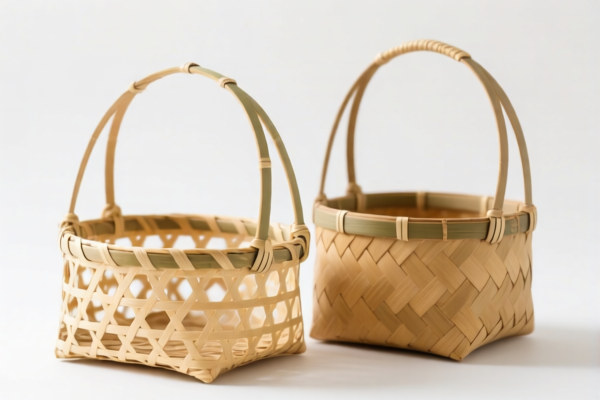
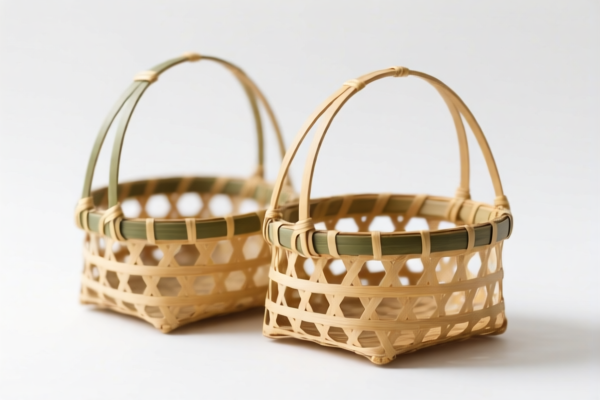
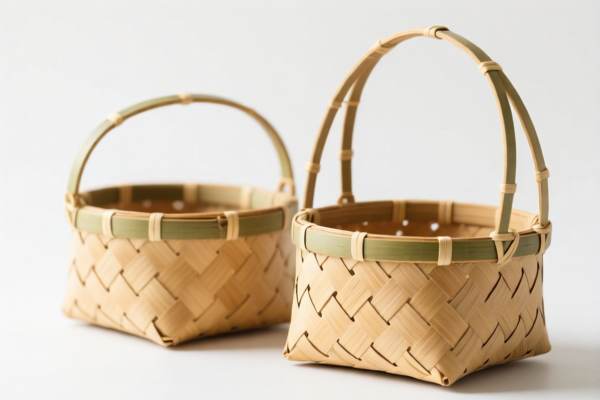
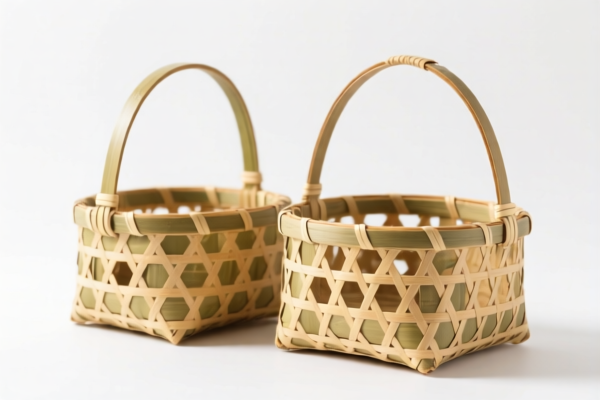
bamboo woven carry baskets
CN → US| HS Code | Tariff Rate | Origin | Destination | Doc |
|---|---|---|---|---|
| 4601922000 | 41.6% | CN | US | Official Doc |
| 4602110900 | 45.0% | CN | US | Official Doc |
| 4601920500 | 37.7% | CN | US | Official Doc |
| 4602110700 | 35.0% | CN | US | Official Doc |
Product Images
AI Analysis
🎋 Bamboo Woven Carry Baskets (HS Code Classification & Tariff Analysis)
🌐 HS Code Reference & Customs Clearance Guide | 2026 Latest Tariff Analysis | Professional Clearance Strategy
📌 I. Product Definition & Classification: Do You Really Understand "Bamboo Baskets"?
Bamboo Woven Carry Baskets are portable containers made primarily from bamboo strips, woven or assembled into specific shapes for carrying goods, picnic items, or produce. In international trade, these products fall under Chapter 46 (Products of weaving materials), specifically within Heading 46.01 (Plaiting materials; plaits and products of plaiting materials) or 46.02 (Plaited goods; basketware and wickerwork).
The key distinction lies in the specific morphology and finishing: * 46.01: Typically covers "plaiting materials" or "plaits," or products classified as generic woven materials if not specifically enumerated in 46.02. * 46.02: Covers "Basketware and Wickerwork," including finished baskets, bags, and containers.
⚠️ Key Distinction Point:
- If the item is classified as a specific finished basket or bag-like structure, it usually falls under 46.02.
- If it is classified under 46.01, it is often treated as a specific type of woven product or material form that doesn't fit the specific "basketware" definition or is a sub-category of plaited goods.
📦 II. HS Code Classification Details (2026 Latest Tariff Authority Comparison)
Based on the provided dataset, there are four specific HS Codes for "Bamboo Woven Carry Baskets." Note that while the product description is similar, the morphology and sub-heading differ, leading to significant tax variations.
| HS Code | Product Description (from Data) | Morphology / Form | Total Tax Rate |
|---|---|---|---|
4601.92.20.00 |
Bamboo woven carry basket | Woven Products (Generic woven form) | 41.6% |
4602.11.09.00 |
Bamboo woven carry basket | Baskets (Finished basketware) | 45.0% |
4601.92.05.00 |
Bamboo woven carry basket | Products of Woven Materials (Material-based form) | 37.7% |
4602.11.07.00 |
Bamboo woven carry basket | Woven Baskets & Bags (Basketware/Bags) | 35.0% |
🔍 Important Note:
- The dataset explicitly lists these four codes for the same generic product name.
- The lowest tax rate (35.0%) applies to4602.11.07.00(Woven Baskets & Bags).
- The highest tax rate (45.0%) applies to4602.11.09.00(Baskets).
- Classification must be precise based on the exact physical form and customs interpretation of "basket" vs. "woven product."
💰 III. 2026 Latest Tariff Rate Breakdown (Including Surtaxes & Policy Add-ons)
✅ Applicable Country: United States (US)
✅ Origin: China (CN)
✅ Effective Date: Current tariffs apply (based on Section 301 and IEEPA)
🎯 1. 4601.92.20.00 —— Bamboo Woven Carry Basket (Woven Products)
| Item | Details |
|---|---|
| Base Tariff | 6.6% (Ad valorem) |
| Surtax (Sec. 301) | +25.0% |
| IEEPA Surcharge | +10.0% (Section 122 Tariff) |
| Total Tax Rate | 41.6% |
| Tax Calculation | CIF Value × 41.6% |
| De Minimis Exemption | ❌ Not Eligible (High tariff rate excludes small shipments from de minimis benefits) |
| Legal Basis | Base Tariff (6.6%) + Section 301 (25%) + IEEPA Section 122 (10%) |
📌 Explanation:
- Base 6.6%: Standard MFN tariff for woven products under 46.01.
- 25% Surtax: Section 301 tariffs on Chinese goods.
- 10% IEEPA: Additional surcharge under International Emergency Economic Powers Act.
- Total 41.6%: High cost of entry.
🎯 2. 4602.11.09.00 —— Bamboo Woven Carry Basket (Baskets)
| Item | Details |
|---|---|
| Base Tariff | 10.0% |
| Surtax (Sec. 301) | +25.0% |
| IEEPA Surcharge | +10.0% (Section 122 Tariff) |
| Total Tax Rate | 45.0% |
| Tax Calculation | CIF Value × 45.0% |
| De Minimis Exemption | ❌ Not Eligible |
| Legal Basis | Base Tariff (10.0%) + Section 301 (25%) + IEEPA Section 122 (10%) |
📌 Note:
- This is the highest tax bracket in the dataset.
- "Basket" classification under 46.02.11 carries a higher base rate (10%) than other woven forms.
🎯 3. 4601.92.05.00 —— Bamboo Woven Carry Basket (Products of Woven Materials)
| Item | Details |
|---|---|
| Base Tariff | 2.7% |
| Surtax (Sec. 301) | +25.0% |
| IEEPA Surcharge | +10.0% (Section 122 Tariff) |
| Total Tax Rate | 37.7% |
| Tax Calculation | CIF Value × 37.7% |
| De Minimis Exemption | ❌ Not Eligible |
| Legal Basis | Base Tariff (2.7%) + Section 301 (25%) + IEEPA Section 122 (10%) |
📌 Explanation:
- Lower base rate (2.7%) makes this more competitive than4602.11.09.00.
- Suitable if the product can be argued as a "product of woven materials" rather than a specific "basket."
🎯 4. 4602.11.07.00 —— Bamboo Woven Carry Basket (Woven Baskets & Bags)
| Item | Details |
|---|---|
| Base Tariff | 0.0% |
| Surtax (Sec. 301) | +25.0% |
| IEEPA Surcharge | +10.0% (Section 122 Tariff) |
| Total Tax Rate | 35.0% |
| Tax Calculation | CIF Value × 35.0% |
| De Minimis Exemption | ❌ Not Eligible |
| Legal Basis | Base Tariff (0.0%) + Section 301 (25%) + IEEPA Section 122 (10%) |
📌 Key Advantage:
- Lowest Total Tax Rate (35.0%) in the dataset.
- Base tariff is 0%, meaning all tax comes from surcharges (25% + 10%).
- Best option if the product qualifies as "Woven Baskets & Bags" under this specific subheading.
🛠️ IV. Customs Clearance Practical Advice (Avoid Pitfalls)
✅ 1. Preparation Checklist (All Required)
| Document | Required | Notes |
|---|---|---|
| ✅ Product Specifications | ✔️ | Include dimensions, weight, weaving method, bamboo type |
| ✅ Product Photos | ✔️ | Show overall shape, handle, and interior structure |
| ✅ Commercial Invoice | ✔️ | Clearly state "Bamboo Woven Carry Basket" and HS Code |
| ✅ Packing List | ✔️ | Detail quantity, gross/net weight, packaging type |
| ✅ Origin Certificate | ✔️ | Confirm China origin to apply correct surtaxes |
✅ 2. Classification Strategy (Key Rules)
🔥 “Lowest Base Rate Wins, But Accuracy is Key!”
| Scenario | Recommended HS Code | Total Tax | Reason |
|---|---|---|---|
| Standard Carry Basket | 4602.11.07.00 |
35.0% | 0% base rate + 35% surtax. Lowest total. |
| Generic Woven Product | 4601.92.05.00 |
37.7% | 2.7% base + 35% surtax. |
| Generic Woven Item | 4601.92.20.00 |
41.6% | 6.6% base + 35% surtax. |
| Standard Basket | 4602.11.09.00 |
45.0% | 10% base + 35% surtax. Highest total. |
📌 Advice:
- Aim for4602.11.07.00if your product can be described as "Woven Baskets & Bags" to minimize tax to 35.0%.
- Avoid4602.11.09.00unless necessary, as it results in the highest cost (45.0%).
✅ 3. Special Considerations
| Situation | Handling Advice |
|---|---|
| OEM/Custom Designs | Ensure the description matches the physical form (basket vs. bag vs. woven product) to avoid misclassification penalties. |
| Mixed Shipments | Declare each HS Code separately if the product varies significantly in form. |
| De Minimis | ❌ Not applicable due to high tariff rates (35-45%). All shipments must clear formal customs. |
🌍 V. Global Market Comparison (2026 Update)
| Country/Region | Recommended HS Code | Total Tax (China Origin) | Notes |
|---|---|---|---|
| 🇺🇸 United States | 4602.11.07.00 |
35.0% | Best rate among options. |
| 🇺🇸 United States | 4602.11.09.00 |
45.0% | Avoid if possible. |
| 🇨🇳 China (Import) | Various | Varies | Generally lower base rates, no US surtaxes. |
| 🇪🇺 EU | 4601/4602 | 0-5% | No Section 301 or IEEPA surtaxes. |
📌 Conclusion:
- US Market has high barriers due to Section 301 (25%) and IEEPA (10%).
- EU and other markets do not apply these surtaxes, making bamboo baskets more competitive globally.
- For US imports, classification accuracy is critical to achieve the 35.0% rate vs. 45.0%.
📌 VI. Common Errors & Pitfalls (Lessons Learned)
❌ Error 1: Using 4602.11.09.00 for a standard basket
👉 Consequence: Pay 45.0% tax instead of 35.0%. Extra 10% cost!
❌ Error 2: Misclassifying as "Wooden Basket" (44.21)
👉 Consequence: Wrong HS Code, potential penalties, delays, and re-evaluation of duties.
❌ Error 3: Assuming De Minimis applies
👉 Consequence: Shipments seized or forced into formal entry due to high tariffs.
✅ Correct Approach:
“Bamboo Woven Carry Basket, Wickerware, for Picnic Use, Model XYZ”
→ Classify as4602.11.07.00(Woven Baskets & Bags) for the 35.0% rate.
🎯 VII. Conclusion: Professional Classification Saves Money!
🎯 Key Takeaway:
🔹 “35% is the goal, 45% is the trap.”
🔹4602.11.07.00is the most cost-effective HS Code for Bamboo Woven Carry Baskets in the US.
🔹 Always verify the morphology (Basket vs. Bag vs. Woven Product) to ensure correct classification.
📌 Pro Tip:
- If you can argue the product is a "Bag" (e.g., foldable bamboo fiber bag), it may still fall under
4602.11.07.00, ensuring the 0% base rate.- Consult a customs broker for Advance Ruling if unsure about the morphology.
📣 Immediate Action:
📞 Contact a licensed customs broker.
📄 Provide detailed product photos and specifications.
🚀 Minimize your tax burden to 35.0% by choosing the correct HS Code!
✨ Precision Classification Starts Here!
💼 Your Profit Margin Depends on These Zeros!
Customer Reviews
About HS Code Classification
The Harmonized System (HS) is an internationally standardized nomenclature developed by the World Customs Organization (WCO) to classify traded products. Over 200 countries use the HS system as the basis for customs tariffs, trade statistics, and import/export regulations.
Each HS code follows a hierarchical structure:
- Chapter (2 digits) — Broad category of goods (e.g., Chapter 84: Machinery and Mechanical Appliances)
- Heading (4 digits) — More specific grouping within the chapter
- Subheading (6 digits) — Internationally standardized breakdown, used by all WCO member countries
- National subdivisions (8-10 digits) — Country-specific extensions for further classification, such as US HTSUS 10-digit codes
Correct HS code classification is essential for smooth customs clearance, accurate duty payment, and compliance with trade regulations. Misclassification can lead to customs delays, overpayment of duties, or penalties.
When importing from CN to US, the applicable tariff rates may include:
- Most-Favored-Nation (MFN) rate — The standard duty rate applied to WTO members
- General rate — Applied to countries without trade agreements
- Trade remedy duties — Additional tariffs such as Section 301 (anti-dumping), Section 232 (national security), or countervailing duties
The information provided on this page is for reference purposes only. For official classification, please consult with your local customs authority or a licensed customs broker.