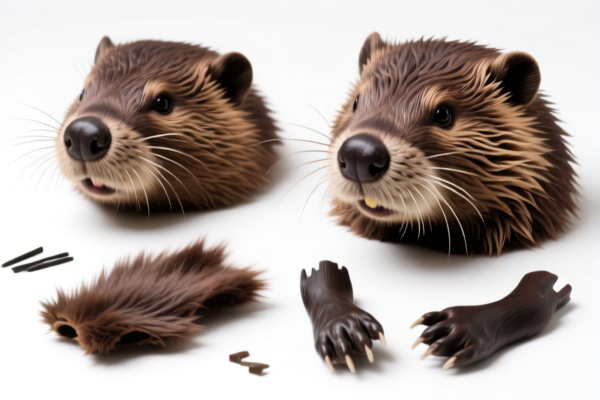
beaver fur heads unassembled
CN → US| HS Code | Tariff Rate | Origin | Destination | Doc |
|---|---|---|---|---|
| 4302203000 | 37.1% | CN | US | Official Doc |
| 4302206000 | 38.5% | CN | US | Official Doc |
| 4302193030 | 36.5% | CN | US | Official Doc |
| 4302193040 | 36.5% | CN | US | Official Doc |
Product Images



AI Analysis
🦫 Beaver Fur Heads (Unassembled / Assembled Parts)
🌐 HS Code Reference & Customs Clearance Guide | 2026 Latest Tariff Analysis | Professional Clearance Strategy
📌 I. Product Definition & Classification: What Are "Beaver Fur Heads"?
In international trade, "beaver fur heads" typically refer to processed animal skins (heads) of beavers, often used for taxidermy, collectors’ items, or fur processing. The key distinction in classification depends on:
- Whether they are considered "collections" or "collectors’ pieces":
- If they are intended for scientific, historical, or collection purposes → Classified under Chapter 97 (Works of Art, Collectors’ Pieces and Antiques).
-
If they are raw or processed materials for commercial fur production → Classified elsewhere (e.g., Chapter 43).
-
Whether they represent extinct or endangered species:
- Beavers (Castor fiber or Castor canadensis) may be protected under CITES (Convention on International Trade in Endangered Species), which affects clearance requirements even if the HS code itself has low duties.
⚠️ Key Distinction:
- If marketed or intended as collectors’ items, taxidermy specimens, or educational pieces → Chapter 97.
- If marketed as raw fur material → Chapter 43 (but not listed in<DATA>).
- Since<DATA>only provides Chapter 97 codes, we focus on the collectors’/scientific interest interpretation.
📦 II. HS Code Classification Details (Based on Provided <DATA>)
| HS Code | Product Description | Applicable Scenario | Tax Rate (Total) |
|---|---|---|---|
9705.29.00.00 |
Collections and collectors’ pieces of zoological, botanical, mineralogical, anatomical or paleontological interest: Other | Beaver fur heads sold as taxidermy displays, educational specimens, or non-endangered collectors’ items | 0.0% |
9705.22.00.00 |
Collections and collectors’ pieces of zoological, botanical, mineralogical, anatomical or paleontological interest: Extinct or endangered species and parts thereof | Beaver fur heads where the species is classified as endangered or extinct under CITES or national law | 0.0% |
🔍 Important Notes:
- Both codes carry a 0.0% total tax rate (base + additional duties).
- However, 0% tariff does NOT mean zero regulatory burden.
- CITES permits may still be required for international trade, even if duties are waived.
💰 III. 2026 Tariff Rate Breakdown (Detailed)
✅ Applicable Country: United States (US)
✅ Origin: Any (not specified in<DATA>)
✅ Effective Date: Current as per 2026 tariff schedule
🎯 1. 9705.29.00.00 — Other Zoological Collections/Collectors’ Pieces
| Item | Detail |
|---|---|
| Base Tariff | 0.0% |
| Additional Duties | 0.0% |
| Total Tax Rate | 0.0% |
| Tax Calculation | CIF Value × 0% = $0 |
| De Minimis Eligibility | ❓ Depends on shipment value and country of origin |
| Legal Basis | HTSUS 9705.29.00.00 |
📌 Explanation:
- This code captures beaver fur heads not classified as endangered/extinct.
- Often used for retail taxidermy, museum pieces, or decorative collectors’ items.
- No tariff burden, but customs may require documentation proving non-endangered status.
🎯 2. 9705.22.00.00 — Extinct or Endangered Species Parts
| Item | Detail |
|---|---|
| Base Tariff | 0.0% |
| Additional Duties | 0.0% |
| Total Tax Rate | 0.0% |
| Tax Calculation | CIF Value × 0% = $0 |
| De Minimis Eligibility | ❌ Likely restricted due to endangered status |
| Legal Basis | HTSUS 9705.22.00.00 |
📌 Explanation:
- Applies if beavers are legally classified as endangered in the country of origin or destination.
- Even with 0% tariff, CITES export/import permits are mandatory.
- Failure to provide permits can result in confiscation, fines, or criminal charges.
🛠️ IV. Customs Clearance Practical Advice
✅ 1. Required Documentation Checklist
| Document | Required? | Notes |
|---|---|---|
| ✅ Commercial Invoice | ✔️ | Must clearly describe item as "Beaver Fur Heads – Taxidermy/Collectors’ Item" |
| ✅ Packing List | ✔️ | Include quantity, weight, dimensions |
| ✅ CITES Permit | ✔️ | Mandatory if species is endangered (verify with local wildlife authority) |
| ✅ Certificate of Non-Dangerous Species | ✔️ | If not endangered, provide scientific verification |
| ✅ Photo of Items | ✔️ | Show condition, labeling, and any tags |
| ✅ HS Code Pre-Ruling (Optional) | ✔️ | Recommended for high-value shipments |
📌 Critical:
- CITES does not care about tariff rates. Even with 0% duty, trade in endangered species parts is strictly regulated.
- Beavers are NOT globally extinct, but some subspecies may be protected locally. Verify CITES Appendix status.
✅ 2. Classification Tips
| Scenario | Correct HS Code | Reason |
|---|---|---|
| Beaver heads sold as decorative taxidermy | 9705.29.00.00 |
Non-endangered, collectors’ item |
| Beaver heads from endangered subspecies | 9705.22.00.00 |
Endangered species part |
| Raw, unprocessed beaver heads (commercial fur) | Not in <DATA> |
Likely Chapter 43; not covered here |
| Beaver heads with scientific/educational purpose | 9705.29.00.00 |
Falls under "other" zoological collections |
🔥 Rule of Thumb:
- If it’s sold as a collector’s item, museum piece, or taxidermy display → Chapter 97.
- If it’s sold as fur material → Chapter 43 (outside<DATA>scope).
✅ 3. Special Cases & Red Flags
| Situation | Advice |
|---|---|
| Shipment from CITES-listed countries | Obtain export permit from country of origin |
| Shipment to US/EU with endangered species | Obtain import permit before shipping |
| Mixed shipment (beaver + other animal parts) | Declare separately; each species may have different HS codes |
| Unassembled vs. Assembled | "Unassembled" does not change classification; content determines HS code |
| De Minimis Claim | Not recommended for animal parts; high risk of inspection |
🌍 V. Global Market Comparison (2026)
| Country/Region | Recommended HS Code | Tariff | CITES Requirement | Notes |
|---|---|---|---|---|
| 🇺🇸 USA | 9705.29.00.00 or 9705.22.00.00 |
0% | Mandatory if endangered | Strict wildlife enforcement |
| 🇪🇺 EU | 9705.29/9705.22 | 0% | Mandatory if endangered | CITES Annex I/II compliance |
| 🇨🇳 China | 9705.29/9705.22 | 0% | Mandatory if endangered | Wildlife Protection Law applies |
| 🇬🇧 UK | 9705.29/9705.22 | 0% | Mandatory if endangered | Post-Brexit CITES rules apply |
| 🇯🇵 Japan | 9705.29/9705.22 | 0% | Mandatory if endangered | Enforcement varies by prefecture |
📌 Conclusion:
- Tariff is 0% globally for these HS codes.
- Regulatory burden (CITES) is the real cost driver.
- Non-compliance leads to seizure, fines, or criminal liability.
📌 VI. Common Mistakes & Pitfalls
❌ Mistake 1: Assuming 0% tariff means no restrictions
👉 Reality: CITES permits are still required for endangered species.
❌ Mistake 2: Using vague descriptions like "animal parts"
👉 Reality: Customs requires scientific name, CITES status, and purpose (collector vs. commercial).
❌ Mistake 3: Splitting shipments to avoid thresholds
👉 Reality: This triggers fraud suspicion; declare accurately.
❌ Mistake 4: Ignoring country-specific endangered lists
👉 Reality: A species may be protected in the import country even if not in the export country.
✅ Best Practice:
"Beaver Fur Heads, Taxidermy Specimens, Scientific Name: Castor fiber, CITES Status: Appendix II, For Collection Pur Only, Origin: [Country]"
🎯 VII. Conclusion: Clear Compliance, Zero Duty, Zero Trouble
🎯 Key Takeaways:
🔹 HS Codes
9705.29.00.00and9705.22.00.00both carry 0% tariff.
🔹 CITES permits are the real hurdle, not duties.
🔹 Accurate description and documentation are critical.
🔹 Unassembled status does not change classification.
📌 Pro Tip:
- Always verify CITES status before shipping.
- Apply for pre-rulings if shipment value is high.
- Work with licensed customs brokers familiar with wildlife trade regulations.
📣 Immediate Action:
📞 Consult a wildlife trade compliance expert + customs broker
🚀 Ensure CITES permits are secured before shipment
✈️ Clear customs smoothly, avoid seizures, protect your business!
✨ Precision in Classification, Compliance in Trade!
💼 Your reputation and profits depend on accurate declarations!
Customer Reviews
About HS Code Classification
The Harmonized System (HS) is an internationally standardized nomenclature developed by the World Customs Organization (WCO) to classify traded products. Over 200 countries use the HS system as the basis for customs tariffs, trade statistics, and import/export regulations.
Each HS code follows a hierarchical structure:
- Chapter (2 digits) — Broad category of goods (e.g., Chapter 84: Machinery and Mechanical Appliances)
- Heading (4 digits) — More specific grouping within the chapter
- Subheading (6 digits) — Internationally standardized breakdown, used by all WCO member countries
- National subdivisions (8-10 digits) — Country-specific extensions for further classification, such as US HTSUS 10-digit codes
Correct HS code classification is essential for smooth customs clearance, accurate duty payment, and compliance with trade regulations. Misclassification can lead to customs delays, overpayment of duties, or penalties.
When importing from CN to US, the applicable tariff rates may include:
- Most-Favored-Nation (MFN) rate — The standard duty rate applied to WTO members
- General rate — Applied to countries without trade agreements
- Trade remedy duties — Additional tariffs such as Section 301 (anti-dumping), Section 232 (national security), or countervailing duties
The information provided on this page is for reference purposes only. For official classification, please consult with your local customs authority or a licensed customs broker.