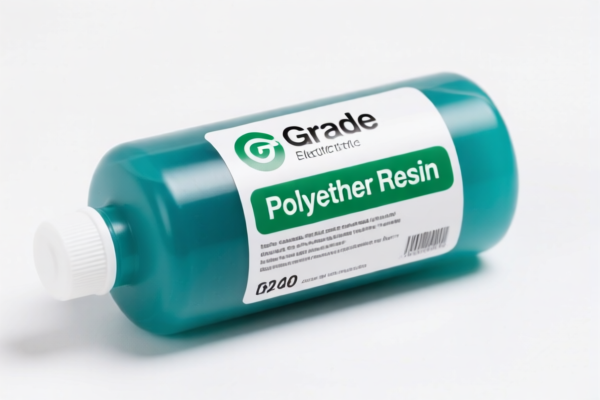
electronic grade polyether resin material
CN → US| HS Code | Tariff Rate | Origin | Destination | Doc |
|---|---|---|---|---|
| 3907290000 | 41.5% | CN | US | Official Doc |
| 3911909110 | 41.5% | CN | US | Official Doc |
| 3911909150 | 41.5% | CN | US | Official Doc |
| 3907210000 | 41.5% | CN | US | Official Doc |
| 3824999397 | 40.0% | CN | US | Official Doc |
Product Images



AI Analysis
🧪 Electronic Grade Polyether Resin Material
🌐 HS Code Reference & Customs Clearance Guide | 2026 Latest Tariff Analysis | Professional Entry Strategy
📌 I. Product Definition: What is "Electronic Grade Polyether Resin"?
"Electronic Grade Polyether Resin" refers to high-purity polyether-based raw materials used in advanced manufacturing, particularly in semiconductor packaging, printed circuit boards (PCBs), and microelectronics. The key characteristics defining its classification are:
- Material Composition: Polyether (a type of polymer resin).
- Physical State: Primary form/raw material (often granules, powders, or liquid precursors), not yet processed into finished electronic components.
- Quality Grade: "Electronic Grade" implies high purity, low ionic contamination, and specific thermal/electrical properties required for sensitive electronic applications.
⚠️ Key Distinction:
- If the material is a raw polymer/resin (pre-polymer or intermediate) → It falls under Chapter 39 (Plastics and Articles Thereof).
- If it is a mixed chemical preparation with specific additives for non-structural purposes, it might fall under Chapter 38, but pure resins are typically Ch 39.
- Critical Factor: The term "Resin" usually points to Ch 39, specifically Heading 3907 (Polyacetals, Other Polyethers, and Epoxide Resins) or Heading 3911 (Polymeric Alcohols, Polymeric Phenols, etc.). Given "Polyether" is explicitly stated, Heading 3907 is the primary candidate, though 3911 is considered if the specific structure fits "other resins" not covered in 3907.
📦 II. HS Code Classification Details (2026 Latest Tariff Alignment)
Based on the provided data, five potential HS Codes have been identified. The classification logic depends on the specific chemical structure and regulatory interpretation of "Polyether Resin."
| HS Code | Product Description & Logic | Tax Rate (Total) | Key Tax Components |
|---|---|---|---|
3907.29.00.00 |
Other Polyethers (Primary Match) Logic: The product name explicitly contains "Polyether," matching the material requirement for "Other Polyethers." The "Resin" form is considered a primary/initial product, consistent with the polyether category. |
41.5% | Base: 6.5% Additional: 25.0% 122 Clause: 10% |
3911.90.91.10 |
Other Polymeric Resins Logic: Classified as a "Polyether Resin." Since thermal thermoplasticity vs. thermosetting is not specified, it is inferred to fit under "Other Resins" in 3911.90 based on the "no conflict" principle. |
41.5% | Base: 6.5% Additional: 25.0% 122 Clause: 10% |
3911.90.91.50 |
Electronic Grade Resins Logic: Fits the "Polyether Resin" material. Although thermal type is unspecified, the "Electronic Grade" (high purity) usage suggests it may fit here, provided there are no material conflicts. |
41.5% | Base: 6.5% Additional: 25.0% 122 Clause: 10% |
3907.21.00.00 |
Polyacetals, Other Polyethers Logic: Successful match. "Polyether Resin" matches "Other Polyethers." "Electronic Grade" describes the chemical attribute in its raw form, with no material or form conflicts. |
41.5% | Base: 6.5% Additional: 25.0% 122 Clause: 10% |
3824.99.93.97 |
Other Chemical Products/Preparations Logic: Viewed as a "Chemical Product" under Chapter 38. Since the form is unspecified but "Resin" suggests a chemical raw material, it fits the "Other" catch-all category without conflict. |
40.0% | Base: 5.0% Additional: 25.0% 122 Clause: 10% |
🔍 Important Note:
- Four out of five codes carry a 41.5% total tax rate.
- Only3824.99.93.97carries a slightly lower rate of 40.0%.
- All codes include USITC Section 301 Tariff (25%) and IEEPA Section 122 Tariff (10%) due to Chinese origin.
💰 III. 2026 Latest Tariff Rate Breakdown (Including Surtaxes)
✅ Applicable Country: United States (US)
✅ Origin: China (CN)
✅ Effective Date: From November 10, 2025 (and subsequent imports)
🎯 1. Primary Codes: 3907.29.00.00, 3911.90.91.10, 3911.90.91.50, 3907.21.00.00
| Item | Content |
|---|---|
| Base Tariff Rate | 6.5% (ad valorem) |
| USITC Surcharge (Section 301) | +25.0% |
| IEEPA Surcharge (Section 122) | +10.0% (for China/HK products) |
| Total Effective Tax Rate | 41.5% |
| Tax Calculation | CIF Value × 41.5% |
| De Minimis Exemption Eligible? | ❌ No (deny_de_minimis applies to Section 301/122 goods) |
| Legal Authority Path | USITC:3907.29.00.00 / 3911.90.91.10 / 3911.90.91.50 / 3907.21.00.00 → FOOTNOTE:9903.88.01 (301 Tariff) → IEEPA:9903.01.24/25 (122 Tariff) |
📌 Explanation:
- The 25% is the standard Section 301 tariff on Chinese plastic products/resins.
- The 10% is the additional Section 122 tariff imposed on specific Chinese chemical and polymer imports.
- Combined 41.5% is a significant cost driver. Pre-classification is critical to ensure the correct 6.5% base rate applies (not a higher base for other chapters).
🎯 2. Alternative Code: 3824.99.93.97
| Item | Content |
|---|---|
| Base Tariff Rate | 5.0% (ad valorem) |
| USITC Surcharge (Section 301) | +25.0% |
| IEEPA Surcharge (Section 122) | +10.0% |
| Total Effective Tax Rate | 40.0% |
| Tax Calculation | CIF Value × 40.0% |
| De Minimis Exemption Eligible? | ❌ No |
| Legal Authority Path | USITC:3824.99.93.97 → FOOTNOTE:9903.88.01 → IEEPA:9903.01.24/25 |
📌 Note:
- While this code offers a 1.5% saving compared to the 39xx codes, it relies on interpreting the product as a "preparation" rather than a "primary plastic resin."
- Risk: Customs may argue that "Polyether Resin" is inherently a plastic material (Chapter 39) and reject Chapter 38 classification. Verify with the manufacturer’s MSDS and chemical structure.
🛠️ IV. Customs Clearance Practical Advice (Battle-Tested Strategy)
✅ 1. Required Documentation Checklist (Non-Negotiable)
| Document | Must Provide | Explanation |
|---|---|---|
| ✅ Product Specification Sheet | ✔️ | Must detail chemical composition, molecular weight, purity ("Electronic Grade" level), and physical form (liquid/powder/granules). |
| ✅ MSDS (Material Safety Data Sheet) | ✔️ | Critical for classifying as a chemical vs. plastic. Must show it’s a resin/pre-polymer. |
| ✅ Chemical Structure Diagram | ✔️ | To justify classification under 3907 (Polyethers) vs. 3911 (Other Resins) or 3824. |
| ✅ Product Photos | ✔️ | Clear images of packaging, labels, and the material itself (e.g., granules vs. bulk liquid). |
| ✅ Commercial Invoice | ✔️ | Must clearly state: "Electronic Grade Polyether Resin, Raw Material, No Finished Goods." |
| ✅ Certificate of Origin (CO) | ✔️ | To confirm Chinese origin (triggers surcharges). |
| ✅ Packing List | ✔️ | Confirm net/gross weight; ensure no mixed shipments with finished electronics. |
✅ 2. Declaration Tactics (Key Mnemonics)
🔥 “Resin is Plastic, Not a Machine; Purity Defines Grade, Not HS Code!”
| Scenario | Correct Declaration Approach | Incorrect Practice |
|---|---|---|
| Raw Polyether Resin | Declare as "Polyether Resin, Unpolymerized/Pre-polymer" → HS 3907.xx | Calling it "Electronic Component Material" → Risk of reclassification |
| High Purity (Electronic Grade) | Highlight "High Purity, Low Ionic Content" in description | Ignoring grade → Customs may suspect finished goods |
| Liquid/Powder Form | Specify "Primary Form" (not a mixture) | Describing as "Compound" → Could trigger Ch 38 scrutiny |
| Mixed Shipment (Resin + PCBs) | Split Declaration | Combining → All items taxed at the highest rate + seizure risk |
✅ 3. Special Handling Scenarios
| Scenario | Recommendation |
|---|---|
| Is it a Thermoplastic or Thermoset? | If thermoplastic → Strong case for 3907. If thermoset/resin → Consider 3911. Provide manufacturer’s data sheet to clarify. |
| Contains Additives? | If >10% by weight of other chemicals, Customs may push to 3824. If <10%, stay with 3907/3911. |
| OEM for Semiconductor Client? | Provide end-user certification. Still classified as raw material, but proves "Electronic Grade" necessity. |
| Sample vs. Commercial Shipment | Both are subject to 41.5%. No de minimis exemption for Chinese resin imports. |
🌍 V. Global Market Customs Comparison (2026 Latest)
| Country/Region | Recommended HS Code | Tariff (China Origin) | Certification Requirements | Notes |
|---|---|---|---|---|
| 🇺🇸 USA | 3907.29.00.00 / 3907.21.00.00 |
41.5% | No specific tech cert, but purity docs needed | High tariff burden; 301 & 122 apply |
| 🇨🇳 China | 3907.29.00.00 |
6.5% | None typically for raw resins | Base rate only; no surcharges |
| 🇪🇺 EU | 3907.29.00 (approx. 3907 29) |
6.5% | REACH Registration Required | REACH is mandatory for chemical imports |
| 🇬🇧 UK | 3907.29.00 |
6.5% | UK REACH Registration | Post-Brexit UK REACH applies |
| 🇯🇵 Japan | 3907.29.00 |
6.0% | None | Low base rate; no surcharges |
📌 Conclusion:
- USA is the most expensive market for this product due to Section 301 + 122 tariffs.
- EU/UK require REACH registration, which is a compliance hurdle but not a tariff one.
- Japan/China offer the lowest base tariffs.
📌 VI. Common Mistakes & Pitfalls (Lessons Learned)
❌ Mistake 1: Declaring "Polyether" as "Plastic Packaging Material"
👉 Consequence: Incorrect HS code; potential penalty for undervaluation/misclassification.
❌ Mistake 2: Omitting "Electronic Grade" in description
👉 Consequence: Customs may assume lower purity, leading to requests for additional chemical testing, delaying clearance by weeks.
❌ Mistake 3: Assuming "Resin" is a finished product
👉 Consequence: If declared as a finished good, it may be subject to different import quotas or licensing requirements.
❌ Mistake 4: Ignoring the 10% IEEPA 122 Clause
👉 Consequence: Underpayment of duties → Back taxes + Interest + Penalties upon audit.
✅ Correct Practice:
"Electronic Grade Polyether Resin, Pre-polymer Form, High Purity, CAS [Insert CAS Number], For Semiconductor Packaging, Made in China"
🎯 VII. Conclusion: Precision in Classification Saves Money
🎯 Remember the Golden Rules:
🔹 "Resin is Chapter 39, Not 38, Unless Mixed."
🔹 "41.5% is the Real Cost in the US; Plan Accordingly."
🔹 "Purity Docs are Key for 'Electronic Grade' Verification."
📌 Pro Tip:
If your supply chain includes Vietnam, Thailand, or Malaysia, check for Rules of Origin. If substantial transformation occurs there, you MAY avoid the US surcharges.
Recommend Advance Ruling (Binding Ruling Request) with U.S. CBP if the chemical structure is ambiguous between 3907 and 3911.
📣 Immediate Action:
📞 Engage a licensed customs broker + Provide MSDS + CAS Number + Request HS Code Pre-Ruling
🚀 Ensure your Electronic Grade Polyether Resin clears customs smoothly, legally, and cost-effectively!
✨ Professional Clearance Starts with Accurate Classification!
💼 Every percentage point of tax is a matter of correct coding!
Customer Reviews
About HS Code Classification
The Harmonized System (HS) is an internationally standardized nomenclature developed by the World Customs Organization (WCO) to classify traded products. Over 200 countries use the HS system as the basis for customs tariffs, trade statistics, and import/export regulations.
Each HS code follows a hierarchical structure:
- Chapter (2 digits) — Broad category of goods (e.g., Chapter 84: Machinery and Mechanical Appliances)
- Heading (4 digits) — More specific grouping within the chapter
- Subheading (6 digits) — Internationally standardized breakdown, used by all WCO member countries
- National subdivisions (8-10 digits) — Country-specific extensions for further classification, such as US HTSUS 10-digit codes
Correct HS code classification is essential for smooth customs clearance, accurate duty payment, and compliance with trade regulations. Misclassification can lead to customs delays, overpayment of duties, or penalties.
When importing from CN to US, the applicable tariff rates may include:
- Most-Favored-Nation (MFN) rate — The standard duty rate applied to WTO members
- General rate — Applied to countries without trade agreements
- Trade remedy duties — Additional tariffs such as Section 301 (anti-dumping), Section 232 (national security), or countervailing duties
The information provided on this page is for reference purposes only. For official classification, please consult with your local customs authority or a licensed customs broker.