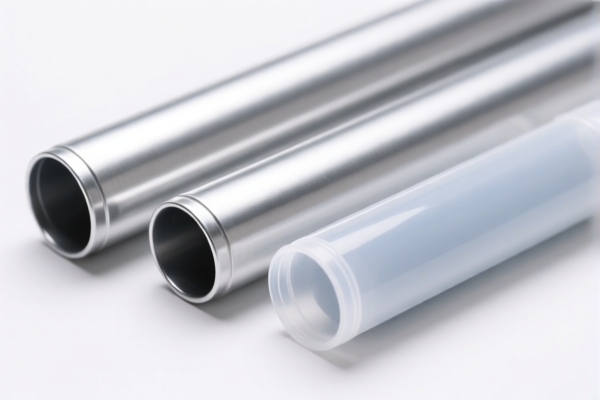
other plastic rigid silver tubes
CN → US| HS Code | Tariff Rate | Origin | Destination | Doc |
|---|---|---|---|---|
| 3926909989 | 22.8% | CN | US | Official Doc |
| 3917290090 | 38.1% | CN | US | Official Doc |
| 3917290050 | 38.1% | CN | US | Official Doc |
| 3926909987 | 22.8% | CN | US | Official Doc |
Product Images



AI Analysis
🧪 Other Plastic Rigid Silver Tubes
🌐 HS Code Reference & Customs Clearance Guide | 2026 Latest Tariff Analysis | Professional Clearance Strategy
📌 I. Product Definition & Classification: Do You Really Know "Plastic Rigid Silver Tubes"?
"Other Plastic Rigid Silver Tubes" are typically industrial or consumer packaging components, often used for cosmetics, adhesives, or specialty products. The key characteristics defining their classification are:
- Material: Plastic (Polymer base).
- Form: Rigid Tubes (Hard-bodied, not collapsible like standard toothpaste tubes, or semi-rigid depending on specific resin).
- Appearance: Silver (This refers to surface treatment/decoration, not the material composition. They are NOT metal tubes).
⚠️ Critical Distinction:
- If the tube is made of metal (silver-plated or stainless steel) → It would fall under Chapter 73 or 76.
- Since the prompt specifies "Plastic", it must remain in Chapter 39.
- The term "Silver" is a descriptive attribute (color/finish) and does not change the material classification unless it constitutes a significant metal cladding that changes the essential character (rare for standard plastic tubes).
📦 II. HS Code Classification Details (2026 Latest Tariff Authority Comparison)
Based on the provided data, the product falls into two main categories: General Plastic Articles or Plastic Pipes/Hoses/Tubes. The choice depends on whether the "tube" is viewed as a specific pipe/hose article (3917) or a general manufactured article (3926).
| HS Code | Product Description | Application Scenario | Key Classification Logic |
|---|---|---|---|
3917.29.00.90 |
Other plastic rigid tubes | Industrial tubing, rigid packaging tubes, chemical-resistant pipes | ✅ Match: Material is plastic, form is rigid tube. Fits "Other plastic rigid tubes". |
3917.29.00.50 |
Other plastic rigid tubes | Similar to above, used as a "catch-all" for rigid plastic tubing not elsewhere specified | ✅ Match: Material is plastic, form is rigid tube. "Other" category covers generic rigid tubes. |
3926.90.99.89 |
Other plastic articles (General) | Garden hoses, decorative tubes, or tubes not considered "pipes/tubing" in the strict sense | ✅ Match: If deemed a "garden tube" or general accessory, it falls under the residual "other articles" category. |
3926.90.99.87 |
Other plastic articles (General) | Similar to above, often used for specific industrial plastic items not classified as pipes | ✅ Match: Material is plastic, form is rigid. "Garden use" or general utility places it here as a residual category. |
🔍 Key Clarification:
- 3917 vs. 3926:
- 3917 covers "Trunking, pipe and hose fittings... and tubes, pipes and hoses." If the tube is a functional conduit or rigid packaging tube, 3917 is the more specific heading.
- 3926 covers "Other articles of plastics." This is the "catch-all" for plastic items that don't fit into specific headings like bottles (3923), tubes (3917), or fittings. If the "silver tube" is a decorative item or a garden hose (as hinted in the data), 3926 is applied.
- Why "Silver" Doesn't Matter: The color or metallic finish (silver plating/foil on plastic) does not override the base material (plastic) for HS classification purposes unless it becomes a composite article where metal is the essential character (which is not the case here).
💰 III. 2026 Latest Tariff Rate Breakdown (Including Surtaxes & Policy Add-ons)
✅ Applicable Country: United States (US)
✅ Origin: China (CN)
✅ Effective Date: From November 10, 2025 (and subsequent imports)
🎯 1. 3917.29.00.90 & 3917.29.00.50 —— Other Plastic Rigid Tubes
These two codes share the same tariff structure as per the provided data.
| Item | Content |
|---|---|
| Base Tariff | 3.1% (ad valorem) |
| Section 301 Surtax | +25.0% (Additional duty under US Trade Act Section 301) |
| 122-Clause Tariff | +10.0% (Section 122 tariff, often related to specific strategic sectors or trade remedies) |
| Total Tariff Rate | 38.1% |
| Tax Calculation | CIF Value × 38.1% |
| De Minimis Eligibility | ❌ No (Denied) |
| Legal Basis Path | Base Tariff: 3.1% → Section 301: 25.0% → Section 122: 10.0% → Total: 38.1% |
📌 Interpretation:
- Plastic tubes are heavily scrutinized under Section 301 due to their widespread use in manufacturing and packaging.
- The 38.1% total rate is significantly higher than the base rate, impacting profit margins.
- Section 122 adds an extra 10%, further increasing the cost.
🎯 2. 3926.90.99.89 & 3926.90.99.87 —— Other Plastic Articles
These two codes share the same tariff structure.
| Item | Content |
|---|---|
| Base Tariff | 5.3% (ad valorem) |
| Section 301 Surtax | +7.5% (Additional duty under US Trade Act Section 301) |
| 122-Clause Tariff | +10.0% (Section 122 tariff) |
| Total Tariff Rate | 22.8% |
| Tax Calculation | CIF Value × 22.8% |
| De Minimis Eligibility | ❌ No (Denied) |
| Legal Basis Path | Base Tariff: 5.3% → Section 301: 7.5% → Section 122: 10.0% → Total: 22.8% |
📌 Interpretation:
- These codes are categorized under "Other Plastic Articles," which often includes garden hoses or non-industrial rigid tubes.
- The 22.8% total rate is lower than the 3917 codes, making it a more cost-effective classification if the product can be justified as a general plastic article or garden supply rather than an industrial tube.
- Why lower Section 301? The specific subheading may be eligible for a reduced surtax rate under certain exemptions or policy adjustments for general plastic goods.
🛠️ IV. Customs Clearance Practical Advice (Battle-Tested Pitfall Guide)
✅ 1. Required Documentation Checklist (Non-Negotiable)
| Document | Must Provide | Explanation |
|---|---|---|
| ✅ Product Specifications | ✔️ | Detailed description: Material (e.g., PE, PP, PVC), Wall Thickness, Diameter, Rigid vs. Semi-Rigid. |
| ✅ Product Photos | ✔️ | Clear images showing the "Silver" finish, cross-section (to prove plastic, not metal), and labels. |
| ✅ Material Safety Data Sheet (MSDS) | ✔️ | For plastic composition, especially if used for food/cosmetic contact. |
| ✅ Commercial Invoice | ✔️ | Clearly state "Plastic Rigid Tube," NOT "Metal Tube." Include HS Code if pre-approved. |
| ✅ Packing List | ✔️ | Detail weight, dimensions, and number of pieces. |
| ✅ Declaration Statement | ✔️ | Explicitly state: "Made of Plastic, Silver Finish is Surface Treatment, Not Metal." |
✅ 2. Declaration Strategy (Key Rules)
🔥 "Plastic Base, Silver Look, Choose 3917 or 3926, Avoid Metal Mistake!"
| Scenario | Correct Declaration | Wrong Practice |
|---|---|---|
| Industrial Rigid Tube | HS: 3917.29.00.90 or 3917.29.00.50Tax: 38.1% |
Misdeclaring as Metal Tube (7304/7608) → High duty + Fraud risk |
| Garden Hose/Decorative Tube | HS: 3926.90.99.89 or 3926.90.99.87Tax: 22.8% |
Misdeclaring as General Plastic without justification → Audit risk |
| Metal-Coated Plastic Tube | HS: 3917 or 3926(If plastic is essential character) |
Declaring as Metal → Incorrect classification |
| Collapsible Tube | HS: 3923.21.00.00 (Packaging) |
Declaring as "Rigid Tube" → Mismatch with physical form |
📌 Critical Tip:
- Do NOT use the word "Silver" alone to describe the material. Always specify "Plastic, Silver Finished" or "Polymer Tube with Metallic Appearance."
- If the tube is used for garden purposes, lean towards 3926 for the lower 22.8% tariff, but ensure it's not classified as a "pipe" for industrial fluids.
✅ 3. Special Situations Handling
| Situation | Handling Advice |
|---|---|
| Silver Plating Thickness | If the silver layer is thin (decorative), it remains a plastic article. If thick enough to be a metal tube, reclassify. Provide proof of thinness (e.g., coating microns). |
| OEM Custom Silver Tubes | Provide design specs and client contracts. Ensure the description matches the actual physical product. |
| Food-Grade Plastic Tubes | Provide FDA compliance certificates. May require additional testing for migration. |
| High-Value Precision Tubes | Consider applying for an Exclusion under Section 301 if available for specific plastic articles (check USTR exclusion list). |
🌍 V. Global Market Customs Comparison (2026 Latest)
| Country/Region | Recommended HS Code | Tariff Rate | Certification Requirements | Notes |
|---|---|---|---|---|
| 🇺🇸 USA | 3917.29.00.90 / 3926.90.99.89 |
38.1% / 22.8% | FDA (if food contact), Prop 65 | High surtaxes apply. |
| 🇨🇳 China | 3917 / 3926 |
5-6% | CCC (if applicable) | Lower tariffs, no Section 301. |
| 🇪🇺 EU | 3917 / 3926 |
6.5% / 4.5% | REACH, RoHS | No surtaxes, but strict chemical compliance. |
| 🇬🇧 UK | 3917 / 3926 |
6.5% / 4.5% | UKCA, REACH | Post-Brexit rules apply. |
| 🇨🇦 Canada | 3917 / 3926 |
5-6% | ISED (if electronic components) | Generally low tariffs. |
📌 Conclusion:
- USA is the most expensive market due to Section 301 and 122 tariffs.
- 3926 codes (22.8%) offer significant savings over 3917 codes (38.1%) if the product can be classified as "Other Plastic Articles" (e.g., garden tubes).
- EU/UK have stable, lower tariffs but require strict environmental compliance (REACH).
📌 VI. Common Mistakes & Pitfall Guide (Blood & Tears Lessons)
❌ Mistake 1: Declaring "Silver Tube" without specifying material
👉 Consequence: Customs may suspect metal → Audit → Delay + Penalty.
Fix: Always state "Plastic" and "Silver Finish."
❌ Mistake 2: Using HS 3917 for Garden Hoses
👉 Consequence: Higher tariff (38.1%) vs. 3926 (22.8%).
Fix: If it's a garden hose, use 3926.90.99.89 or 3926.90.99.87.
❌ Mistake 3: Misrepresenting Material as Metal
👉 Consequence: Fraud investigation, seizure of goods.
Fix: Provide material certificates proving plastic base.
✅ Correct Practice:
"Plastic Rigid Tube, Silver Metallic Finish, Material: PP, Diameter: 25mm, For Cosmetic Packaging, FDA Compliant, HS Code: 3917.29.00.90"
🎯 VII. Conclusion: Professional Classification, Time-Saving, Cost-Reduction!
🎯 Remember the Mantra:
🔹 "Plastic Base, Silver Look, 3917 is High (38.1%), 3926 is Lower (22.8%)."
🔹 "HS Code Determines Tax, 15% Difference Matters, Misclassification Costs Millions!"
📌 Pro Tip:
If your product qualifies as "Other Plastic Articles" (e.g., garden tubes, decorative items), use
3926.90.99.89to save 15.3% in tariffs compared to3917.
However, ensure the product does not function as an industrial pipe/tube (which would mandate3917).
Always consult a customs broker for pre-classification rulings if unsure.
📣 Immediate Action:
📞 Contact a professional customs broker + Provide product photos + Apply for HS Code Pre-Ruling
🚀 Let your "Plastic Rigid Silver Tubes" clear customs smoothly, efficiently, and profitably!
✨ Professional Clearance Starts with Accurate Classification!
💼 Every cent of cost should be precisely calculated!
Customer Reviews
About HS Code Classification
The Harmonized System (HS) is an internationally standardized nomenclature developed by the World Customs Organization (WCO) to classify traded products. Over 200 countries use the HS system as the basis for customs tariffs, trade statistics, and import/export regulations.
Each HS code follows a hierarchical structure:
- Chapter (2 digits) — Broad category of goods (e.g., Chapter 84: Machinery and Mechanical Appliances)
- Heading (4 digits) — More specific grouping within the chapter
- Subheading (6 digits) — Internationally standardized breakdown, used by all WCO member countries
- National subdivisions (8-10 digits) — Country-specific extensions for further classification, such as US HTSUS 10-digit codes
Correct HS code classification is essential for smooth customs clearance, accurate duty payment, and compliance with trade regulations. Misclassification can lead to customs delays, overpayment of duties, or penalties.
When importing from CN to US, the applicable tariff rates may include:
- Most-Favored-Nation (MFN) rate — The standard duty rate applied to WTO members
- General rate — Applied to countries without trade agreements
- Trade remedy duties — Additional tariffs such as Section 301 (anti-dumping), Section 232 (national security), or countervailing duties
The information provided on this page is for reference purposes only. For official classification, please consult with your local customs authority or a licensed customs broker.