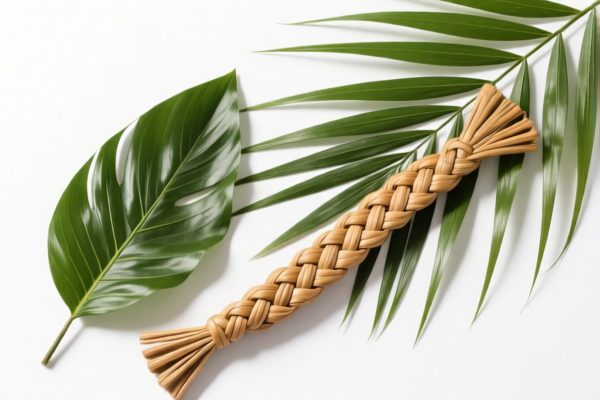
palm leaf braided products
CN → US| HS Code | Tariff Rate | Origin | Destination | Doc |
|---|---|---|---|---|
| 4602191400 | 35.0% | CN | US | Official Doc |
| 4602191600 | 40.0% | CN | US | Official Doc |
| 9403893020 | 35.0% | CN | US | Official Doc |
| 9403893010 | 35.0% | CN | US | Official Doc |
| 4602191400 | 35.0% | CN | US | Official Doc |
Product Images



AI Analysis
🌿 Palm Leaf Braided Products (Woven Goods)
🌐 HS Code Reference & Customs Clearance Guide | 2026 Latest Tariff Structure | Professional Clearance Strategy 📌 I. Product Definition & Classification: Do You Know "Palm Leaf" Goods?
Palm leaf braided products are traditional handicrafts and home decor items made from dried palm fronds. In international trade, the classification depends heavily on the specific material source (true palm vs. look-alike materials like rattan/visco) and the form (finished good vs. raw material).
Under US Customs regulations (HTSUS), these items generally fall under Chapter 46 (Woven materials of plaiting materials) or Chapter 94 (Furniture, lighting, etc.).
⚠️ Critical Distinction:
- If the product is a finished woven good (e.g., baskets, mats, hats) made specifically from palm leaves → It belongs to 4602.19.
- If the product is classified under "Other" furniture or woven materials that are not specifically palm, or if they are considered "basketware" not specified elsewhere → It may fall under 9403.89.
- Key Risk: Misclassifying "palm" as "rattan/visco" or vice versa can trigger different duty rates due to Section 301 and Section 122 tariffs.
📦 II. HS Code Classification Details (Based on Provided Data)
The following HS Codes are extracted strictly from the provided <DATA> for Palm Leaf Braided Products.
| HS Code | Product Summary | Material / Form | Total Tax Rate |
|---|---|---|---|
4602.19.14.00 |
Palm leaf braided finished goods | Material: Palm leaves Form: Woven products |
35.0% |
4602.19.16.00 |
Palm leaf braided finished goods | Material: Palm leaves Form: Woven items |
40.0% |
9403.89.30.20 |
Other palm leaf woven materials | Material: Palm leaves (Rattan/Willow-like) Form: Woven materials |
35.0% |
9403.89.30.10 |
Other palm leaf woven materials | Material: Rattan-like/Similar Form: Woven materials (Catch-all category) |
35.0% |
4602.19.14.00 |
Other palm leaf woven materials | Material: Palm leaves Form: Woven products (Other categories) |
35.0% |
🔍 Analysis:
- Codes4602.19.14.00and9403.89.30.20&.10share the same total tax rate of 35%.
- Code4602.19.16.00is the most expensive at 40%.
- The difference often lies in the specific sub-headings for "woven materials" vs. "finished woven goods" and the precise definition of "palm" vs. "rattan-like" materials in customs interpretation.
💰 III. 2026 Latest Tariff Rate Breakdown (Detailed Policy)
✅ Applicable Country: United States (US)
✅ Origin: China (CN) [Assumed based on tariff structure: Section 301 + Section 122]
✅ Effective Date: Current applicable rates as per provided data
🎯 1. HS Code 4602.19.14.00 & 9403.89.30.20 / .10
(Most Common Classifications for Palm Leaf Goods)
| Item | Content |
|---|---|
| Base Tariff | 0.0% (Ad Valorem) |
| Section 301 Surcharge | +25.0% (Trade Act of 1974, Section 301) |
| Section 122 Surcharge | +10.0% (Specific provision for certain goods from China) |
| Total Tax Rate | 35.0% |
| Tax Calculation | CIF Value × 35% |
| De Minimis Exemption | ❌ Not Eligible (Section 301 and 122 duties typically do not apply to de minimis, but for commercial import, it applies) |
| Legal Basis Path | Base Rate: 0% → USITC Section 301 Footnote → Section 122 Provision |
📌 Explanation:
- Base Rate 0%: Woven goods of plaiting materials (Ch 46) often have low base duties.
- Section 301 (25%): Applied to most Chinese-origin manufactured goods, including many woven products.
- Section 122 (10%): A specific additional duty applied to certain goods from China.
- Total 35%: This is the standard high-duty bracket for these items.
🎯 2. HS Code 4602.19.16.00
(Higher Duty Category)
| Item | Content |
|---|---|
| Base Tariff | 5.0% |
| Section 301 Surcharge | +25.0% |
| Section 122 Surcharge | +10.0% |
| Total Tax Rate | 40.0% |
| Tax Calculation | CIF Value × 40% |
| De Minimis Exemption | ❌ Not Eligible |
| Legal Basis Path | Base Rate: 5% → USITC Section 301 Footnote → Section 122 Provision |
📌 Note:
- The base rate for this specific sub-category is 5%, unlike the 0% for others.
- Even with a 5% base, the total remains 40% due to the same 35% in surcharges (25% + 10%).
- Avoid this code if possible if4602.19.14.00is applicable, as it saves 5% on the CIF value.
🛠️ IV. Customs Clearance Practical Advice (Pitfall Avoidance)
✅ 1. Preparation Checklist (Non-negotiable)
| Document | Required? | Explanation |
|---|---|---|
| ✅ Product Specifications | ✔️ | Must clearly state "Material: Palm Leaves" vs. "Rattan/Vienna Grass". |
| ✅ Material Composition Certificate | ✔️ | Prove the material is palm. If it's synthetic, HTSUS changes completely. |
| ✅ High-Res Photos | ✔️ | Show texture to distinguish palm from rattan/willow. |
| ✅ Commercial Invoice | ✔️ | Must match the HS Code description exactly (e.g., "Woven Palm Leaf Basket"). |
| ✅ Packing List | ✔️ | Weight and dimensions for customs valuation. |
| ✅ Section 301 Exclusion (if applicable) | ❌ | Note: Exclusions for these items are rare/expired. Assume 35-40% duty. |
✅ 2. Declaration Tips (Key Mnemonics)
🔥 "Be Precise: Palm vs. Rattan, Finish vs. Material"
| Situation | Correct Declaration | Wrong Practice |
|---|---|---|
| Finished Baskets/Mats | 4602.19.14.00 (35%) | Declare as "Home Decor" → Unclear → Delay |
| Unfinished Weaves | 9403.89.30.20 (35%) | Declare as "Finished Goods" → Overpay? Or Underpay? Risk |
| Rattan/Willow Imitation | Check if 9403.89.30.10 (35%) | Call it "Palm" if it's not → Fraud/Risk |
| Synthetic Plastic "Palm" | 3926.90 (Different Code) | Call it "Natural Palm" → Seizure |
✅ 3. Special Handling
| Scenario | Recommendation |
|---|---|
| Mixed Materials | If the product has palm leaves + metal/plastic parts, the essential character determines the code. If palm is dominant, Ch 46 may still apply, but consult a broker. |
| Sample vs. Bulk | Samples for evaluation may qualify for Section 321 (De Minimis) if < $800, but do not use for commercial goods to avoid "structuring" allegations. |
| Origin Labeling | Must clearly mark "Made in China" on products and packaging. Missing labels can lead to penalties. |
🌍 V. Global Market Comparison (2026)
| Country/Region | Recommended HS Code | Estimated Duty | Notes |
|---|---|---|---|
| 🇺🇸 USA | 4602.19.14.00 |
35% | High due to Sec 301 + 122. |
| 🇺🇸 USA | 4602.19.16.00 |
40% | Higher base rate. Avoid if possible. |
| 🇨🇳 China | 4602.19.14.00 |
~5-8% | Import duty for China (reverse flow) may differ. |
| 🇪🇺 EU | 4602.19 |
Varies (0-6%) | No Section 301 equivalent. Check CE/FSC certification for wood-based. |
| 🇬🇧 UK | 4602.19 |
~6% | Post-Brexit tariffs may apply. |
📌 Conclusion:
- USA is the most expensive market for these goods due to punitive tariffs.
- Cost Optimization: Try to classify under4602.19.14.00(35%) rather than4602.19.16.00(40%).
- Alternative: If products are plastic/synthetic, they may have lower duties but face stricter environmental regulations.
📌 VI. Common Mistakes & Pitfalls (Blood & Tears Lessons)
❌ Mistake 1: Calling all woven baskets "Palm Leaf"
👉 Consequence: If customs finds it's rattan, they may reassess. If it's synthetic, it's a different HS code entirely.
👉 Solution: Provide material analysis.
❌ Mistake 2: Ignoring Section 122 Tariff
👉 Consequence: Many importers only account for Section 301 (25%). Forgetting the extra 10% leads to underpayment of duties.
👉 Solution: Always calculate Base + 25% + 10%.
❌ Mistake 3: Confusing "Woven Material" with "Woven Product"
👉 Consequence: 9403.89 codes are for "Other" furniture/materials. 4602 is specific. Misclassification can lead to audits.
👉 Solution: Use 4602 for genuine woven goods of plaiting materials.
✅ Correct Declaration Example:
"Hand-woven Palm Leaf Basket, Natural Color, No Metal Parts.
HS Code: 4602.19.14.00
Country of Origin: China
Base Duty: 0%, Sec 301: 25%, Sec 122: 10%, Total: 35%"
🎯 VII. Conclusion: Smart Classification, Lower Costs
🎯 Key Takeaways:
🔹 "Palm is 35%, 'Other' is 35%, Specific is 40%."
🔹 "Don't forget the 10% Section 122 on top of 25% Section 301!"
🔹 "Always distinguish Palm from Rattan to avoid Misclassification."
📌 Pro Tip:
If you are shipping < $800 per shipment into the US, you MAY qualify for De Minimis (Section 321) exemption, BUT be aware that:
1. Section 301 tariffs are still applicable even under de minimis for China-origin goods.
2. Do not structure shipments to evade duties.
3. For commercial imports (> $800), budget for 35-40% duty.
📣 Action Required:
📞 Consult a Licensed Customs Broker to confirm if your specific product fits
4602.19.14.00vs4602.19.16.00.
📄 Ensure "Made in China" labels are visible on every item.
📉 Negotiate Price: Factor in the 35-40% duty into your landed cost.
✨ Clear Classification, Smooth Clearance, Profitable Trade!
💼 Every percent counts in the age of tariffs.
Customer Reviews
About HS Code Classification
The Harmonized System (HS) is an internationally standardized nomenclature developed by the World Customs Organization (WCO) to classify traded products. Over 200 countries use the HS system as the basis for customs tariffs, trade statistics, and import/export regulations.
Each HS code follows a hierarchical structure:
- Chapter (2 digits) — Broad category of goods (e.g., Chapter 84: Machinery and Mechanical Appliances)
- Heading (4 digits) — More specific grouping within the chapter
- Subheading (6 digits) — Internationally standardized breakdown, used by all WCO member countries
- National subdivisions (8-10 digits) — Country-specific extensions for further classification, such as US HTSUS 10-digit codes
Correct HS code classification is essential for smooth customs clearance, accurate duty payment, and compliance with trade regulations. Misclassification can lead to customs delays, overpayment of duties, or penalties.
When importing from CN to US, the applicable tariff rates may include:
- Most-Favored-Nation (MFN) rate — The standard duty rate applied to WTO members
- General rate — Applied to countries without trade agreements
- Trade remedy duties — Additional tariffs such as Section 301 (anti-dumping), Section 232 (national security), or countervailing duties
The information provided on this page is for reference purposes only. For official classification, please consult with your local customs authority or a licensed customs broker.