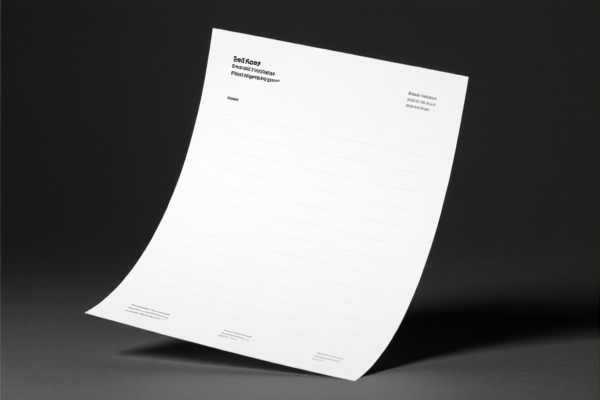
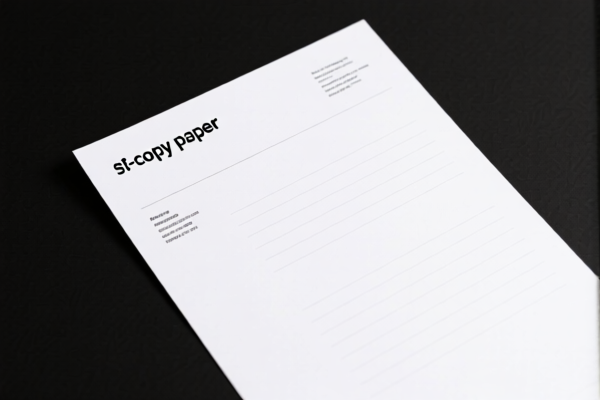
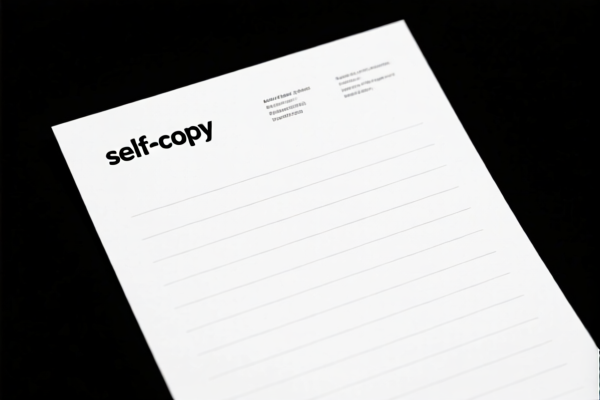
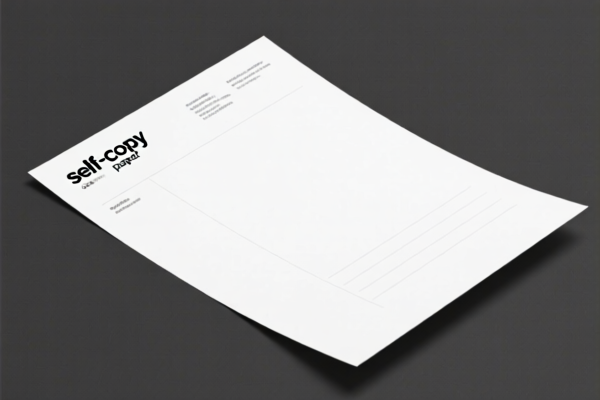
single sheet carbonless paper
CN → US| HS Code | Tariff Rate | Origin | Destination | Doc |
|---|---|---|---|---|
| 4820400000 | 35.0% | CN | US | Official Doc |
| 4811908050 | 35.0% | CN | US | Official Doc |
| 4819200040 | 35.0% | CN | US | Official Doc |
| 4820104000 | 35.0% | CN | US | Official Doc |
| 4811904090 | 35.0% | CN | US | Official Doc |
Product Images
AI Analysis
📄 Single Sheet Carbonless Paper (NCR Paper)
🌐 HS Code Reference & Customs Clearance Guide | 2026 Latest Tariff Analysis | Professional Entry Strategy
📌 I. Product Definition & Classification: Do You Truly Understand "Carbonless Paper"?
Carbonless copy paper, commonly known as NCR (No Carbon Required) paper, is a specialized multilingual paper that produces copies without the need for traditional carbon paper or thermal treatment. In international trade, its classification depends heavily on its state (rolled sheet vs. bound book) and processing method (coated vs. plain).
For "Single Sheet Carbonless Paper", the primary forms are: 1. Loose Sheets: Often classified under headings for coated papers (4811) or specific carbonless types. 2. Multi-part Forms: If the sheets are perforated or assembled into business forms, they may fall under 4820 or 4819.
⚠️ Key Distinction:
- If the item is loose, unbound sheets of coated paper → Typically 4811 or 4819.
- If the item is bound, folded, or assembled into a booklet/form → Typically 4820 or 4819.
- Carbonless specifically refers to the chemical coating (CL/CFB/CF) that enables replication.
📦 II. HS Code Classification Details (2026 Latest Tariff Authority Comparison)
Based on the provided data, here are the exact classifications for Carbonless Paper/Forms:
| HS Code | Product Description | Application Scenario | Physical Form |
|---|---|---|---|
4811.90.80.50 |
Carbonless Paper (Loose Sheets) | Unbound coated paper, printing substrate, or raw material for forms. | Loose Sheets (Rolls or Flat Sheets) |
4811.90.40.90 |
Carbon式复写纸 (Carbon Paper) | Traditional or chemical carbon paper for multi-part forms. | Coated/Treated Paper |
4820.40.00.00 |
Carbonless Books/Forms | Multi-part business documents, invoices, receipts prepared for use. | Assembled Forms (Multi-part) |
4820.10.40.00 |
Notebooks/Account Books | Bound carbonless notebooks or ledgers. | Bound/Assembled |
4819.20.00.40 |
Folding/Binding Paper Containers | Folded or bound paper articles (e.g., pre-folded carbonless forms). | Folded/Containerized |
🔍 Critical Reminder:
- Loose Sheets vs. Finished Forms: The most common error is misclassifying loose carbonless sheets as "books" or vice versa.
- Coated Paper (4811): If the paper is simply coated carbonless material without being printed or bound into a specific document format, 4811.90.80.50 is the most accurate.
- Multi-part Business Forms: If the sheets are already perforated, assembled, or printed as specific business forms (e.g., 3-ply invoices), 4820.40.00.00 is preferred.
💰 III. 2026 Latest Tariff Rate Breakdown (Including Surcharges & Policy Add-ons)
✅ Applicable Country: United States (US)
✅ Origin: China (CN)
✅ Effective Date: From November 10, 2025 (including subsequent imports)
🎯 1. 4811.90.80.50 —— Carbonless Paper (Coated Paper Products)
| Item | Content |
|---|---|
| Base Tariff | 0.0% (Ad Valorem) |
| Section 301 Surcharge | +25.0% (USITC Footnote) |
| Section 122 Tariff | +10.0% (Specific China-related clause) |
| Total Tariff Rate | 35.0% |
| Tax Calculation | CIF Value × 35% |
| De Minimis Eligibility | ❌ Not Eligible (High tariff threshold blocks 800 USD exemption) |
| Legal Authority Path | USITC:4811.90.80.50 → Section 301: 25% → Section 122: 10% |
📌 Explanation:
- "Base Tariff 0%": Standard MSW (Most Favored Nation) rate for many paper products is low or zero.
- "301 Surcharge 25%": Added under Trade Act Section 301 for Chinese-origin goods.
- "Section 122 Tariff 10%": Specific additional tariff applicable to certain Chinese imports.
- Total 35%: This is a high effective duty rate. Importers must budget accordingly.
🎯 2. 4811.90.40.90 —— Carbon式复写纸 (Carbon Paper)
| Item | Content |
|---|---|
| Base Tariff | 0.0% |
| Section 301 Surcharge | +25.0% |
| Section 122 Tariff | +10.0% |
| Total Tariff Rate | 35.0% |
| Tax Calculation | CIF × 35% |
| De Minimis Eligibility | ❌ Not Eligible |
| Legal Authority Path | USITC:4811.90.40.90 → Section 301: 25% → Section 122: 10% |
📌 Note:
- Whether classified as "Carbonless Paper" or "Carbon Paper," the tariff structure is identical due to the 301 and 122 clauses.
- Ensure the description clearly distinguishes between "Carbonless" (NCR) and "Carbon" (wet/dry transfer) to avoid海关 review delays.
🎯 3. 4820.40.00.00 / 4820.10.40.00 / 4819.20.00.40 —— Finished Forms/Books
| Item | Content |
|---|---|
| Base Tariff | 0.0% |
| Section 301 Surcharge | +25.0% |
| Section 122 Tariff | +10.0% |
| Total Tariff Rate | 35.0% |
| Tax Calculation | CIF × 35% |
| De Minimis Eligibility | ❌ Not Eligible |
| Legal Authority Path | USITC:[Code] → Section 301: 25% → Section 122: 10% |
📌 Note:
- Even if the product is a "finished book" or "form," the 35% total rate applies.
- Classification must be precise:
- 4820.40.00.00: For multi-part business forms (e.g., invoices, receipts).
- 4820.10.40.00: For notebooks/ledgers.
- 4819.20.00.40: For folded/bound paper containers.
🛠️ IV. Customs Clearance Practical Advice (Battle-Tested Pitfall Avoidance)
✅ 1. Document Preparation Checklist (All Mandatory)
| Document | Mandatory | Description |
|---|---|---|
| ✅ Product Specification Sheet | ✔️ | Must specify: Paper weight (gsm), coating type (CL/CFB/CF), number of parts (e.g., 2-ply, 3-ply). |
| ✅ Material Composition | ✔️ | Clearly state: "Paper base with chemical coating, no carbon insert." |
| ✅ Product Photos | ✔️ | Show coating color, packaging, and any printed multi-part format. |
| ✅ Commercial Invoice | ✔️ | Must match HS Code description exactly. Avoid vague terms like "Stationery." |
| ✅ Packing List | ✔️ | Detail quantity, weight, and packaging type (rolls vs. sheets). |
✅ 2. Declaration Tips (Key Mnemonics)
🔥 "Coat vs. Bind, 301 Hits 25%, 122 Adds 10%, Total 35%!"
| Scenario | Correct Declaration | Common Mistake |
|---|---|---|
| Loose Carbonless Sheets | 4811.90.80.50 |
Misclassifying as 4802 (plain paper) → Risk of audit |
| Pre-printed Multi-part Forms | 4820.40.00.00 |
Declaring as "notebooks" → 4820.10.40.00 (similar rate, but wrong description) |
| Bound Carbonless Notebooks | 4820.10.40.00 |
Declaring as "loose paper" → Potential duty discrepancy |
| Folded Receipt Books | 4819.20.00.40 |
Declaring as "cardboard boxes" → Wrong classification |
📌 Critical Advice:
- Do not assume "Stationery" is a valid classification. It is too vague.
- Do not split a multi-part form into individual sheets for declaration if they are intended for use as a set.
✅ 3. Special Circumstances Handling
| Situation | Handling Advice |
|---|---|
| OEM Custom Forms | Provide design files and print proofs to prove "specialized business form" status. |
| Mixed Shipments | Declare carbonless paper and plain paper separately. Mixing may trigger full inspection. |
| Small Samples | If value < $800, still subject to 35% duty due to high tariff rate (de minimis exemption denied). |
🌍 V. Global Market Customs Comparison (2026 Latest)
| Country/Region | Recommended HS Code | Tariff Rate | Certification | Notes |
|---|---|---|---|---|
| 🇺🇸 USA | 4811.90.80.50 |
35% | None specific | High tariff due to 301 & 122 clauses. |
| 🇨🇳 China | 4811.90.80.50 |
5-8% | CCC (if applicable) | Lower export duty. |
| 🇪🇺 EU | 4811.90 |
6.5% | REACH | No US-style surcharges. |
| 🇬🇧 UK | 4811.90 |
6.5% | UKCA | Post-Brexit alignment with EU. |
| 🇯🇵 Japan | 4811.90 |
6.0% | PSE (if electrical parts) | No major surcharges. |
📌 Conclusion:
- USA is the most expensive market for Chinese carbonless paper due to 35% total tariff.
- China and EU have significantly lower duties, but China is the manufacturing hub, not the destination.
- Strategic Sourcing: Consider sourcing from non-Chinese origins (e.g., Vietnam, India) to avoid Section 301 and 122 tariffs if shipping to the US.
📌 VI. Common Errors & Pitfall Guide (Blood-Taught Lessons)
❌ Mistake 1: Declaring "Carbonless Paper" as "Plain Paper" (4802)
👉 Consequence: Under-declaration of value/duty → Fines + Back Taxes!
👉 Reality: Carbonless paper requires special chemical coatings, classified under 4811/4820.
❌ Mistake 2: Ignoring Section 122 Tariff
👉 Consequence: Customs assessment includes 10% extra charge → Unexpected Cost!
👉 Reality: 122 clause applies to many Chinese paper products. Always check total rate.
❌ Mistake 3: Vague Description "Office Supplies"
👉 Consequence: Customs holds shipment for inspection → Delays + Demurrage Fees!
👉 Reality: Use precise terms: "Carbonless Copy Paper, Coated, 2-Ply, 50 Sheets."
✅ Correct Practice:
"Carbonless Paper, Multi-part, No Carbon Required (NCR), Coated Paper, 70gsm, 2-Ply Form, HS Code 4811.90.80.50, Made in China."
🎯 VII. Conclusion: Precision in Classification Saves Costs!
🎯 Remember This Mantra:
🔹 "Loose Sheets = 4811, Finished Forms = 4820, Total Duty = 35%!"
🔹 "301 Adds 25%, 122 Adds 10%, No De Minimis Exemption!"
📌 Pro Tip:
If your carbonless paper is originating from Vietnam, Malaysia, or India, you may avoid Section 301 and 122 tariffs, reducing the rate to 0-6.5%.
Recommend Advance Ruling (Pre-classification) with US CBP to confirm the HS Code before shipping.
📣 Immediate Action:
📞 Consult a licensed customs broker + Provide product specs + Apply for HS Code pre-ruling
🚀 Ensure smooth customs clearance, avoid unexpected fees, and maximize profit margins!
✨ Professional Customs Clearance Starts with Accurate Classification!
💼 Every Percent of Duty Counts!
Customer Reviews
About HS Code Classification
The Harmonized System (HS) is an internationally standardized nomenclature developed by the World Customs Organization (WCO) to classify traded products. Over 200 countries use the HS system as the basis for customs tariffs, trade statistics, and import/export regulations.
Each HS code follows a hierarchical structure:
- Chapter (2 digits) — Broad category of goods (e.g., Chapter 84: Machinery and Mechanical Appliances)
- Heading (4 digits) — More specific grouping within the chapter
- Subheading (6 digits) — Internationally standardized breakdown, used by all WCO member countries
- National subdivisions (8-10 digits) — Country-specific extensions for further classification, such as US HTSUS 10-digit codes
Correct HS code classification is essential for smooth customs clearance, accurate duty payment, and compliance with trade regulations. Misclassification can lead to customs delays, overpayment of duties, or penalties.
When importing from CN to US, the applicable tariff rates may include:
- Most-Favored-Nation (MFN) rate — The standard duty rate applied to WTO members
- General rate — Applied to countries without trade agreements
- Trade remedy duties — Additional tariffs such as Section 301 (anti-dumping), Section 232 (national security), or countervailing duties
The information provided on this page is for reference purposes only. For official classification, please consult with your local customs authority or a licensed customs broker.