Tear off Paper Label
CN → US| HS Code | Tariff Rate | Origin | Destination | Doc |
|---|---|---|---|---|
| 4821902000 | 35.0% | CN | US | Official Doc |
| 4821904000 | 35.0% | CN | US | Official Doc |
| 4911996000 | 17.5% | CN | US | Official Doc |
| 4911998000 | 17.5% | CN | US | Official Doc |
Product Images

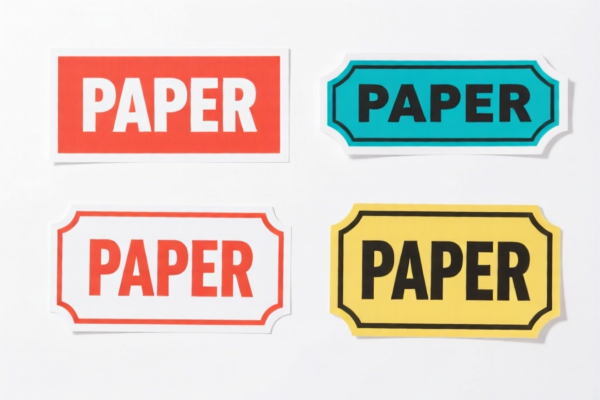

AI Analysis
🏷️ Tear-Off Paper Label (Tear-off Adhesive Labels)
🌐 HS Code Reference & Customs Clearance Guide | 2026 Latest Tariff Analysis | Professional Strategy for Cross-Border Trade
📌 I. Product Definition & Classification: What Exactly is a "Tear-Off Label"?
A Tear-off Paper Label is a self-adhesive label printed on paper substrate, designed to be torn off the liner or roll after application. It is distinct from permanent "permanent adhesive" labels due to its re-removability or specific tear-line functionality.
In international trade, the classification hinges on two critical factors: 1. Material Composition: Is it purely paper, or does it contain significant synthetic components? 2. Printing Nature: Is it considered a simple "label" under Chapter 48, or a complex "printed matter" under Chapter 49?
⚠️ Key Classification Distinction:
- Paper Substrate + Adhesive Liner: Falls under Chapter 48 (Paper/Paperboard) if the primary value is the paper structure.
- Printed Matter: Falls under Chapter 49 (Printed Books/Newspapers) if the value is primarily in the printing content itself, and it fits the definition of "other printed matter."
📦 II. HS Code Classification Details (2026 Latest Tariff Authority Comparison)
Based on the provided data, there are four potential HS Codes. Here is the precise breakdown for Tear-Off Paper Labels:
| HS Code | Product Description | Application Scenario | Classification Logic |
|---|---|---|---|
4821.90.20.00 |
Labels, of paper or paperboard | Standard tear-off labels, price tags, shipping labels where the paper substrate is dominant. | Matches Material: Paper. Matches Use: Label. Category: Paper Labels. |
4821.90.40.00 |
Other labels, of paper or paperboard | Generic paper labels not specifically enumerated elsewhere. "Paper labels" consistency. | Matches Material: "Paper label" in name aligns with "Paper/Board labels" in classification. |
4911.99.60.00 |
Other printed matter | Labels where the printing is the primary characteristic (e.g., complex graphics, branding). Assumed planar printing process. | Matches Material: "Printed on paper". Assumption: Common sense infers planar printing technology. |
4911.99.80.00 |
Other printed matter | General "other printed matter" category. No material conflict. | Matches Attribute: Fits "other printed matter" regarding printed media/materials. |
🔍 Critical Note:
- Chapter 48 (4821): Focuses on the physical product (the label itself). This is the most common classification for commercial paper labels.
- Chapter 49 (4911): Focuses on the content/printing. This is often used for high-value printed materials where the paper cost is negligible compared to the print value.
- Risk: Misclassifying a standard paper label as "printed matter" (Ch 49) when it should be "paper labels" (Ch 48) can lead to duty discrepancies. Ch 48 is generally safer for standard adhesive labels.
💰 III. 2026 Latest Tariff Rate Breakdown (Including Surtaxes & Policy Add-ons)
✅ Applicable Country: United States (US)
✅ Origin: China (CN)
✅ Effective Date: 2025/2026 Import Period
🎯 1. 4821.90.20.00 & 4821.90.40.00 —— Paper Labels (Chapter 48)
These two codes share the same tariff structure in the provided data.
| Item | Content |
|---|---|
| Base Rate | 0.0% (Ad Valorem) |
| USITC Surtax (Section 301) | +25.0% |
| IEEPA Surtax (Section 122) | +10.0% |
| Total Duty Rate | 35.0% |
| Duty Calculation | CIF Value × 35% |
| De Minimis Eligibility | ❌ NO (Denied under current rules for high-duty items from CN) |
| Legal Basis Path | Base: 4821 → USITC: 301 Clause (25%) → IEEPA: 122 Clause (10%) |
📌 Explanation:
- "Base 0%": Paper labels generally have low base tariffs in the US Harmonized Tariff Schedule.
- "301 Clause 25%": Additional duty on Chinese goods under Trade Act Section 301.
- "122 Clause 10%": Specific surcharge referenced in the data (likely related to recent executive orders or specific trade provisions).
- Total 35%: This is a significant cost factor. Even though the base is 0%, the surtaxes make it expensive.
🎯 2. 4911.99.60.00 & 4911.99.80.00 —— Other Printed Matter (Chapter 49)
These two codes also share the same tariff structure.
| Item | Content |
|---|---|
| Base Rate | 0.0% (Ad Valorem) |
| USITC Surtax (Section 301) | +7.5% |
| IEEPA Surtax (Section 122) | +10.0% |
| Total Duty Rate | 17.5% |
| Duty Calculation | CIF Value × 17.5% |
| De Minimis Eligibility | ❌ NO (Check latest de minimis thresholds; often restricted for CN origin) |
| Legal Basis Path | Base: 4911 → USITC: 301 Clause (7.5%) → IEEPA: 122 Clause (10%) |
📌 Explanation:
- Why Lower?: The USITC surtax for "Other Printed Matter" (4911) is listed as 7.5% in the data, compared to 25% for Paper Labels (4821).
- Strategic Implication: If your product can legally be classified under Chapter 49, you save 17.5% in duties (17.5% vs 35%).
- Caution: This classification requires strong justification that the item is primarily "printed matter" rather than a "label" by use. Customs may challenge this if the product is functionally a label.
🛠️ IV. Customs Clearance Practical Advice (Real-World Pitfall Guide)
✅ 1. Preparation Checklist (Non-Negotiable)
| Document | Required? | Explanation |
|---|---|---|
| ✅ Product Specification Sheet | ✔️ | Must specify: Material (Paper type), Adhesive type (Removable/Tear-off), Dimensions, Printing method. |
| ✅ Product Photos | ✔️ | Show the tear-off line, the label surface, and the liner. Prove it is a "label." |
| ✅ Commercial Invoice | ✔️ | Clearly describe as "Tear-off Paper Labels" or "Printed Paper Labels." Avoid vague terms like "Paper Product." |
| ✅ Origin Certificate | ✔️ | Crucial for determining eligibility for surtax exemptions (if any) or verifying CN origin. |
| ✅ Printing Details | ✔️ | If claiming Ch 49 (17.5%), provide evidence of printing process (e.g., Litho, Digital) to support "Printed Matter" status. |
✅ 2. Declaration Strategy (Key Mantra)
🔥 "Paper Labels = 35%, Printed Matter = 17.5%. Choose Wisely!"
| Scenario | Correct HS Code | Estimated Duty | Risk Level |
|---|---|---|---|
| Standard Price Tag / Shipping Label | 4821.90.20.00 |
35.0% | 🟢 Low (Standard) |
| Generic Paper Labels (no specific sub-item) | 4821.90.40.00 |
35.0% | 🟢 Low (Standard) |
| High-Graphic, Branding-Heavy Labels | 4911.99.60.00 / 4911.99.80.00 |
17.5% | 🟡 Medium (May require customs ruling) |
💡 Pro Tip:
- If the label is a simple price tag, stick to 4821 (35%). It’s safer and less likely to be audited for classification error.
- If the label is high-value packaging with complex art, argue for 4911 (17.5%) to save costs, but be prepared to justify why it’s "printed matter" and not just a "label."
✅ 3. Special Cases & Handling
| Case | Handling Advice |
|---|---|
| Tear-Off Mechanism | Clearly document that the label is designed to be torn. This confirms it is a "label" (4821) and not a "sheet of paper" (4816). |
| Adhesive Type | Specify "Removable" or "Tear-off" adhesive. This distinguishes it from permanent labels, though HS classification for paper remains similar. |
| Multi-Material | If the label has a plastic overlaminate, it may move out of Chapter 48. Stick to pure paper for these codes. |
| Sample vs. Commercial | Commercial shipments will be audited strictly. Ensure sample descriptions match commercial goods. |
🌍 V. Global Market Comparison (2026 Outlook)
| Country/Region | Recommended HS Code | Duty Rate (CN Origin) | Key Certification | Notes |
|---|---|---|---|---|
| 🇺🇸 USA | 4821.90.20.00 |
35.0% (Total) | None | High surtaxes make classification critical. |
| 🇨🇳 China | 4821.90.20.00 |
~5-10% | None | Lower base tariffs. |
| 🇪🇺 EU | 4821.90.90 |
~0-2% | None | Generally low duties for paper labels. |
| 🇬🇧 UK | 4821.90.00 |
~0-2% | None | Post-Brexit rules may vary slightly. |
| 🇦🇺 Australia | 4821.90.00 |
~5% | None | Moderate duties. |
📌 Conclusion:
- The US is the most expensive market due to the 35% total duty (0% base + 25% 301 + 10% 122).
- Cost Optimization: If possible, explore Ch 49 classification (17.5%) to save nearly half the duty, but ensure it’s defensible.
- Competitor Edge: Many competitors absorb this 35% cost. Offering a 17.5% landed cost via correct classification can be a major competitive advantage.
📌 VI. Common Mistakes & Pitfall Guide (Lessons Learned)
❌ Mistake 1: Ignoring the 35% surtax in profit calculations.
👉 Consequence: Profit margin eaten by unexpected customs duties.
❌ Mistake 2: Misclassifying "Tear-Off Labels" as "Stationery" (e.g., 4820).
👉 Consequence: Incorrect duty rate, potential audits, and delays.
❌ Mistake 3: Claiming 4911 (17.5%) for a simple white label with a small black print.
👉 Consequence: Customs will reclassify to 4821 (35%), charge the difference + penalties.
❌ Mistake 4: Failing to specify "Adhesive" or "Label" in the description.
👉 Consequence: Customs may view it as "Paper Sheets" (higher duty or different rule).
✅ Correct Practice:
"Tear-Off Adhesive Paper Labels, Self-Adhesive, Paper Substrate, Unframed, for Commercial Use"
🎯 VII. Conclusion: Precision Saves Money!
🎯 Remember the Golden Rule:
🔹 "Paper Label = 35%, Printed Matter = 17.5%. Justify the 17.5% carefully!"
🔹 "301 + 122 = 35%. Don’t let it surprise you at the border."
📌 Pro Tip:
If your labels are originally from Vietnam, Thailand, or Malaysia, you may be eligible for IEEPA exemptions or lower USITC rates.
For US-bound goods, consider applying for a Customs Ruling (Pre-classification) to secure the 17.5% rate if applicable, or lock in the 35% rate for certainty.
📣 Immediate Action:
📞 Consult a Customs Broker + Provide Product Photos + Clarify "Label vs. Printed Matter".
🚀 Minimize Tariff Impact, Accelerate Clearance, Maximize Profit!
✨ Professional Clearance Starts with Precise Classification!
💼 Every Percentage Point of Duty is Your Bottom Line!
Customer Reviews
About HS Code Classification
The Harmonized System (HS) is an internationally standardized nomenclature developed by the World Customs Organization (WCO) to classify traded products. Over 200 countries use the HS system as the basis for customs tariffs, trade statistics, and import/export regulations.
Each HS code follows a hierarchical structure:
- Chapter (2 digits) — Broad category of goods (e.g., Chapter 84: Machinery and Mechanical Appliances)
- Heading (4 digits) — More specific grouping within the chapter
- Subheading (6 digits) — Internationally standardized breakdown, used by all WCO member countries
- National subdivisions (8-10 digits) — Country-specific extensions for further classification, such as US HTSUS 10-digit codes
Correct HS code classification is essential for smooth customs clearance, accurate duty payment, and compliance with trade regulations. Misclassification can lead to customs delays, overpayment of duties, or penalties.
When importing from CN to US, the applicable tariff rates may include:
- Most-Favored-Nation (MFN) rate — The standard duty rate applied to WTO members
- General rate — Applied to countries without trade agreements
- Trade remedy duties — Additional tariffs such as Section 301 (anti-dumping), Section 232 (national security), or countervailing duties
The information provided on this page is for reference purposes only. For official classification, please consult with your local customs authority or a licensed customs broker.