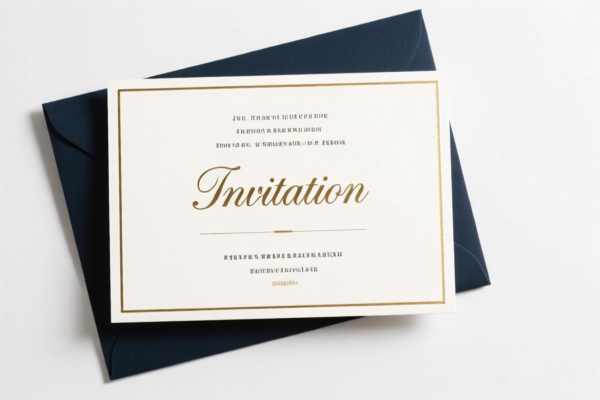
invitation
CN → US| HS Code | Tariff Rate | Origin | Destination | Doc |
|---|---|---|---|---|
| 9505906000 | 10.0% | CN | US | Official Doc |
| 4817204000 | 35.0% | CN | US | Official Doc |
| 4817202000 | 35.0% | CN | US | Official Doc |
| 4911998000 | 17.5% | CN | US | Official Doc |
| 4911914040 | 17.5% | CN | US | Official Doc |
| 9505904000 | 10.0% | CN | US | Official Doc |
Product Images


AI Analysis
🎉 Invitation Cards (Jewelry, Party Supplies & Printed Materials)
🌐 HS Code Reference & Customs Clearance Guide | 2026 Latest Tariff Analysis | Professional Clearance Strategy
📌 I. Product Definition & Classification: Do You Really Understand “Invitations”?
An Invitation is a document used to invite guests to an event, party, wedding, or festival. In international trade, its classification depends heavily on its primary purpose, material, and design. It is not a single HS code but a category that spans multiple chapters depending on whether it is treated as a festival good, printing material, or stationery.
⚠️ Key Distinction Point:
- If the item is primarily for festive/decorative purposes (e.g., Halloween, Christmas, Party Supplies) →归入 Chapter 95 (Toys, Games, Sports Articles)
- If the item is primarily for communication/printing purposes (e.g., Business Cards, Letter Cards, General Printed Matter) →归入 Chapter 48 or 49
📦 II. HS Code Classification Details (2026 Latest Tariff Authority Comparison)
| HS Code | Product Description | Applicable Scenario | Primary Purpose |
|---|---|---|---|
9505.90.60.00 |
Festival or Entertainment Related Invitations | Halloween, Christmas, Birthday Parties, Festival Decor | ✅ Festival/Entertainment |
9505.90.40.00 |
Party Supplies (Paper Invitations) | Party Decorations, Novelty Items | ✅ Party Supplies |
4817.20.40.00 |
Communication Cards / Letter Cards | Business Invitations, Formal Correspondence | ✅ Stationery/Communication |
4817.20.20.00 |
Letter Cards of Paper or Paperboard | Standard Paper Invitations, Postcards | ✅ Stationery/Communication |
4911.99.80.00 |
Other Printed Matter (General) | General Printed Invitations, Catalogs with Invitations | ✅ General Printing |
4911.91.40.40 |
Other Printed Matter (Pictures/Designs/Photos) | Photo Invitations, Designer Graphics Invitations | ✅ Artistic Printing |
🔍 Key Reminder:
- Chapter 95 (9505) is typically the lowest tax bracket for invitations because they are often classified as "festival goods" or "party supplies."
- Chapters 48/49 (4817,4911) are classified as "paper products" or "printed matter," which may be subject to higher additional tariffs (Section 301/122).
- Material vs. Purpose: If the invitation is made of plastic or metal but used for a party, it might still fall under Chapter 95 if the function is festive. However, most paper invitations are judged by their use.
💰 III. 2026 Latest Tariff Rate Breakdown (Including Additional Duties & Policy Surcharges)
✅ Applicable Country: United States (US)
✅ Origin: China (CN)
✅ Effective Date: Post-November 2025 (Current Trade Environment)
🎯 1. 9505.90.60.00 & 9505.90.40.00 —— Festival/Party Invitations (Best Case Scenario)
| Item | Content |
|---|---|
| Base Tariff | 0% (ad valorem) |
| USITC Additional Tariff (Section 301) | +0% (Exempted for Chapter 95) |
| Section 122 Tariff | +10% (Specific to certain festive goods from China) |
| Total Tariff Rate | 10.0% |
| Tax Calculation | CIF Value × 10% |
| De Minimis Exemption | ❌ Not Applicable (Requires formal entry for most values, though small gifts may pass) |
| Legal Basis Path | Section 122: 1734.34 → USITC:9505.90.60.00 |
📌 Explanation:
- Why 10%? These items are often subject to Section 122 tariffs (import relief for festive goods) rather than the full Section 301 (25%) tariff.
- Benefit: This is the most cost-effective classification for party/festival invitations.
- Condition: Must be clearly identified as "Festival" or "Party" supplies.
🎯 2. 4817.20.40.00 & 4817.20.20.00 —— Communication/Letter Cards (High Cost Scenario)
| Item | Content |
|---|---|
| Base Tariff | 0% (ad valorem) |
| USITC Additional Tariff (Section 301) | +25% (Standard Section 301 Rate) |
| Section 122 Tariff | +10% (Applies to certain paper products) |
| Total Tariff Rate | 35.0% |
| Tax Calculation | CIF Value × 35% |
| De Minimis Exemption | ❌ Not Applicable |
| Legal Basis Path | Section 301: 9903.88.01 → Section 122: 1734.34 → USITC:4817.20.40.00 |
📌 Warning:
- Why 35%? Classified as paper products/stationery, these attract the full 25% Section 301 tariff PLUS 10% Section 122.
- Risk: High tariff impact. Avoid this classification for casual party invites.
- Use Case: Only use if the item is strictly a "business letter card" with no festive element.
🎯 3. 4911.99.80.00 & 4911.91.40.40 —— General Printed Matter (Medium Cost Scenario)
| Item | Content |
|---|---|
| Base Tariff | 0% (ad valorem) |
| USITC Additional Tariff (Section 301) | +7.5% (Reduced Rate for some printed goods) |
| Section 122 Tariff | +10% |
| Total Tariff Rate | 17.5% |
| Tax Calculation | CIF Value × 17.5% |
| De Minimis Exemption | ❌ Not Applicable |
| Legal Basis Path | Section 301: 9903.88.01 (Footnote for 7.5%) → Section 122: 1734.34 → USITC:4911.99.80.00 |
📌 Note:
- Why 17.5%? Some printed materials qualify for a reduced 7.5% Section 301 rate instead of 25%, depending on specific subheadings and trade notes.
- Comparison: Cheaper than letter cards (35%) but more expensive than festival goods (10%).
- Condition: Must be purely "printed matter" without significant 3D structure or festive decoration.
🛠️ IV. Customs Clearance Practical Advice (Real-World Pitfall Guide)
✅ 1. Preparation Checklist (Non-Negotiable)
| Document | Required | Description |
|---|---|---|
| ✅ Product Photos | ✔️ | Show the invitation’s design, material, and any festive elements (e.g., ribbons, glitter). |
| ✅ Commercial Invoice | ✔️ | Clearly state: "Festival Invitation Card" or "Party Supply" (NOT just "Paper Card"). |
| ✅ Description of Goods | ✔️ | Detailed description: "Paper Invitation for Wedding Party, 5x7 inch, with Gold Foil Design." |
| ✅ Harmonized Tariff Schedule (HTS) Justification | ✔️ | Provide reasoning for choosing 9505 over 4817 (i.e., "Primary use is festive"). |
| ✅ Packing List | ✔️ | Specify quantity and weight per box. |
✅ 2. Declaration Strategy (Key Rules)
🔥 "Festive First, Paper Second! Name Matters, Tax Drops by Half!"
| Scenario | Correct Declaration | Wrong Practice |
|---|---|---|
| Wedding/Party Invitations | 9505.90.40.00 or 9505.90.60.00 |
Misdeclare as "Paper Stationery" → 35% Tax |
| Business Meeting Invites | 4817.20.40.00 |
Use 9505 → Risk of Re-classification & Penalty |
| Photo Invitations | 4911.91.40.40 |
Use 4817 → 17.5% vs 35% Savings |
| Mixed Batches (Festive + Business) | Split Declaration | Combine all → Highest Rate Applies to Entire Shipment |
✅ 3. Special Cases & Mitigation
| Situation | Handling Advice |
|---|---|
| Invitations with Plastic Parts | If >50% value is plastic, still try 9505 if for party use, but be prepared for scrutiny. |
| Bulk Wholesale vs. Retail | Retail packages (single invites) are easier to classify as 9505. Bulk reams are 4817. |
| Custom Design/Logo | If heavily branded, declare as "Printed Advertising Material" → 4911 (17.5%). |
| High Value Luxury Invites | May still fall under 9505 if festive, but ensure quality documentation to prove "entertainment" purpose. |
🌍 V. Global Market Comparison (2026 Latest)
| Country/Region | Recommended HS Code | Tariff Rate | Certification | Remarks |
|---|---|---|---|---|
| 🇺🇸 USA | 9505.90.60.00 |
10% (Section 122) | None | Best Rate. Avoid 4817 (35%). |
| 🇨🇳 China | 4911.99.80.00 |
0% - 6% | N/A | No Section 301. Low tax. |
| 🇪🇺 EU | 4909.00.90 |
0% - 2.7% | CE (if ink safety) | Generally low duty. |
| 🇬🇧 UK | 4909.00.90 |
0% - 2.7% | UKCA | Post-Brexit rules apply. |
| 🇯🇵 Japan | 4911.99.00 |
0% - 3.2% | FSC (if paper) | Low tariff, focus on packaging. |
📌 Conclusion:
- USA is the most challenging market due to Section 122 and Section 301 differences.
- Classifying as Festival/Party Goods (9505) is the optimal strategy for saving costs in the US.
- EU/Japan/China have minimal tariffs, so classification is less critical for cost, but critical for compliance.
📌 VI. Common Errors & Pitfalls (Lessons Learned)
❌ Error 1: Declaring Party Invitations as "Stationery" (4817)
👉 Consequence: Pay 35% instead of 10% → Loss of 25% margin!
❌ Error 2: Vague Description "Paper Card"
👉 Consequence: Customs may classify under highest available duty → Audit & Back Taxes.
❌ Error 3: Combining Festive and Business Invitations in One Shipment
👉 Consequence: Entire shipment may be classified under the highest rate → Unnecessary Tax Burden.
❌ Error 4: Ignoring Section 122
👉 Consequence: Missed opportunity to apply 10% instead of 25%+.
✅ Correct Practice:
"Party Invitation Cards, Paper, 5x7 inch, Gold Foil Design, for Birthday Party Use, Model XYZ, HS 9505.90.40.00"
🎯 VII. Conclusion: Smart Classification Saves Money!
🎯 Remember the Mantra:
🔹 "Festive First, Paper Second!"
🔹 "9505 is 10%, 4817 is 35% – Choose Wisely!"
🔹 "Clear Description, Lower Tax, Smooth Clearance!"
📌 Pro Tip:
If your invitations are sold as a set with party favors (e.g., confetti, hats), declare them as "Party Supplies Set" under 9505. This strengthens the "festival" argument and justifies the 10% rate.
📣 Immediate Action:
📞 Consult a Customs Broker to confirm "Primary Use"
📝 Prepare Product Images showing festive elements
🚀 Optimize Your Supply Chain: Classify as9505for Maximum Savings in the US Market!
✨ Professional Clearance, Starts with Precise Classification!
💼 Every Percent Saved is Pure Profit!
Customer Reviews
About HS Code Classification
The Harmonized System (HS) is an internationally standardized nomenclature developed by the World Customs Organization (WCO) to classify traded products. Over 200 countries use the HS system as the basis for customs tariffs, trade statistics, and import/export regulations.
Each HS code follows a hierarchical structure:
- Chapter (2 digits) — Broad category of goods (e.g., Chapter 84: Machinery and Mechanical Appliances)
- Heading (4 digits) — More specific grouping within the chapter
- Subheading (6 digits) — Internationally standardized breakdown, used by all WCO member countries
- National subdivisions (8-10 digits) — Country-specific extensions for further classification, such as US HTSUS 10-digit codes
Correct HS code classification is essential for smooth customs clearance, accurate duty payment, and compliance with trade regulations. Misclassification can lead to customs delays, overpayment of duties, or penalties.
When importing from CN to US, the applicable tariff rates may include:
- Most-Favored-Nation (MFN) rate — The standard duty rate applied to WTO members
- General rate — Applied to countries without trade agreements
- Trade remedy duties — Additional tariffs such as Section 301 (anti-dumping), Section 232 (national security), or countervailing duties
The information provided on this page is for reference purposes only. For official classification, please consult with your local customs authority or a licensed customs broker.