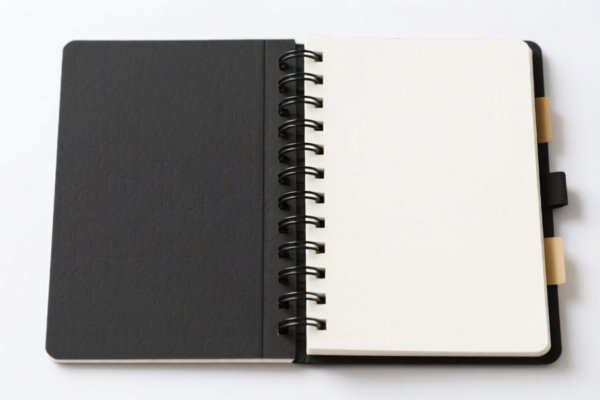
spiral bound notebook
CN → US| HS Code | Tariff Rate | Origin | Destination | Doc |
|---|---|---|---|---|
| 4820102060 | 35.0% | CN | US | Official Doc |
| 4820104000 | 10.0% | CN | US | Official Doc |
Product Images



AI Analysis
📓 Spiral Bound Notebook (Paper Stationery)
🌐 HS Code Reference & Customs Clearance Guide | 2026 Latest Tariff Analysis | Professional Entry Strategy
📌 I. Product Definition & Classification: What is a "Spiral Bound Notebook"?
A Spiral Bound Notebook is a stationery item consisting of multiple sheets of paper (or paperboard) stacked and bound together using a plastic or metal coil/spiral, typically used for writing, note-taking, or sketching.
In international trade, these items fall under Chapter 48 (Paper and Paperboard) and specifically under Heading 4820. The classification hinges on the fact that it is a "similar article of stationery" made of paper/paperboard.
⚠️ Key Distinction:
- If the item is strictly for writing/recording (e.g., ruled pages, grids, blank paper bound in spiral) → It falls under 4820.
- If it is primarily a photographic album or a specialized technical drawing pad not considered standard stationery, it might fall elsewhere (e.g., 4901 or 4903).
- Note: The provided data focuses on standard stationery notebooks under HS Code 4820.10.
📦 II. HS Code Classification Details (2026 Latest Tariff Authority Comparison)
Based on the provided <DATA>, there are two specific sub-headings for spiral bound notebooks depending on their exact binding type and intended use (e.g., diary vs. general memo).
| HS Code | Product Description | Applicable Scenario | Binding Type |
|---|---|---|---|
4820.10.20.60 |
Diaries, notebooks and address books, bound | Standard spiral-bound notebooks, diaries, address books | ✅ Bound (Spiral/Thread) |
4820.10.40.00 |
Other registers, account books, notebooks, etc. | General memo pads, loose-leaf notebooks, or notebooks not specifically defined as "diaries/address books" | ✅ Bound/Looseleaf |
🔍 Important Note:
- Both codes fall under the broader category of "Registers, account books, notebooks... of paper or paperboard."
- The distinction between4820.10.20.60and4820.10.40.00often lies in whether the notebook is explicitly marketed as a diary or address book (often pre-printed with dates/names) versus a general-purpose notebook or memo pad.
- For most generic "Spiral Bound Notebooks" sold in retail,4820.10.20.60or4820.10.40.00are the primary candidates. Always check local customs interpretation, but both carry the same tax rate in this context.
💰 III. 2026 Latest Tariff Rate Breakdown (Including Additional Duties & Policy Surcharges)
✅ Applicable Country: United States (US)
✅ Origin: China (CN)
✅ Effective Date: 2025+ (Based on provided data)
🎯 1. 4820.10.20.60 —— Diaries, Notebooks, Address Books (Bound)
| Item | Detail |
|---|---|
| Base Tariff Rate | 0.0% (Ad Valorem) |
| Section 301 Additional Tariff | +25.0% |
| Total Tax Rate | 25.0% |
| Tax Calculation | CIF Value × 25% |
| De Minimis Exemption | ❌ Not Applicable (For shipments from China, Section 301 duties apply even to low-value items under $800 in many enforcement contexts, but specifically for this HS code, the 301 surcharge is mandatory.) |
| Legal Basis Path | USITC:4820.10.20.60 → Section 301: Footnote 9903.88.01 |
📌 Explanation:
- Although the Base Tariff is 0%, the 25% Section 301 tariff is heavily applied to Chinese-made stationery goods.
- This results in a total landed tax cost of 25% on the customs value.
- Do not assume 0% because the base rate is 0%! The 301 tariff is the dominant cost driver.
🎯 2. 4820.10.40.00 —— Other Notebooks (e.g., Memo Pads, General Use)
| Item | Detail |
|---|---|
| Base Tariff Rate | 0.0% (Ad Valorem) |
| Section 301 Additional Tariff | +25.0% |
| Total Tax Rate | 25.0% |
| Tax Calculation | CIF Value × 25% |
| De Minimis Exemption | ❌ Not Applicable |
| Legal Basis Path | USITC:4820.10.40.00 → Section 301: Footnote 9903.88.01 |
📌 Note:
- Identical tax treatment to4820.10.20.60.
- Even if the notebook is not a "diary" but a simple "memo pad," the 25% surcharge still applies.
🛠️ IV. Customs Clearance Practical Advice (Avoiding Pitfalls)
✅ 1. Required Documentation Checklist
| Document | Required? | Notes |
|---|---|---|
| ✅ Commercial Invoice | ✔️ | Must clearly state "Spiral Bound Notebook, Paper, Made in China" |
| ✅ Packing List | ✔️ | Include dimensions, weight, and quantity per box |
| ✅ Product Photos | ✔️ | Show the spiral binding, paper quality, and any printed covers |
| ✅ Materials Declaration | ✔️ | Confirm composition (e.g., "100% Paper, Plastic Spiral Binding") |
| ✅ Origin Certificate | ✔️ | Proves country of origin as China (triggers 301 tariff) |
✅ 2. Classification Tips
| Scenario | Correct HS Code | Why? |
|---|---|---|
| Standard School/Office Notebook | 4820.10.20.60 |
Falls under "Notebooks... bound" |
| Address Book / Diary | 4820.10.20.60 |
Explicitly listed in description |
| Loose-Leaf Binder with Paper | 4820.10.40.00 |
"Other" category for non-diary bound items |
| Leather-bound Journal | ❌ Not 4820 | If cover is leather, it may fall under Chapter 46 or 49, but paper-dominated items usually stay in 4820. Check with customs if cover is significant. |
🔥 Golden Rule:
"Spiral binding = Paper Stationery = 4820. 301 Tariff = 25%. Do not misdeclare as 'Plastic' to avoid taxes."
✅ 3. Special Considerations
| Situation | Advice |
|---|---|
| Low-Value Shipments (<$800) | While Section 321 (de minimis) often exempts goods under $800 from duties, recent enforcement actions have targeted Chinese-origin stationery for Section 301 violations. Assume 25% tax liability to be safe. |
| Mixed Containers | If shipping notebooks with other items (e.g., pens, bags), ensure the invoice clearly separates the HS codes to avoid cross-contamination of tariffs. |
| Branded vs. Generic | Brand name does not affect HS code or tariff rate. Focus on physical description (paper, binding). |
🌍 V. Global Market Comparison (2026 Overview)
| Country/Region | Recommended HS Code | Tariff Rate (China Origin) | Notes |
|---|---|---|---|
| 🇺🇸 USA | 4820.10.20.60 / 4820.10.40.00 |
25% (301 Tariff) | Base rate 0%, but 301 adds 25%. |
| 🇨🇳 China | 4820.10.20.20 (Approx.) |
0% (MFN) | Import duty is low; VAT applies. |
| 🇪🇺 EU | 4820.10.00 |
0% | No Section 301 equivalent. Standard EU duty is often 0% for notebooks. |
| 🇬🇧 UK | 4820.10.00.90 |
0% | Post-Brexit, many paper products have 0% duty. |
📌 Conclusion:
- The US market is the most expensive for Chinese-made spiral notebooks due to the 25% Section 301 tariff.
- EU and UK markets offer 0% duty, making them more cost-effective for direct imports.
📌 VI. Common Mistakes & Pitfalls (Lessons Learned)
❌ Mistake 1: Assuming 0% tax because the base rate is 0%.
👉 Consequence: Underpayment of 25% duty → Penalties + Back Taxes!
❌ Mistake 2: Declaring as "Plastic Products" to avoid Chapter 48.
👉 Consequence: Customs will reclassify based on essential character (paper), leading to delays and fines.
❌ Mistake 3: Mixing "Diaries" and "Blank Notebooks" without distinction.
👉 Consequence: While tax rates are the same, incorrect description may trigger audits for compliance.
❌ Mistake 4: Ignoring the "Made in China" label.
👉 Consequence: If origin is obscured, customs may apply higher punitive tariffs (e.g., 60%+) for transshipment or false origin.
✅ Correct Practice:
"Paper Spiral Notebook, Ruled Pages, A5 Size, Cover Cardboard, Binding Plastic Coil, Made in China"
🎯 VII. Conclusion: Professional Declaration, Cost Control, Efficient Clearance!
🎯 Remember the Mantra:
🔹 "Spiral Bound = Paper Stationery = 4820"
🔹 "China Origin = 25% 301 Tariff"
🔹 "Base 0% is a Trap – Plan for 25%!"
📌 Pro Tip:
- For large volumes, consider tariff engineering (e.g., combining with 0%-tariff items in a single shipment) but ensure compliance.
- Always keep sample photos and product specifications ready for customs inspections.
- Consult a licensed customs broker for Advance Rulings if uncertain about specific notebook types (e.g., sketchbooks vs. notebooks).
📣 Take Action Now:
📞 Verify your supplier's origin
📦 Label clearly: "Made in China"
💡 Budget for 25% duty in your cost model
🚀 Ensure smooth customs clearance and maximize profit margins!
✨ Professional clearance starts with accurate classification!
💼 Every cent counts in international trade!
Customer Reviews
About HS Code Classification
The Harmonized System (HS) is an internationally standardized nomenclature developed by the World Customs Organization (WCO) to classify traded products. Over 200 countries use the HS system as the basis for customs tariffs, trade statistics, and import/export regulations.
Each HS code follows a hierarchical structure:
- Chapter (2 digits) — Broad category of goods (e.g., Chapter 84: Machinery and Mechanical Appliances)
- Heading (4 digits) — More specific grouping within the chapter
- Subheading (6 digits) — Internationally standardized breakdown, used by all WCO member countries
- National subdivisions (8-10 digits) — Country-specific extensions for further classification, such as US HTSUS 10-digit codes
Correct HS code classification is essential for smooth customs clearance, accurate duty payment, and compliance with trade regulations. Misclassification can lead to customs delays, overpayment of duties, or penalties.
When importing from CN to US, the applicable tariff rates may include:
- Most-Favored-Nation (MFN) rate — The standard duty rate applied to WTO members
- General rate — Applied to countries without trade agreements
- Trade remedy duties — Additional tariffs such as Section 301 (anti-dumping), Section 232 (national security), or countervailing duties
The information provided on this page is for reference purposes only. For official classification, please consult with your local customs authority or a licensed customs broker.